

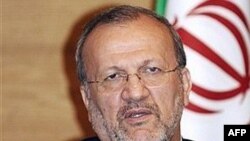
Manuchehr Mottaki said that only if the United States admits its "wrong policies in Iraq and decides to change those policies...one could be optimistic about these talks and their future."
Mottaki said Iran is interested in holding talks with the United States "for the sake of the Iraqi people and government."
The U.S. and Iranian ambassadors in Iraq, Ryan Crocker and Hassan Kazemi, will meet on May 28 in the highest-level official talks between the two countries since the 1979 Islamic revolution.
Both Iran and the United States have said that the talks will only concern Iraq, and not other contentious issues, such as Tehran's nuclear program.
The UN's nuclear agency, the International Atomic Energy Agency (IAEA) reported on May 23 that Iran is defying the world body by accelerating uranium enrichment.
Iran also has raised the tension level recently by detaining people with dual Iranian and U.S. citizenship, including Radio Farda reporter Parnaz Azima and American-Iranian scholar Haleh Esfandiari.
(AFP, dpa)
Mottaki said Iran is interested in holding talks with the United States "for the sake of the Iraqi people and government."
The U.S. and Iranian ambassadors in Iraq, Ryan Crocker and Hassan Kazemi, will meet on May 28 in the highest-level official talks between the two countries since the 1979 Islamic revolution.
Both Iran and the United States have said that the talks will only concern Iraq, and not other contentious issues, such as Tehran's nuclear program.
The UN's nuclear agency, the International Atomic Energy Agency (IAEA) reported on May 23 that Iran is defying the world body by accelerating uranium enrichment.
Iran also has raised the tension level recently by detaining people with dual Iranian and U.S. citizenship, including Radio Farda reporter Parnaz Azima and American-Iranian scholar Haleh Esfandiari.
(AFP, dpa)
| U.S.-IRAN TALKS | |
 Despite a willingness to talk, Iranian officials remain wary of U.S. motives. more |  Richard Perle sees little use in talking to the current Iranian regime. more |
Muqtada Al-Sadr
Muqtada Al-Sadr
 Al-Sadr supporters demonstrating against the U.S. presence in Iraq in October 2006 (epa)
A RADICAL CLERIC. Shi'ite cleric Muqtada al-Sadr is a key figure in Iraq. He heads the Imam Al-Mahdi Army militia and a political bloc that is prominent in parliament and the government. His ties to Iran have also provoked concerns in some quarters.
RELATED ARTICLES
Cracking Down On Al-Sadr No Easy Task
Political Parties Consider Uniting Against Al-Sadr
Is Al-Sadr Stirring The Pot Or Promoting Peace?
Radical Shi'ite Cleric Calls For Shi'ite-Sunni Unity
Al-Sadr Reasserts Himself -- This Time Against Coreligionists
