


The two incidents are clear illustrations of the Russian state's two-pronged policy on demonstrations as the country's election season moves into high gear.
The clampdown on non-Kremlin-friendly demonstrations has been going on for over a year now, an important part of the administration's strategy for marginalizing all opposition. On September 30, the nongovernmental organization (NGO) Legal Team issued a statement decrying the government's restriction of the right to demonstrate. Legal Team said that almost all opposition demonstrations in 2007 were either banned or dispersed and that the government had succeeded in associating protest in the public mind with violence and arrests. In late September, state-owned Rossia television aired a prime-time "special report" in which it was claimed that opposition demonstrators routinely provoke the police into attacking them.
Increasingly Isolated Protests
Moreover, Legal Team noted that penalties for participating in demonstrations have become more severe. While in the past it was normal to receive an administrative fine, now detainees are often sentenced to 15 days in jail following summary legal proceedings that do not ensure their rights.
 The statement said detainees are rarely given access to counsel or allowed to call witnesses and that sentencing is often based exclusively on police reports. Activists with the NGO told "Kommersant" that Moscow had adopted a policy of granting permission for opposition demonstrations only in areas far from the center of town and noted that provincial cities have followed suit.
According to the activists, Moscow authorities have not given permission for a single opposition-organized march all year, authorizing only rallies in remote locations. Aleksei Kozlov, an activist with the Groza movement, told "Gazeta" that Aeroflot, Russian Railways, and other state-controlled transport companies routinely provide information about the movements of activists around the country to the police. "
At stations and airports, people who are on these lists are detained by police and questioned," Kozlov said. Legal Team expert Natalia Zvyagina told "Kommersant" that pro-Kremlin groups routinely ask for and are granted permission to hold multiple demonstrations at high-visibility locations, and that the authorities use these permissions as an excuse to deny permission to opposition groups.
Driving Opposition Underground
As traditional rallies and demonstrations become increasingly problematic, opposition figures have been forced to adopt guerrilla tactics that, while often clever, give the impression of frivolousness. "Since demonstrations and pickets have been banned, the [Union of Rightist Forces, or SPS] has developed a new technology of civic protest," SPS campaign chief Anton Bakov told gazeta.ru on October 11. "We are moving to actions in stores and on public transport."
A few hundred SPS supporters today converged on a Moscow supermarket that is part of a chain owned by Unified Russia supporter and State Duma Deputy Vladimir Gruzdev as part of an action intended to draw attention to rising prices for foodstuffs. Of course, it is even more easily justified for the authorities to crack down on actions of this sort staged in private businesses and public-transport locations.
However, in Russia today not all demonstrations are equal. Pro-Kremlin groups -- especially the youth groups Nashi, Youth Guard, and Mestnye (Locals) -- carry out demonstrations without hindrance all over the country. Opposition leader Garry Kasparov and Mikhail Kasyanov routinely face disruptive pickets and demonstrations when they attempt to make public appearances.
Last month, Nashi picketers blockaded the entrance to a resort outside Moscow where Kasyanov was scheduled to give a speech. On October 11, Nashi activists in Rostov-na-Donu staged a demonstration at a book presentation by SPS Political Council member Boris Nemtsov, handing out "dollars" from Nemtsov's "overseas protectors."
The crackdown on public demonstrations is just one of the most visible and blatantly unconstitutional ways in which the authorities are strictly controlling the political environment in Russia in order to manufacture a false consensus in the upcoming elections. Moreover, it shows how thoroughly the police and courts have been subordinated to the task of achieving the political ends of the Putin administration.
The latest Levada Center opinion poll shows Unified Russia with some 68 percent support. On October 11, Putin held a closed-door meeting with the heads of all of Russia's regions. The process of generating a landslide is under full steam.
Real Audio Windows Media
The clampdown on non-Kremlin-friendly demonstrations has been going on for over a year now, an important part of the administration's strategy for marginalizing all opposition. On September 30, the nongovernmental organization (NGO) Legal Team issued a statement decrying the government's restriction of the right to demonstrate. Legal Team said that almost all opposition demonstrations in 2007 were either banned or dispersed and that the government had succeeded in associating protest in the public mind with violence and arrests. In late September, state-owned Rossia television aired a prime-time "special report" in which it was claimed that opposition demonstrators routinely provoke the police into attacking them.
Increasingly Isolated Protests
Moreover, Legal Team noted that penalties for participating in demonstrations have become more severe. While in the past it was normal to receive an administrative fine, now detainees are often sentenced to 15 days in jail following summary legal proceedings that do not ensure their rights.

According to the activists, Moscow authorities have not given permission for a single opposition-organized march all year, authorizing only rallies in remote locations. Aleksei Kozlov, an activist with the Groza movement, told "Gazeta" that Aeroflot, Russian Railways, and other state-controlled transport companies routinely provide information about the movements of activists around the country to the police. "
At stations and airports, people who are on these lists are detained by police and questioned," Kozlov said. Legal Team expert Natalia Zvyagina told "Kommersant" that pro-Kremlin groups routinely ask for and are granted permission to hold multiple demonstrations at high-visibility locations, and that the authorities use these permissions as an excuse to deny permission to opposition groups.
Driving Opposition Underground
As traditional rallies and demonstrations become increasingly problematic, opposition figures have been forced to adopt guerrilla tactics that, while often clever, give the impression of frivolousness. "Since demonstrations and pickets have been banned, the [Union of Rightist Forces, or SPS] has developed a new technology of civic protest," SPS campaign chief Anton Bakov told gazeta.ru on October 11. "We are moving to actions in stores and on public transport."
A few hundred SPS supporters today converged on a Moscow supermarket that is part of a chain owned by Unified Russia supporter and State Duma Deputy Vladimir Gruzdev as part of an action intended to draw attention to rising prices for foodstuffs. Of course, it is even more easily justified for the authorities to crack down on actions of this sort staged in private businesses and public-transport locations.
However, in Russia today not all demonstrations are equal. Pro-Kremlin groups -- especially the youth groups Nashi, Youth Guard, and Mestnye (Locals) -- carry out demonstrations without hindrance all over the country. Opposition leader Garry Kasparov and Mikhail Kasyanov routinely face disruptive pickets and demonstrations when they attempt to make public appearances.
Last month, Nashi picketers blockaded the entrance to a resort outside Moscow where Kasyanov was scheduled to give a speech. On October 11, Nashi activists in Rostov-na-Donu staged a demonstration at a book presentation by SPS Political Council member Boris Nemtsov, handing out "dollars" from Nemtsov's "overseas protectors."
The crackdown on public demonstrations is just one of the most visible and blatantly unconstitutional ways in which the authorities are strictly controlling the political environment in Russia in order to manufacture a false consensus in the upcoming elections. Moreover, it shows how thoroughly the police and courts have been subordinated to the task of achieving the political ends of the Putin administration.
The latest Levada Center opinion poll shows Unified Russia with some 68 percent support. On October 11, Putin held a closed-door meeting with the heads of all of Russia's regions. The process of generating a landslide is under full steam.
Boris Nemtsov At RFE/RL
Boris Nemtsov At RFE/RL
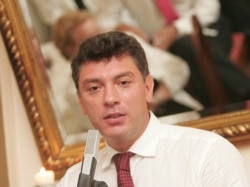 Boris Nemtsov speaking to an RFE/RL event in Prague on June 11 (RFE/RL)
'SOFT DICTATORSHIP.' Former Russian First Deputy Prime Minister Boris Nemtsov, a member of the Political Council of the Union of Rightist Forces party, told an RFE/RL gathering that Russia is facing a watershed moment with its 2008 presidential election.
LISTEN
Listen to the entire briefing (about 35 minutes):Real Audio Windows Media
ARCHIVE
RFE/RL's complete coverage of Russia. The website of RFE/RL's Russian Service.