



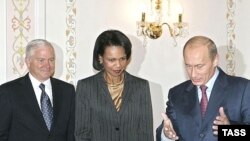
They also briefly met with President Vladimir Putin at the presidential residence at Novo-Ogaryevo, outside the Russian capital.
The talks were expected to be tense, but the two top U.S. officials may not have anticipated such a frosty reception from their Russian hosts.
Rice and Gates were hoping to overcome Russian objections to U.S. plans to deploy elements of a missile-defense system in the Czech Republic and Poland.
Instead, Lavrov called for the project to be frozen. Putin even appeared to mock the U.S. missile plans.
"Both of us, one day, may decide that an antimissile-defense system can be deployed on the moon," Putin said. "But before we get there, the possibility of reaching an agreement may be lost because you will have implemented your own plans. But our American partners' constructive disposition on continuing the dialogue is, of course, a very positive signal."
Washington says the shield is intended to counter threats from what it calls "rogue states," such as Iran and North Korea. Moscow strongly opposes having a U.S. missile-defense system on its doorstep, saying this will upset the global balance of power.
Putin has proposed that Russia and the United States jointly use a Russian-operated radar station in Azerbaijan. Speaking to a news conference after the talks, Gates said the Azerbaijani base "could play a very useful role" but would not be a substitute for the Czech and Polish sites.
Both sides failed to reach a compromise on the Intermediate-Range Nuclear Forces Treaty (INF), with Putin reiterating that Russia may quit the treaty unless it was expanded to embrace other countries. The treaty, signed in 1987, bans U.S. and Russian short- and medium-range nuclear missiles in Europe.
Points Of Disagreement
Rice and Gates left the round of talks empty-handed on another major source of friction -- Russia's unwillingness to back U.S.-led sanctions against Iran over its nuclear program, which the United States and its Western allies suspect is a cover to develop nuclear weapons.
Lavrov said unilateral sanctions were undermining efforts to negotiate a solution. "We believe collective work would be much more effective if there were no parallel steps to use unilateral sanctions against Iran, let alone recurring calls to use force against Iran," he said. "Such unilateral actions stand in contrast to our collective work and undermine our efforts, making them less effective."
Rice fired back, saying the United States would continue to impose financial sanctions on Tehran. "The United States does not intend to allow Iran to use the international financial system to pursue ill-gotten gains from proliferation and/or terrorism," she said. "Therefore, under American law, when we find that Iranian entities or individuals are engaging in such activities, we will sanction them."
The two sides were also expected to discuss the fate of Serbia's breakaway province of Kosovo. Russia, a strong ally of Serbia, has vehemently opposed a UN resolution granting Kosovo internationally supervised independence.
Rice and Gates were scheduled to meet with human-rights activists in Moscow and attend a dinner with First Deputy Prime Minister Sergei Ivanov.

The talks were expected to be tense, but the two top U.S. officials may not have anticipated such a frosty reception from their Russian hosts.
Rice and Gates were hoping to overcome Russian objections to U.S. plans to deploy elements of a missile-defense system in the Czech Republic and Poland.
Instead, Lavrov called for the project to be frozen. Putin even appeared to mock the U.S. missile plans.
"Both of us, one day, may decide that an antimissile-defense system can be deployed on the moon," Putin said. "But before we get there, the possibility of reaching an agreement may be lost because you will have implemented your own plans. But our American partners' constructive disposition on continuing the dialogue is, of course, a very positive signal."
Washington says the shield is intended to counter threats from what it calls "rogue states," such as Iran and North Korea. Moscow strongly opposes having a U.S. missile-defense system on its doorstep, saying this will upset the global balance of power.
Putin has proposed that Russia and the United States jointly use a Russian-operated radar station in Azerbaijan. Speaking to a news conference after the talks, Gates said the Azerbaijani base "could play a very useful role" but would not be a substitute for the Czech and Polish sites.
Both sides failed to reach a compromise on the Intermediate-Range Nuclear Forces Treaty (INF), with Putin reiterating that Russia may quit the treaty unless it was expanded to embrace other countries. The treaty, signed in 1987, bans U.S. and Russian short- and medium-range nuclear missiles in Europe.
Points Of Disagreement
Rice and Gates left the round of talks empty-handed on another major source of friction -- Russia's unwillingness to back U.S.-led sanctions against Iran over its nuclear program, which the United States and its Western allies suspect is a cover to develop nuclear weapons.
Lavrov said unilateral sanctions were undermining efforts to negotiate a solution. "We believe collective work would be much more effective if there were no parallel steps to use unilateral sanctions against Iran, let alone recurring calls to use force against Iran," he said. "Such unilateral actions stand in contrast to our collective work and undermine our efforts, making them less effective."
Rice fired back, saying the United States would continue to impose financial sanctions on Tehran. "The United States does not intend to allow Iran to use the international financial system to pursue ill-gotten gains from proliferation and/or terrorism," she said. "Therefore, under American law, when we find that Iranian entities or individuals are engaging in such activities, we will sanction them."
The two sides were also expected to discuss the fate of Serbia's breakaway province of Kosovo. Russia, a strong ally of Serbia, has vehemently opposed a UN resolution granting Kosovo internationally supervised independence.
Rice and Gates were scheduled to meet with human-rights activists in Moscow and attend a dinner with First Deputy Prime Minister Sergei Ivanov.
Missile Defense: Not In My Backyard?
Missile Defense: Not In My Backyard?
AN RFE/RL VIDEO PRESENTATION: The Czech Republic responds to the U.S. missile-defense proposal.