



Instead, it wants supervisory powers in return for financial aid and a 2,000-strong assistance mission of legal experts and law enforcement agents.
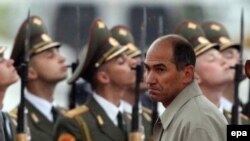
Speaking to journalists in Ljubljana, Slovenian Prime Minister Janez Jansa -- whose country holds the EU Presidency for the next six months -- said on January 7 that Kosovo will not have "total independence." He added that such a European mission wouldn't be sent to a "totally independent country, [a] sovereign country."
Kosovo's security will remain heavily dependent on 16,000 NATO troops in the province.
Jansa indicated the EU will seek to conclude a Stabilization and Association Agreement, which can be a precursor to EU membership, with both Serbia and Kosovo. Dangling such a scenario before Kosovo could be seen as an EU attempt to lure Kosovo away from seeking full-fledged independence.
Several EU member states have reservations about Kosovo's independence. Cyprus, in particular, fears a precedent will be set allowing its own northern Turkish community to secede.
Jansa said EU unanimity is needed only for the establishment of contractual relations between Kosovo and the EU, a development that is not likely to materialize in the immediate future. Abstentions within the EU will not, on the other hand, deter it from providing assistance to Kosovo.
All EU member states agree that Kosovo's current status as a Serbian province is not sustainable. Jansa said his own experience as a pro-democracy campaigner in what was Yugoslavia 20 years ago suggests it is "obvious" there cannot be a solution that satisfies both Serbia and Kosovo. Therefore, he said, the EU is now "looking for the second-best solution."
This solution will have to be found quickly, Jansa warned, or stability in the region will be at risk.
Jansa offered no clear views on how the EU expects to mollify Serbia, which has left no doubt it will not acquiesce to the loss of Kosovo. He said Serbia's intransigence is not "in the interests of the Serbian people," and that the choice, "which was artificially made by some politicians in Serbia," of "Kosovo or the European Union" is a "real alternative."
Jansa appeared to offer a conflicting set of predictions when quizzed on Serbia. On the one hand, he noted it would take a generational change before the Serbian public could accept the loss of Kosovo. On the other hand, Jansa said tough talk was a Balkan specialty and does not preclude quick changes of position. He predicted that "after a year's time, the situation could be quite different -- maybe not among the Serbian elites, but among the people."
Jansa noted that no conceivable solution will immediately guarantee stability in the region and warned of a "period of turbulence" in the course of which the EU will need to be "very sensitive and very strong."
Looking ahead, Jansa said the fate of ethnically divided Bosnia-Herzegovina will prove a "more serious problem" than Kosovo. He said the 1995 Dayton peace accord produced only one result -- the cessation of hostilities. All other goals have remained unattainable, Jansa said, adding the effect of the accord will need to be "reassessed." This is likely to take place during the EU's Czech presidency in the first half of 2009.

Speaking to journalists in Ljubljana, Slovenian Prime Minister Janez Jansa -- whose country holds the EU Presidency for the next six months -- said on January 7 that Kosovo will not have "total independence." He added that such a European mission wouldn't be sent to a "totally independent country, [a] sovereign country."
Kosovo's security will remain heavily dependent on 16,000 NATO troops in the province.
Jansa indicated the EU will seek to conclude a Stabilization and Association Agreement, which can be a precursor to EU membership, with both Serbia and Kosovo. Dangling such a scenario before Kosovo could be seen as an EU attempt to lure Kosovo away from seeking full-fledged independence.
Several EU member states have reservations about Kosovo's independence. Cyprus, in particular, fears a precedent will be set allowing its own northern Turkish community to secede.
Jansa said EU unanimity is needed only for the establishment of contractual relations between Kosovo and the EU, a development that is not likely to materialize in the immediate future. Abstentions within the EU will not, on the other hand, deter it from providing assistance to Kosovo.
All EU member states agree that Kosovo's current status as a Serbian province is not sustainable. Jansa said his own experience as a pro-democracy campaigner in what was Yugoslavia 20 years ago suggests it is "obvious" there cannot be a solution that satisfies both Serbia and Kosovo. Therefore, he said, the EU is now "looking for the second-best solution."
This solution will have to be found quickly, Jansa warned, or stability in the region will be at risk.
Jansa offered no clear views on how the EU expects to mollify Serbia, which has left no doubt it will not acquiesce to the loss of Kosovo. He said Serbia's intransigence is not "in the interests of the Serbian people," and that the choice, "which was artificially made by some politicians in Serbia," of "Kosovo or the European Union" is a "real alternative."
Jansa appeared to offer a conflicting set of predictions when quizzed on Serbia. On the one hand, he noted it would take a generational change before the Serbian public could accept the loss of Kosovo. On the other hand, Jansa said tough talk was a Balkan specialty and does not preclude quick changes of position. He predicted that "after a year's time, the situation could be quite different -- maybe not among the Serbian elites, but among the people."
Jansa noted that no conceivable solution will immediately guarantee stability in the region and warned of a "period of turbulence" in the course of which the EU will need to be "very sensitive and very strong."
Looking ahead, Jansa said the fate of ethnically divided Bosnia-Herzegovina will prove a "more serious problem" than Kosovo. He said the 1995 Dayton peace accord produced only one result -- the cessation of hostilities. All other goals have remained unattainable, Jansa said, adding the effect of the accord will need to be "reassessed." This is likely to take place during the EU's Czech presidency in the first half of 2009.
RFE/RL Balkan Report
RFE/RL Balkan Report