



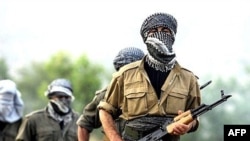
Azerbaijani Deputy Foreign Minister Araz Azimov tells RFE/RL that the PKK issue was the main focus of his talks on February 14 with visiting U.S. Deputy Assistant Secretary of State on Terrorism Frank Urbanchik.
"We suggested that this issue be watched closely," he says. "These issues will be more broadly discussed, I believe, in the next round of talks between Azerbaijan and the United States."
Like Turkish officials, Azimov describes the PKK as a "terrorist group." But Azimov stops short of confirming Turkish state media reports that allege the PKK has already moved from northern Iraq into the Azerbaijani districts of Fuzuli and Lachin. Both of those districts have been occupied since the early 1990s by ethnic-Armenian forces who waged a separatist war in Azerbaijan's breakaway region of Nagorno-Karabakh.
But Azimov does suggest that PKK fighters are moving closer to Azerbaijani territory. "Lately, we have been watching [PKK] activities...very closely," he says. "Due to the problems that Turkey is facing, we have been very vigilant. According to the information we are receiving from different sources, the activities of this organization are approaching our country."
More specifically, Azimov says the PKK is building "close relations" with "terrorist groups and organizations" that are enemies of both Turkey and Azerbaijan -- a remark seen in Baku as a reference to Armenia or ethnic-Armenian forces.
Government officials in Yerevan have consistently denied Turkish media reports that PKK militants have moved into the districts of Azerbaijan that are occupied by ethnic Armenians.
Independent and opposition media in Azerbaijan also report that PKK militants are now active in parts of Azerbaijan. Those reports alleged that ethnic-Kurdish officials in Azerbaijan's government have been backing the PKK -- a claim that Baku also denies.
U.S. Regional Concerns
Jonathan Henik, a public-affairs officer at the U.S. Embassy in Baku, confirms that the United States and Azerbaijan have been discussing the threat of PKK militancy. He says most of Washington's previous discussions on the issue had been with Turkey or with European governments.
But Henik says the United States is increasingly concerned about what appears to be growing ties between the PKK and other groups in the Caucasus that have been deemed terrorist organizations. He says Washington is also worried about the threat the PKK poses to energy infrastructure in the Caucasus.
 Click image to enlargeThose concerns focus on a 1,770-kilometer pipeline that carries Caspian oil from Baku through Georgia and on to southeastern Turkey's Mediterranean port of Ceyhan.
About 20 million ethnic Kurds are scattered mainly in northern Iraq, Syria, Iran, Turkey, and Azerbaijan. Describing themselves as the world's largest stateless minority, most live in southeastern Turkey, where the PKK has fought an insurgency since 1984. More than 30,000 people have been killed in that fighting, most of them ethnic Kurds.
Though the PKK declared a cease-fire in 1999, fighting by separatists resumed in southeastern Turkey in 2004. Authorities in Ankara fear that the Kurds in northern Iraq plan to set up their own state -- a move that would stir tensions and lead to increased calls for autonomy by Turkish Kurds.
Turkish President Abdullah Gul raised the issue during talks at the White House in early January with U.S. President George W. Bush. After that meeting, Bush told reporters he supported Turkey's efforts to fight the PKK militants in northern Iraq.
"Relations between the United States and Turkey are important for our country. And we have worked hard to make them strong," Bush said. "And I believe they are strong. We deal with common problems. One such problem is our continuing fight against a common enemy -- and that's terrorists. And such a common enemy is the PKK. It's an enemy to Turkey. It's an enemy to Iraq. And it's an enemy to people who want to live in peace."
(RFE/RL's Azerbaijani Service correspondent Alekber Raufoglu contributed to this report from Baku.)
"We suggested that this issue be watched closely," he says. "These issues will be more broadly discussed, I believe, in the next round of talks between Azerbaijan and the United States."
Like Turkish officials, Azimov describes the PKK as a "terrorist group." But Azimov stops short of confirming Turkish state media reports that allege the PKK has already moved from northern Iraq into the Azerbaijani districts of Fuzuli and Lachin. Both of those districts have been occupied since the early 1990s by ethnic-Armenian forces who waged a separatist war in Azerbaijan's breakaway region of Nagorno-Karabakh.
But Azimov does suggest that PKK fighters are moving closer to Azerbaijani territory. "Lately, we have been watching [PKK] activities...very closely," he says. "Due to the problems that Turkey is facing, we have been very vigilant. According to the information we are receiving from different sources, the activities of this organization are approaching our country."
More specifically, Azimov says the PKK is building "close relations" with "terrorist groups and organizations" that are enemies of both Turkey and Azerbaijan -- a remark seen in Baku as a reference to Armenia or ethnic-Armenian forces.
Government officials in Yerevan have consistently denied Turkish media reports that PKK militants have moved into the districts of Azerbaijan that are occupied by ethnic Armenians.
Independent and opposition media in Azerbaijan also report that PKK militants are now active in parts of Azerbaijan. Those reports alleged that ethnic-Kurdish officials in Azerbaijan's government have been backing the PKK -- a claim that Baku also denies.
U.S. Regional Concerns
Jonathan Henik, a public-affairs officer at the U.S. Embassy in Baku, confirms that the United States and Azerbaijan have been discussing the threat of PKK militancy. He says most of Washington's previous discussions on the issue had been with Turkey or with European governments.
But Henik says the United States is increasingly concerned about what appears to be growing ties between the PKK and other groups in the Caucasus that have been deemed terrorist organizations. He says Washington is also worried about the threat the PKK poses to energy infrastructure in the Caucasus.

About 20 million ethnic Kurds are scattered mainly in northern Iraq, Syria, Iran, Turkey, and Azerbaijan. Describing themselves as the world's largest stateless minority, most live in southeastern Turkey, where the PKK has fought an insurgency since 1984. More than 30,000 people have been killed in that fighting, most of them ethnic Kurds.
Though the PKK declared a cease-fire in 1999, fighting by separatists resumed in southeastern Turkey in 2004. Authorities in Ankara fear that the Kurds in northern Iraq plan to set up their own state -- a move that would stir tensions and lead to increased calls for autonomy by Turkish Kurds.
Turkish President Abdullah Gul raised the issue during talks at the White House in early January with U.S. President George W. Bush. After that meeting, Bush told reporters he supported Turkey's efforts to fight the PKK militants in northern Iraq.
"Relations between the United States and Turkey are important for our country. And we have worked hard to make them strong," Bush said. "And I believe they are strong. We deal with common problems. One such problem is our continuing fight against a common enemy -- and that's terrorists. And such a common enemy is the PKK. It's an enemy to Turkey. It's an enemy to Iraq. And it's an enemy to people who want to live in peace."
(RFE/RL's Azerbaijani Service correspondent Alekber Raufoglu contributed to this report from Baku.)

