



On March 3, the UN Security Council approved a third round of sanctions against Iran because of its refusal to halt uranium enrichment. The resolution imposes financial and travel restrictions on Iranian individuals and companies that are linked to Iran's nuclear or ballistic-missile programs.
The diplomats, who demanded anonymity, say Russia set the condition because authorities in Moscow were unhappy they were not informed earlier about plans for such a resolution.
They say that after the deal was reached with Moscow, Russia joined the four other permanent UN Security Council members and nine of the nonpermanent members in supporting the sanctions. Indonesia abstained.
It was not immediately clear whether the sponsors of the planned IAEA resolution had agreed not to go forward with it.
Asked In Vienna about the Kremlin's ultimatum, Russia's chief IAEA delegate, Grigory Berdennikov, said Moscow was "not happy about the developments" and was "not consulted." He declined further comment.
But Russian UN Ambassador Vitaly Churkin said the dispute was resolved by an agreement that future initiatives, proposals, or discussions on the Iranian nuclear issue would be made within the framework of the so-called six-party talks.
Members of those six-party talks include Germany and the five permanent UN Security Council members -- the United States, Russia, China, France, and the United Kingdom.
Those countries issued a statement after the March 3 vote for tighter UN sanctions against Iran that calls for fresh talks between EU foreign-policy chief Javier Solana and Iran's nuclear negotiator and Supreme National Security Council chief, Said Jalili.
That statement, read out by British UN Ambassador John Sawers, says the six countries are ready to possibly expand a 2006 offer of economic and trade incentives provided that Iran freezes its uranium-enrichment activities.
Tehran insists that its nuclear program is legal and is aimed only at producing nuclear energy for peaceful, civilian use. Iranian UN Ambassador Mohammad Khazai condemned the March 3 vote, saying it shows the Security Council has been "pushed to take unlawful action" against a country that is defending its legal right to conduct peaceful nuclear research.
"The international community is once again witnessing that the credibility of the Security Council -- whose primary responsibility is to maintain international peace and security -- is readily downgraded to a mere tool of the international foreign policy of just a few countries," Khazai said.
The new sanctions include freezing the assets of several individuals and companies with links to Iran's nuclear or ballistic missile programs. It would require countries to "exercise vigilance" and report on where and when those people traveled.
For the first time, it would ban trade with Iran in goods with both civilian and military uses. It would also impose a system of financial monitoring on two Iranian banks, Bank Melli and Bank Saderat.
IAEA To Discuss Iran's Weapons Program
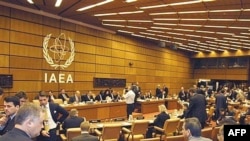
Meanwhile, the IAEA board of governors meets in Vienna this week to discuss new evidence about alleged Iranian "nuclear-weapons studies."
IAEA chief Muhammad el-Baradei says Iran continues to obstruct UN experts who are trying to confirm whether or not Tehran has been conducting nuclear weapons experiments.
"The one outstanding issue that is relevant to Iran's past activities is the so-called 'alleged studies' involving possible weaponization activities," e-Baradei said. "These 'alleged studies,' which are among the issues which the Security Council directed the agency to clarify, came to the agency's attention in 2005."
El-Baradei explained that Iranian authorities have not yet fully cooperated with IAEA experts on the issue of the alleged weaponization studies.
"After a period during which Iran was reluctant to fully discuss this issue, Iran finally agreed in the work plan to address it," he said. "Iran continues to maintain that these 'alleged studies' either relate to conventional weapons, only, or are fabricated. However, a full-fledged examination of this issue has yet to take place."
El-Baradei also stressed that Tehran has continued to ignore calls from the UN Security Council to halt uranium enrichment. Instead, he says, Tehran is trying to build more efficient centrifuges -- which Iran would need to amass enough weapons-grade enriched uranium to build a nuclear weapon. He described this as "regrettable," but added that the IAEA "has not observed any increase in the number of centrifuges in operation" since November.
The diplomats, who demanded anonymity, say Russia set the condition because authorities in Moscow were unhappy they were not informed earlier about plans for such a resolution.
They say that after the deal was reached with Moscow, Russia joined the four other permanent UN Security Council members and nine of the nonpermanent members in supporting the sanctions. Indonesia abstained.
It was not immediately clear whether the sponsors of the planned IAEA resolution had agreed not to go forward with it.
Asked In Vienna about the Kremlin's ultimatum, Russia's chief IAEA delegate, Grigory Berdennikov, said Moscow was "not happy about the developments" and was "not consulted." He declined further comment.
But Russian UN Ambassador Vitaly Churkin said the dispute was resolved by an agreement that future initiatives, proposals, or discussions on the Iranian nuclear issue would be made within the framework of the so-called six-party talks.
Members of those six-party talks include Germany and the five permanent UN Security Council members -- the United States, Russia, China, France, and the United Kingdom.
Those countries issued a statement after the March 3 vote for tighter UN sanctions against Iran that calls for fresh talks between EU foreign-policy chief Javier Solana and Iran's nuclear negotiator and Supreme National Security Council chief, Said Jalili.
That statement, read out by British UN Ambassador John Sawers, says the six countries are ready to possibly expand a 2006 offer of economic and trade incentives provided that Iran freezes its uranium-enrichment activities.
Tehran insists that its nuclear program is legal and is aimed only at producing nuclear energy for peaceful, civilian use. Iranian UN Ambassador Mohammad Khazai condemned the March 3 vote, saying it shows the Security Council has been "pushed to take unlawful action" against a country that is defending its legal right to conduct peaceful nuclear research.
"The international community is once again witnessing that the credibility of the Security Council -- whose primary responsibility is to maintain international peace and security -- is readily downgraded to a mere tool of the international foreign policy of just a few countries," Khazai said.
The new sanctions include freezing the assets of several individuals and companies with links to Iran's nuclear or ballistic missile programs. It would require countries to "exercise vigilance" and report on where and when those people traveled.
For the first time, it would ban trade with Iran in goods with both civilian and military uses. It would also impose a system of financial monitoring on two Iranian banks, Bank Melli and Bank Saderat.
IAEA To Discuss Iran's Weapons Program
Meanwhile, the IAEA board of governors meets in Vienna this week to discuss new evidence about alleged Iranian "nuclear-weapons studies."
IAEA chief Muhammad el-Baradei says Iran continues to obstruct UN experts who are trying to confirm whether or not Tehran has been conducting nuclear weapons experiments.
"The one outstanding issue that is relevant to Iran's past activities is the so-called 'alleged studies' involving possible weaponization activities," e-Baradei said. "These 'alleged studies,' which are among the issues which the Security Council directed the agency to clarify, came to the agency's attention in 2005."
El-Baradei explained that Iranian authorities have not yet fully cooperated with IAEA experts on the issue of the alleged weaponization studies.
"After a period during which Iran was reluctant to fully discuss this issue, Iran finally agreed in the work plan to address it," he said. "Iran continues to maintain that these 'alleged studies' either relate to conventional weapons, only, or are fabricated. However, a full-fledged examination of this issue has yet to take place."
El-Baradei also stressed that Tehran has continued to ignore calls from the UN Security Council to halt uranium enrichment. Instead, he says, Tehran is trying to build more efficient centrifuges -- which Iran would need to amass enough weapons-grade enriched uranium to build a nuclear weapon. He described this as "regrettable," but added that the IAEA "has not observed any increase in the number of centrifuges in operation" since November.
Iran's Nuclear Program
Iran's Nuclear Program

THE COMPLETE PICTURE: RFE/RL's complete coverage of controversy surrounding Iran's nuclear program.