



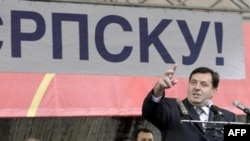
The absence of war is not really peace, as Bosnia-Herzegovina is amply demonstrating these days. More than 13 years after the Dayton agreement ended the fighting in the country, Bosnia is in danger of "sleepwalking into another Balkan crisis," U.S. Ambassador Richard Holbrooke -- the principle architect of Dayton -- and former High Representative in Bosnia Paddy Ashdown warned in "The Guardian."
Their comments came just days after Croatian Foreign Minister Gordan Jandrokovic warned bluntly that the international community must pay more attention to Bosnia. And on October 21, Deputy High Representative Rafi Gregorian publicly charged that Milorad Dodik -- prime minister of the Bosnian Serb entity of Republika Srpska -- and the Bosniak member of the tripartite Bosnian Presidency, Haris Silajdzic, are most responsible for the ongoing instability in Bosnia. Holbrooke and Ashdown also fingered Dodik and Silajdzic.
For some time now, Dodik and Silajdzic have been locked in an acrimonious rivalry that has frequently metastasized into heightened ethnic intolerance between ethnic Serbs and Bosniaks. Whenever Dodik has a dispute with Silajdzic, he declares it is evidence of an "anti-Serb" attitude in the central government, and every discussion of the dysfunctional state structure is tarred as a "Muslim plot to dissolve the Republika Srpska and renounce the Dayton agreement."
Silajdzic plays this game as well. Disagreement about the role and position of the police in the country gets drowned in accusations that the Republika Srpska is harboring criminals, and so on. With the country's highly partisan media pitching in, the country has lurched from accusation to accusation and from crisis to crisis now for years without any sign that this destructive cycle will end.
Both Dodik and Silajdzic are leader who thrive on crisis -- who use ethnic tension to mobilize their completely ethnically based constituencies to support them. Neither of them is addressing rampant unemployment in the country; the jobless rate passed 40 percent in August. Why? Because poverty and hunger make fertile ground for sowing seeds of suspicion and conflict.
Other serious issues are also being ignored. Half of Bosnia's state budget goes toward paying the salaries of state administrators. Every other country in the Balkans -- even Serbia -- is making more rapid progress toward EU integration than Bosnia.
The two men also had similar reactions to the sharp criticism leveled against them in recent days: Both tried to assert that criticism of them was nothing short of criticism of their respective ethnic groups. Dodik ally Rajko Vasic, executive secretary of Dodik's Alliance of Independent Social Democrats (SNSD), argued that the issue is not the personalities of Dodik and Silajdzic: "This means the 'unitarization' of Bosnia-Herzegovina, a weaker position for the Republika Srpska, and opening the door to removing the Bosnian Serb entity," Vasic said. "If [Dodik and Silajdzic] were removed, it would solve nothing and Bosnia would be even more easily dissolved." Dodik himself made a similar statement a few weeks ago: "If I am replaced, I have a plan ready for taking Republika Srpska into independence."
In an interview this week with the Sarajevo-based daily "Oslobodjenje," Silajdzic makes essentially the same argument. He says that behind the criticism lies a desire to dissolve the state institutions of Bosnia and to establish a dominant Republika Srpska.
Theoretically, both Silajdzic and Dodik are obligated to work within the country's constitutional framework to make the country as efficient as possible, to improve living standards, build democratic institutions, and advance Euro-Atlantic integration. However, both men, in order to maintain their ethnically based constituencies, are doing just the opposite, fostering tensions and divisions within an already weak state. Dodik misses no opportunity to boost the Republika Srpska at the expense of federal institutions, while Silajdzic undercuts the entities in his bid to strengthen state bodies. As a result of their conflicting agendas, both the Bosnian state institutions and those of the Republika Srpska become weaker. Weaker, in fact, to the point that the entire country is on the brink of collapse.
Several years ago, Croatian President Stipe Mesic wisely sent an unambiguous message to Croats in Bosnia that they must exist and thrive within their own country -- and that Croatia intends to deal with Bosnia as a unitary, multiethnic neighbor and not as a collection of fragmented ethnic enclaves. This policy marked the beginning of the end of the manipulation of Croats in Bosnia and of their efforts to someday join Croatia. As a result of Mesic's statesmanship, the representatives of Bosnia's Croats are not playing a role in the process of undermining the Bosnian state the way that the country's Serbs are. Bosnia's Croats need Bosnia because it is the only country they have.
In contrast, Dodik has the backing of elements in Belgrade and, very likely, Moscow. Serbia and Bosnia are not the only countries that Russia has manipulated in its effort to challenge the EU and the United States and to undermine what it views as the current unipolar global system. But Russia is only a behind-the-scenes player, and Belgrade's role is much more important. Not long ago, Serbia's interior minister visited Banja Luka, encouraging Serbian radicals there to maintain their mantra that Republika Srpska will never be abandoned by its friends abroad.
However, Dodik has reason to be nervous.
The situation in the region is definitely changing. Kosovo's independence is now a fact. Montenegro has become a stable, almost "boring" country. Croatia is in NATO and will join the EU within a couple of years. The new government in Serbia is sending different messages now and is taking European integration seriously. Serbian President Boris Tadic clearly thinks better ties with the EU are more important than unwavering support for Republika Srpska. Tadic has said he accepts an EU mission in Kosovo. On October 20, Admiral Michael Mullen became the first chairman of the U.S. Joint Chiefs of Staff to visit Belgrade. Serbia has made the strategic decision to contest the Kosovo situation diplomatically.
It seems only a matter of time before Belgrade follows Croatia's example and builds its relations with Bosnia on ties with Sarajevo exclusively instead of maintaining links with Banja Luka. That development would mark the beginning of Bosnia as a viable unitary state.
So it ironic that neither Silajdzic nor Dodik would likely welcome such a change in Serbia's attitude because of the role that tension and conflict plays in maintaining their own positions. A month ago, Dodik even said he was grateful to Silajdzic and that he would bestow upon him the Republika Srpska's highest order if only he thought Silajdzic would accept it. It wouldn't be surprising if these two men -- Bosnia's Tweedledee and Tweedledum -- forge some sort of compromise to Bosnia's current crisis that enables the two to remain in power and at each other's throats. And if they do, Tweedledee just might accept that medal from Tweedledum.
Nenad Pejic is associate director of broadcasting at RFE/RL. The views expressed in this commentary are the author's own and do not necessarily reflect those of RFE/RL
Their comments came just days after Croatian Foreign Minister Gordan Jandrokovic warned bluntly that the international community must pay more attention to Bosnia. And on October 21, Deputy High Representative Rafi Gregorian publicly charged that Milorad Dodik -- prime minister of the Bosnian Serb entity of Republika Srpska -- and the Bosniak member of the tripartite Bosnian Presidency, Haris Silajdzic, are most responsible for the ongoing instability in Bosnia. Holbrooke and Ashdown also fingered Dodik and Silajdzic.
For some time now, Dodik and Silajdzic have been locked in an acrimonious rivalry that has frequently metastasized into heightened ethnic intolerance between ethnic Serbs and Bosniaks. Whenever Dodik has a dispute with Silajdzic, he declares it is evidence of an "anti-Serb" attitude in the central government, and every discussion of the dysfunctional state structure is tarred as a "Muslim plot to dissolve the Republika Srpska and renounce the Dayton agreement."
Silajdzic plays this game as well. Disagreement about the role and position of the police in the country gets drowned in accusations that the Republika Srpska is harboring criminals, and so on. With the country's highly partisan media pitching in, the country has lurched from accusation to accusation and from crisis to crisis now for years without any sign that this destructive cycle will end.
Both Dodik and Silajdzic are leader who thrive on crisis -- who use ethnic tension to mobilize their completely ethnically based constituencies to support them. Neither of them is addressing rampant unemployment in the country; the jobless rate passed 40 percent in August. Why? Because poverty and hunger make fertile ground for sowing seeds of suspicion and conflict.
Other serious issues are also being ignored. Half of Bosnia's state budget goes toward paying the salaries of state administrators. Every other country in the Balkans -- even Serbia -- is making more rapid progress toward EU integration than Bosnia.
The two men also had similar reactions to the sharp criticism leveled against them in recent days: Both tried to assert that criticism of them was nothing short of criticism of their respective ethnic groups. Dodik ally Rajko Vasic, executive secretary of Dodik's Alliance of Independent Social Democrats (SNSD), argued that the issue is not the personalities of Dodik and Silajdzic: "This means the 'unitarization' of Bosnia-Herzegovina, a weaker position for the Republika Srpska, and opening the door to removing the Bosnian Serb entity," Vasic said. "If [Dodik and Silajdzic] were removed, it would solve nothing and Bosnia would be even more easily dissolved." Dodik himself made a similar statement a few weeks ago: "If I am replaced, I have a plan ready for taking Republika Srpska into independence."
In an interview this week with the Sarajevo-based daily "Oslobodjenje," Silajdzic makes essentially the same argument. He says that behind the criticism lies a desire to dissolve the state institutions of Bosnia and to establish a dominant Republika Srpska.
Theoretically, both Silajdzic and Dodik are obligated to work within the country's constitutional framework to make the country as efficient as possible, to improve living standards, build democratic institutions, and advance Euro-Atlantic integration. However, both men, in order to maintain their ethnically based constituencies, are doing just the opposite, fostering tensions and divisions within an already weak state. Dodik misses no opportunity to boost the Republika Srpska at the expense of federal institutions, while Silajdzic undercuts the entities in his bid to strengthen state bodies. As a result of their conflicting agendas, both the Bosnian state institutions and those of the Republika Srpska become weaker. Weaker, in fact, to the point that the entire country is on the brink of collapse.
Several years ago, Croatian President Stipe Mesic wisely sent an unambiguous message to Croats in Bosnia that they must exist and thrive within their own country -- and that Croatia intends to deal with Bosnia as a unitary, multiethnic neighbor and not as a collection of fragmented ethnic enclaves. This policy marked the beginning of the end of the manipulation of Croats in Bosnia and of their efforts to someday join Croatia. As a result of Mesic's statesmanship, the representatives of Bosnia's Croats are not playing a role in the process of undermining the Bosnian state the way that the country's Serbs are. Bosnia's Croats need Bosnia because it is the only country they have.
In contrast, Dodik has the backing of elements in Belgrade and, very likely, Moscow. Serbia and Bosnia are not the only countries that Russia has manipulated in its effort to challenge the EU and the United States and to undermine what it views as the current unipolar global system. But Russia is only a behind-the-scenes player, and Belgrade's role is much more important. Not long ago, Serbia's interior minister visited Banja Luka, encouraging Serbian radicals there to maintain their mantra that Republika Srpska will never be abandoned by its friends abroad.
However, Dodik has reason to be nervous.
The situation in the region is definitely changing. Kosovo's independence is now a fact. Montenegro has become a stable, almost "boring" country. Croatia is in NATO and will join the EU within a couple of years. The new government in Serbia is sending different messages now and is taking European integration seriously. Serbian President Boris Tadic clearly thinks better ties with the EU are more important than unwavering support for Republika Srpska. Tadic has said he accepts an EU mission in Kosovo. On October 20, Admiral Michael Mullen became the first chairman of the U.S. Joint Chiefs of Staff to visit Belgrade. Serbia has made the strategic decision to contest the Kosovo situation diplomatically.
It seems only a matter of time before Belgrade follows Croatia's example and builds its relations with Bosnia on ties with Sarajevo exclusively instead of maintaining links with Banja Luka. That development would mark the beginning of Bosnia as a viable unitary state.
So it ironic that neither Silajdzic nor Dodik would likely welcome such a change in Serbia's attitude because of the role that tension and conflict plays in maintaining their own positions. A month ago, Dodik even said he was grateful to Silajdzic and that he would bestow upon him the Republika Srpska's highest order if only he thought Silajdzic would accept it. It wouldn't be surprising if these two men -- Bosnia's Tweedledee and Tweedledum -- forge some sort of compromise to Bosnia's current crisis that enables the two to remain in power and at each other's throats. And if they do, Tweedledee just might accept that medal from Tweedledum.
Nenad Pejic is associate director of broadcasting at RFE/RL. The views expressed in this commentary are the author's own and do not necessarily reflect those of RFE/RL