Saturday, May 18, 2013


Transmission

Live Blog: Meteor Strike In Russia

February 15, 2013

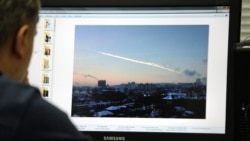
A man in Moscow looks at a computer screen displaying a picture reportedly taken in the Urals city of Chelyabinsk, showing the trail of a falling object above a residential area of the city.

Posts order:
Share:
"This type of event, in general, is very extraordinary -- probably [occurring] once per 30 or 40 years -- and it can happen anywhere, in any part of the world. The largest recorded explosion of a space object was the famous Tunguska event in 1908. That was 5,000 kilometers east of Chelyabinsk. It's very, very rare."

Interview: Meteor Expert Says Russian Strike Was 'Extraordinary'

Marina Ivanova is a senior scientist in the Laboratory of Meteoritics at Moscow's Vernadsky Institute. 

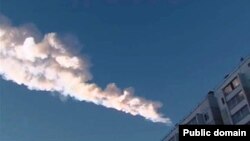
Chelyabinsk region on February 15, 2013.
Share:
In seemingly but not actually related news, scientists say the 46-meter-across asteroid dubbed 2012 DA14 has safely bypassed Earth at a distance of around 28,000 kilometers in the closest recorded flight of a space object of that size. The smaller meteor that hurtled into Chelyabinsk was traveling in the opposite direction of 2012 DA14, so scientists dismissed the notion that the two events might be related.
Share:
The U.S. National Oceanic and Atmospheric Administration (NOAA) has published a GIF image that shows -- from space -- the vapor trail from the meteor hitting Earth's atmosphere as it plummeted toward Chelyabinsk. It's made up of eight images taken at 15-minute intervals.
Share:
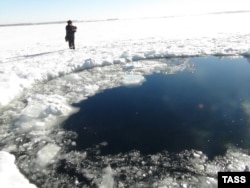
Russia's Emergency Situations Ministry released this photo of a hole in the ice atop a lake in the Chelyabinsk region thought to have been caused by a meteorite from the February 15 incident.
Share:

The Moscow Times:


"By early afternoon, several websites were already selling "fragments of meteorite." 

"I'm selling it because it's useless to me. There are several scratch marks, but in general it's in excellent condition," wrote one Internet user calling himself Alexei and claiming to be from Magnitogorsk in the Chelyabinsk region.
Share:

NASA statement on Russian meteor:


"According to NASA scientists, the trajectory of the Russian meteorite was significantly different than the trajectory of the asteroid 2012 DA14, making it a completely unrelated object. Information is still being collected about the Russian meteorite and analysis is preliminary at this point. In videos of the meteor, it is seen to pass from left to right in front of the rising sun, which means it was traveling from north to south. Asteroid DA14's trajectory is in the opposite direction, from south to north."
Share:

Reuters: The spectacle deeply frightened many Russians, with some elderly women declaring that the world was coming to an end. 

Share:
Sergei Smirnov, a senior astronomer at the Central Astronomical Observatory of the Russian Academy of Sciences in Pulkovo near St. Petersburg, during a live interview with Russian state television, Rossia 24.

Smirnov was asked if there was a link between the Chelyabinsk meteorite and the approaching asteroid 2012 DA 14, which was expected to skim the Earth later on Friday:

"It is clear now that they had different orbits and their orbital planes were inclined considerably. The asteroid that we expect in a few hours is approaching the Earth from the Southern Hemisphere side, in other words its general trajectory lies from south to north, while the Chelyabinsk bolide came from east to west."

Smirnov was also asked whether it had been possible to foresee the appearance of the meteorite:

"Unfortunately the object was not big enough to be detected ahead of time by currently available means at a long distance but big enough to cause a lot of destruction after it broke through toward the Earth."
Share:
We are going to slow down coverage on the live blog. There will still be an interview or two as well as more reactions from Russia posted, but not at the pace of what we did in the morning as events unfolded. Thanks to everyone for watching, reading, and sending their videos. -- RFE/RL's web team
Share:
A few local fisherman got a bit of a surprise on a lake near Chelyabinsk. Lifenews.ru heads out there (w/non-embeddable video)

Share:

Share:
From the Russian Academy of Sciences (article in RU):

The object was "a few meters" across, but weighed around 10 tons and had a total energy of "a few kilotons." It entered the atmosphere at a speed of 15-20 km/second and broke up an altitude of 30-50 kilometers. 
Share:
The meteorite is on Twitter. We can't verify whether or not this is the actual meteorite or a parody account.

This says, "Meteors only fall once. I've already fallen. I cannot fall again."

Share:
Vladimir Putin riding the smoke trail is just one of several memes that have cropped up after the meteorite strike. News.ru has more.

Share:
The Russian Academy of Sciences is calling the strike a "bolide explosion," which is basically a classification of meteors by brightness -- bolides being very bright (link in Russian). Here is the Wikipedia page for meteroids and bolides
Share:
Tragedy is not without humor. This item on the Kommersant Facebook page says:

"The in habitants of the meteorite wached in horror the approach of the oncoming Chelyabinsk"


Share:
Worth revisiting the 1908 Tunguska meteorite strike that leveled nearly 1,000 square miles (2,000 square kilometers) of forest land in Siberia. The Guardian has a great writeup with some archived newspaper clips in a piece published on February 8. 


Pictures below via ITAR-TASS


Share:
Don't believe everything you see on TV. Some news outlets are saying they have shots of the Chelyabinsk meteorite crater -- but they are actually showing the so-called "door to hell" in Turkmenistan's Karakum Desert (pictured below):
Share:
Another video that caught the explosion:

Share:
Russian President Vladimir Putin on the event in Chelyabinsk:

"Everything must be done to assess the damage objectively. I spoke to the leadership of Chelyabinsk Oblast just half an hour ago. People are working. Thank God no large objects fell in populated areas, however there were still people who were injured. We need to think about how to help people -- not just to think about it but do it immediately."

"Chelyabinsk Oblast sustained the heaviest damage. As a result of the air wave and other damaging effects, more than 297 houses, 12 schools, several social-service facilities, and a number of industrial enterprises were damaged."

"It was recommended that a number of enterprises stop their work so that workers could go home to assess the damage and take measures to preserve the heat because a lot of windows had been broken. That was a priority task because the temperature was minus 5 Celsius during the day and a further drop in temperature was expected during the night."
Share:

The website for the city of Chelyabinsk has some decent pictures of damage from today's strike -- check them out here (text in Russian, of course).

Share:
One of the better dashcam videos out there. You can really see the burst and the arc of the meteor's trajectory:

Share:

Here's a picture (click photo to enlarge) of what appears to be the same building from earlier today (via RIA Novosti):

Share:
The latest numbers from Russia are that more than 400 people have been injured -- but with mostly minor injuries. Nine have been hospitalized.
Share:
Nurislam Aybulatov, a local Tatar activist in Chebarkul [map] tells RFE/RL's Tatar-Bashkir Service:

"Around 8 in the morning we saw a huge explosion above the Chebarkul lake. It felt like an earthquake. There are military bases around and sometimes we hear the arms  explosions. First we thought it was the arms explosion. There was also smell of something burnt. There is no damage or injured people in our town."
Share:
Out of the many hundreds or thousands of videos from Russia, this one still sticks -- fast forward to :34 to hear the explosion.

Share:
Interfax reports that the Russian Interior Ministry syas it has found three pieces of the meteorite that crashed to the Earth in Russia. Two pieces were found in Chelyabinsk and one in nearby Zlatoust. [map]

Share:
Chelyabinsk Governor Mikhail Yurevich: "Our main task now is to preserve the heat in offices and homes where windows were shatteted, to prevent the heating system from freezing."

Share:
A couple of good resources on the location of nuclear facilities near the meteor strike in Russia. 

# Here is a small map from PBS that includes a good overview of what the facilities are used for
# The FInancial Times as a Google map with pins of nuclear sites
# Greenpeace (in Russian) has a detailed map of the sites as well
Share:
First video we've found from a dashcam in the Qostanai region of northern Kazakhstan:

Share:
On the terminology -- meteor vs meteorite -- via NASA:

Meteor -- Any of the small particles of matter in the solar system that are directly observable only by their incandescence from frictional heating on entry into the atmosphere.

Meteorite -- A meteor that reaches the surface of the earth without being completely vaporized.

So, if the object is visible, it is a meteor. When and if it makes physical contact with the Earth it becomes a meteorite. It looks like most of the damage was caused simply by the shockwave and pure energy of the thing in the atmosphere, which would mean it is damage from the "meteor." There are some pics of a building up in smoke that looks like it was actually hit by an object, so that would be damage caused by a "meteorite."
Share:
This factory/warehouse door never had a chance:

Share:
Black smoke rises from a factory following sightings of a falling object in the sky in the Urals city of Chelyabinsk (photo by RIA Novosti):

Share:
Share:
Check out the driver's reaction to the blast of light. Plus the camera picks up the meteorite quite well -- embedding was disabled, so you need to view it on YouTube
Share:
Didn't take long for the memes to begin:

Share:
Look at the top left of the screen:

Share:
Via Interfax:

The leader of Russia's Liberal Democratic Party Vladimir Zhirinovsky says that the meteorite shower was actually a new weapons test by the U.S., and that U.S. Secretary of State John Kerry tried to warn his Russian counterpart Sergei Lavrov, but he couldn't get in touch with him. [article in Russian]

By most accounts, this seems to have been a meteorite.
Share:
Dashcams are a big deal in Russia. Usually we just get weird crazy driver sequences...but today there actually seems to be some purpose.
Share:
Sergei Novikov, a spokesman for the Rosatom state nuclear energy agency, says:

"The Rosatom state corporation has six major plants in the Yekaterinburg and Chelyabinsk regions. All of them are working without any change, according to the regular schedule. The meteorite shower has not affected the functioning of these installations or public services in any way."
Share:
A jarring explosion:
Share:

Dmirty Medvedev on the meteorite: It shows that "not only the economy is vulnerable, but the whole planet."
Share:
Although you wouldn't know it by the language, this Russian driver is pretty calm. He says: "What the f***? What is that? This is a f***ing meteorite. F*** me. F***ing hell. Holy fuck. I guess I got on my thing (eds: dash-cam)."

Share:
Locals in Qostanai Oblast in Northern Kazakhstan report having seen the flash from the meteorite -- Itar-TASS
Share:
Vladimir Stepanov, chief of the Crisis Control Center at the Russian Emergency Situations Ministry, says "Radiation levels on the territory of the Russian regions are normal. Energy, communications, transport insfrastrucure, and public services are functioning normally."
Share:
Listen as the meteorite blows out windows and sets of car alarms.
Share:
Some good pics of the damage to various buildings in Chelyabinsk.
Share:
This video is from another building cam Nizhny Tagil [map], a town just north of Yekaterinberg. The flash of light is stunning.

Share:
Via Russia Today:

According to unconfirmed reports, the meteorite was intercepted by an air defense unit at the Urzhumka settlement near Chelyabinsk. A missile salvo reportedly blew the meteorite to pieces at an altitude of 20 kilometers
Share:
This video doesn't actually show the meteorite, but you can see the blast of light. It is from a building's security camera in Chelyabinsk.

Share:
This may be the best video we've seen yet. The driver says, "What the f*** is that? Is that a f***ing meteorite?"
Share:
Follow the Twitter hashtags #Chelyabinsk and #meteorite for the latest.
Share:
Nothing escapes the Russian dashcam:

About This Blog

Written by RFE/RL editors and correspondents, Transmission serves up news, comment, and the odd silly dictator story. While our primary concern is with foreign policy, Transmission is also a place for the ideas -- some serious, some irreverent -- that bubble up from our bureaus. The name recognizes RFE/RL's role as a surrogate broadcaster to places without free media. You can write us at transmission+rferl.org

Most Popular