



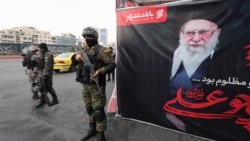
IRGC Claims Strike On Liberian-Flagged Vessel
Iran's Islamic Revolutionary Guards Corps (IRGC) said it had struck a Liberian-flagged vessel in the Strait Of Hormuz that it claimed was owned by Israel.
Tehran has indicated it considers the ships transferring oil to the United States, Israel, and "their partners" as "legitimate" targets.
"We won't allow even one liter of oil to reach the US, Zionists, and their partners. Any vessel or tanker bound to them will be a legitimate target," said Iran's military command spokesman Ebrahim Zolfaqari on March 11.
Amid Ongoing Public Absence, Is Iran's New Leader In Control?
Iran's new supreme leader, Mojtaba Khamenei, is probably in charge despite making no public appearance since being appointed on March 8 and amid reports that he was injured in an air strike, according to a leading Israeli expert on Iran.
Speaking to RFE/RL in Tel Aviv on March 11, Raz Zimmt, who is head of the Iran program at the Institute for National Security Studies, said the question is whether Khamenei would be capable of maintaining "daily contacts with the political and security establishment" to preserve "the ability of the regime to function."
To read the full interview, click here.


War With Iran Has 'No Time Limit,' Israeli Defense Minister Says

Israeli Defense Minister Israel Katz said the US–Israeli military campaign against Iran will continue indefinitely until its objectives are achieved, The Times Of Israel reports.
Speaking after a meeting with senior military officials on March 11, Katz said the operation would "continue without any time limit, as long as required, until we accomplish all objectives and achieve victory in the campaign."
He said the strikes are targeting Iranian leadership figures as well as the Islamic Revolutionary Guards Corps and the Basij, a pro-government militia involved in suppressing protests.
Katz also repeated Israel’s message that military pressure could create conditions for Iranians to rise up against the government.
Some reports suggest Israeli officials are concerned that US President Donald Trump might seek to end the war sooner than Israel prefers.
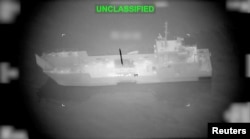
Iran has seen 16 of its mine-laying ships attacked in the Strait of Hormuz, according to US Central Command, which released footage of several strikes on the vessels. The ships were hit on March 10, US officials say, following warnings by US President Donald Trump to Iran against laying mines in the strait.
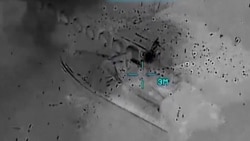

Footage shared on social media shows what appears to be an air strike on the Marivan border regiment, a military unit stationed near the city of Marivan, in the Kuh-e Emam mountain area close to the Iran-Iraq border.
From another angle, the footage also appears to show an attack near Norouz Square in Marivan, a city in Kurdistan Province.
According to RFE/RL's Radio Farda, reports also indicate that several locations across Kurdistan Province -- a largely Kurdish region of western Iran bordering Iraq -- were targeted in attacks on March 11.
Italian PM Criticizes Iran War As Conflict Enters 12th Day

Italian Prime Minister Giorgia Meloni has delivered her strongest criticism yet of the US-Israeli war against Iran, warning that such interventions risk undermining international law.
Speaking to the Italian parliament on March 11, Meloni said the strikes should be viewed in the context of a broader crisis in the global order marked by "increasingly frightening and unilateral interventions."
At the same time, she stressed that Iran must not obtain nuclear weapons, warning this would have “dramatic repercussions for global security.”
Meloni also said Italy was supplying air defense assets to Persian Gulf partners and highlighted the need to protect thousands of Italian citizens and about 2,000 troops stationed in the region as the conflict entered its 12th day.
With reporting by Reuters
Ksenia Svetlova, an associate fellow at the Chatham House and a former member of the Israeli Knesset, said Iran’s leadership has been weakened but is unlikely to collapse in the near term.
“The Iranian regime has been seriously weakened, but it is unlikely to collapse immediately," she told Current Time. "It is quite possible that the collapse of the regime has already begun, but it may stretch over a fairly long period of time.”
“Given Iran's extremely difficult economic situation and the possibility of continued military pressure, for example from Israel alone, there are factors that could eventually undermine the regime,” she said.
Svetlova said Iran relies on asymmetric tactics -- including drones and threats to the Strait of Hormuz -- to buy time, adding that simply surviving the conflict would amount to a victory for the regime.
Commercial Ships Targeted As Iran Threatens Key Gulf Energy Transit Point
- By RFE/RL
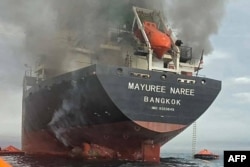
Three vessels were damaged in incidents across the Persian Gulf's key maritime artery, where about one-fifth of the world's oil and gas supplies travel, as Iran continued to launch air attacks around the Middle East.
Commercial ships sailing under the flags of Thailand, Japan, and the Marshall Islands were targeted by unknown projectiles across the Strait of Hormuz, United Kingdom Maritime Trade Operations (UKMTO), a shipping security monitor, said on March 11.
While no crew members were reported dead following the attacks, UKMTO advised ships in the Strait of Hormuz "to transit with caution and report any suspicious activity," adding that investigations into the incidents were ongoing.
Just off the shores of Oman and the United Arab Emirates (UAE), where the shipping lane narrows to a width of less than 4 kilometers, the attacks are the latest in at least a dozen incidents since US and Israeli forces began their military campaign against Iran on February 28. Those attacks have prompted retaliatory strikes by Iran on targets in many neighboring Gulf states.
The flurry of strikes on commercial ships in the Strait of Hormuz follows US President Donald Trump's earlier warning to Iran, in which he demanded Tehran to remove any mines in the area, or otherwise, meet "military consequences" that will be at "a level never seen before."
Read more here.
Oil, War, And The Strait of Hormuz: Can Washington Safeguard Global Energy Markets From Iran?
WASHINGTON -- As the United States and Israel's conflict with Iran converges on the Strait of Hormuz -- the world’s most critical energy chokepoint -- the economic consequences of a major disruption to oil and gas supplies could reverberate around the world.
About one-fifth of global oil and liquefied natural gas (LNG) normally flows through the narrow waterway connecting the Persian Gulf to international markets. Yet tanker traffic has slowed sharply amid security concerns, military threats, and reports that Iran is deploying mines and other asymmetric measures to inflict damage on vessels attempting to use the Strait.
Already the market response has been seen: oil surged toward $120 per barrel before retreating slightly while aviation fuel prices remain around double the levels seen in January.
For analysts, these swings underscore a fundamental question: Can Tehran leverage the global energy system as a strategic weapon -- or can the United States and its partners prevent that scenario?
Read more here.
EU foreign policy chief Kaja Kallas has announced new sanctions against Iranian government individuals and entities she says have been "responsible for serious human rights violations."