



Good morning. We'll start today's live blog with this story that our Washington bureau filed overnight:
Germany Welcomes Putin Call For UN Peacekeepers In Eastern Ukraine

Germany has welcomed Russian President Vladimir Putin's agreement to send UN peacekeepers to eastern Ukraine, saying it heralded "a change in [Russia's] politics that we should not gamble away."
Putin's proposal to send a lightly armed peacekeeping mission to protect international monitors in eastern Ukraine was presented to the United Nations Security Council late on September 5 after Putin called for it during a press conference in China earlier in the day.
German Foreign Minister Sigmar Gabriel, speaking in Berlin, said he found Putin's announcement "surprising" but said he was "very pleased to see this first signal" that Putin "wants to further discuss a demand which Russia had rejected in the past, namely, the use of blue helmets, UN soldiers, a blue helmet mission in eastern Ukraine to implement the cease-fire."
"More importantly, this offer of a UN mission in eastern Ukraine shows that Russia has undergone a change in its politics that we should not gamble away," Gabriel said. "It would be good if we take it as an opening to talk about new ways of detente."
Ukraine said it was "prepared to work on the issue" and dispatched its UN delegation to consult with the UN Security Council.
Ukraine's UN representative Volodymyr Yelchenko said President Petro Poroshenko will touch on the issue in his speech before the UN General Assembly on September 20.
Line Of Contact
But a key Ukrainian lawmaker objected to putting the peacekeepers along the front line of combat rather than at the Russian-Ukrainian border.
Iryna Herashchenko, first deputy speaker of Ukraine's parliament, said on Facebook that "the confrontation line has become a confrontation line because of Russia's aggression."
"To us, this is a line of contact, namely contact with the temporarily occupied...territories. This is not a Ukrainian border, and therefore peacekeepers along the line of contact are out of the question," Herashchenko said.
Peacekeepers should be deployed over the whole Ukrainian territory not currently controlled by Kyiv "to monitor the security situation and demilitarization," Herashchenko said. "Their mandate should end on the Ukrainian-Russian border."
Yelchenko also said the peacekeepers should be deployed on the Russia-Ukraine border to monitor the flow of weapons and fighters coming in from Russia.
Ukraine has long called for the deployment of UN peacekeepers in separatist-held territory but has said that they should be deployed throughout the area, including along the part of the Ukraine-Russia border that Kyiv does not currently control.
Kyiv is concerned that deploying peacekeepers along the demarcation line would only cement the separatists' control over the territory they hold and leave Russia free to keep sending troops and weapons across the international border and fueling the conflict that has already killed more than 10,000 people since 2014.
'Circulated For Consideration'
In calling for the UN peacekeeping force, Putin had insisted that it should be restricted to operating on the "demarcation line" between Ukrainian forces and the separatists and should only ensure the security of the unarmed mission from the Organization for Security and Cooperation in Europe (OSCE).
"Should all of these [conditions be met], in my view it will definitely benefit a resolution of the problem in southeastern Ukraine," Putin said at a press conference in Xiamen, China, after a BRICS summit there.
AFP reported that the draft resolution Russia presented to the UN council late on September 5 was restricted along the lines prescribed by Putin.
AFP said the draft specified that the peacekeeping mission would be deployed after a "complete disengagement of the forces and equipment from the factual line of contact" between Ukrainian troops and Russia-backed separatists.
Russian Ambassador Vasily Nebenzya said there were no immediate plans to call for a vote on Moscow's proposal.
"We are not talking about voting yet. We are circulating it for consideration," he told reporters in New York.
With reporting by AP, AFP, dpa, TASS, and Interfax
We are now closing the live blog for today, but we'll be back again tomorrow morning to follow all the latest developments. Until then, you can keep up with all our other Ukraine coverage here.
Here's a Saakashvili update from our news desk:
Ukraine Confirms Georgia Asked For Ex-President Saakashvili's Extradition
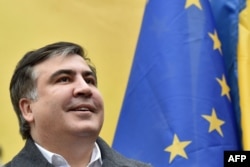
Ukrainian authorities have confirmed that they received a request from Georgia to extradite its former president, Mikheil Saakashvili.
"Ukraine has received a request to search for, detain and extradite Mikheil Saakashvili," Deputy Justice Minister Serhiy Petukhov told a news conference on September 5.
"The Justice Ministry is sending the request from Georgia ... to Ukraine's general prosecutor for an extradition review," Petukhov said.
The Georgian Prosecutor-General's office said on August 18 that it had sent the extradition request to Ukraine.
Citing Georgia's Chief Prosecutor's Office, Petukhov said that Saakashvili was a defendant in four criminal cases.
The charges include misappropriation of property and abuse of office, Petukhov said.
Saakashvili has said the charges are part of a political witch hunt by his opponents.
Saakashvili moved to Ukraine to help drive reforms after the 2014 uprising that ousted pro-Russian President Viktor Yanukovych.
He has been in conflict with the Kyiv authorities since quitting as governor of the Odessa region last year and accusing President Petro Poroshenko of abetting corruption.
Poroshenko stripped him of his Ukrainian citizenship at the end of July, when Saakashvili was out of the country, a move that the former Georgian president condemned as an "illegal way to remove me from the political scene in Ukraine."
When Saakashvili was still the Odesa region's governor, Kyiv refused to extradite him to Georgia at least twice.
He has also been stripped of his Georgian citizenship.
Saakashvili is currently in Poland and has pledged to return to Ukraine on September 10.
Ukrainian authorities have said previously they would bar Saakashvili from entering the country and will confiscate his passport should he attempt entry.
Saakashvili came to power in Georgia after a peaceful pro-Western uprising, known as the Rose Revolution, in 2003.
He was president at the time of a disastrous five-day war with Russia in 2008, a conflict that his critics said was the result of his own miscalculations.
With reporting by Reuters and AFP
Here's the OSCE's report on the conflict area and what happened there yesterday: