





CHISINAU -- Far from the hustle and bustle of urban life, Elena Spinei sings in her home in the Moldovan village of Badiceni.
"One evening in Constanta, which I will never forget..."
She sings to relieve her solitude. And as she sings, she weaves.
She is weaving a carpet, and the loom takes up most of the room in which she lives during the winter.
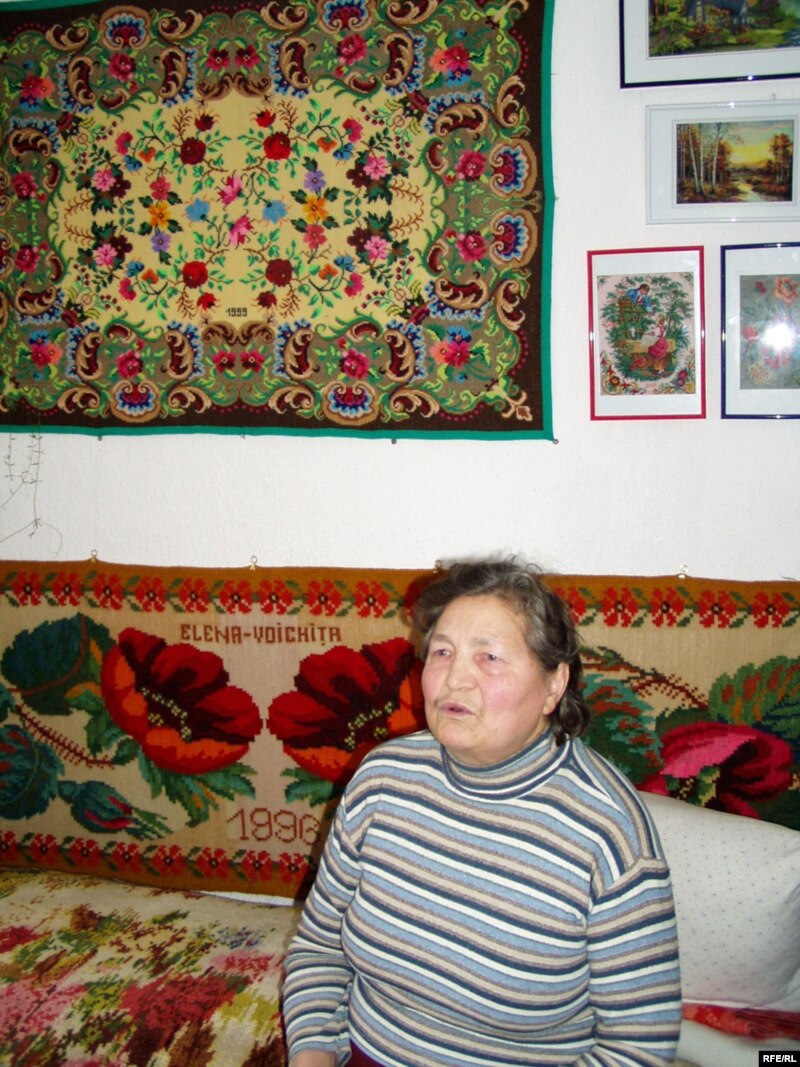
One of her finished carpets is hanging on the wall above her bed. It is a colorful carpet, filled with roses that have deep red and pink colors and are scattered in bouquets over a cream background. The effect is cheery and dignified, and filled with the strength that comes from generations of tradition.
Carpet making has a long history here. By ancient custom, a bride had to include carpets that she had made by her own hand as part of her dowry. They were a measure of a girl's industriousness, her dexterity, and her artistic abilities.
The carpet would go into the "casa mare," the "big house" of a clan's compound. The clan's families had their own sleeping quarters nearby but every evening came together in this place. With its walls hung with the portraits of grandparents, parents, and children and decorated with the embroidery of successive generations, the big house was a memorial to the clan itself.
"I learned to weave from my mother," Spinei says. "You should be careful not to make mistakes, because it is very difficult to do."
Weaving Parties
Decades ago, her carpet weaving was not so solitary. The villagers organized parties where all the young girls and housewives sang songs and wove together. The group efforts were a major economic activity that helped to bring Badiceni, and hundreds of similar small villages, more than just what the fields produce.
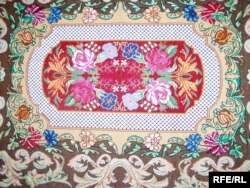 "A feeling of freshness" -- that's how one carpet producer described Moldovan carpets, such as this one by Elena Spinei."My father went to Nikolaev, Ukraine, and exchanged carpets for corn, wool, and clothes," Spinei remembers. "But in the 1970s, the tradition got lost because people went to work in collective farms."
Collectivization took a long time to reach this remote region squeezed between Ukraine and Romania. The area was annexed into the Soviet Union at the end of World War II.
Soviet ruler Josef Stalin sliced off parts and attached them to Ukraine. The rest became the Moldovan Soviet Socialist Republic. Moscow heavily industrialized the new republic's region east of Dniester River and encouraged Ukrainians and Russians to come work in its factories.
The market for private goods disappeared.
"At the beginning of the '70s there was an orchard in the collective farm and people went to work," Spinei says. "The villagers had no time to weave. Many of them gave up on weaving. Just some of them were weaving but now they had nowhere to sell them, so they wove them for themselves."
Migration Of Labor
Today, Moldova is independent and has a free market. But the economic situation is worse than before.
That is because of what happened on the day Moldova was granted membership in the United Nations in 1992. The region east of the Dniester River began a war of secession.
After four months of fighting, the Transdniestrian forces, boosted by Russian arms and Cossacks, carved out their own self-rule entity whose flag still bears the Soviet hammer and sickle. The riverside factories were no longer under Moldova's control and with them went the country's hopes for an industrial economy. The great out-migration of labor began.
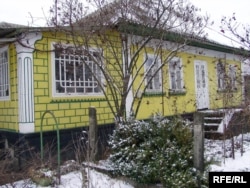 The humble home of carpetmaker Elena SpineiSpinei says she tried to pass on her weaving skills to the next generation. But who needs what can't sell?
"I have three nieces," Spinei says. "I taught all of them to weave, but I doubt if anyone weaves among my relatives."
She says she has periodically tried to find a market for her weavings, but without success.
She has exhibited some of her carpets in a few exhibitions that local craftsmen have organized in the district center.
And she donated one of the rugs she wove when she was young to a local museum. That was in hopes that passing tourists might appreciate her work.
No Demand For Handicrafts
But few tourists come. And in Moldova, there is almost no demand for handicrafts that take months to make. It is cheaper to buy the simple machine-made rugs that come in from China in search of the money your relatives send from the West.
Foreigners who do go to Moldova sometimes say it seems to be peopled only by children, old women, and policemen, like a country at war. The able-bodied are far away, fighting to make ends meet.
It is an irony of fate that Spinei is so isolated from the rest of the world. Because, in fact, there is a rich market for her weavings, if only she could connect with it.
Moldovan suitcase traders occasionally bring Moldovan carpets to Istanbul to sell. They go straight to the Grand Bazaar where the carpet sellers are. There, they unroll the rugs before the dealers, who pretend they have no interest but buy them anyway -- as if from charity.
It is easy to feign boredom when the suitcases open. The bazaar is full of rugs from every corner of the east, from colorful Turkish kilims for tourists, to luxurious Persian carpets for rich businessmen, to antique Turkmen weavings that only collectors can afford. Offering a simple Moldovan is like bringing a faded rose into a flower shop.
Still, the carpet merchants know the Moldovans have value. So, they forward them to Western Europe.
Attracting Interest In Germany
Some old Moldovan weavings recently came up for sale in Germany. An Istanbul dealer had brought a small stack of them to Domotex, the carpet world's largest trade show, which takes place every January in Hanover.
The fair is where hundreds of carpet producers from Turkey, Iran, India, Pakistan, Afghanistan, and China meet with the thousands of wholesalers who supply Europe's retail carpet shops. The hand-woven carpets fill five hangar-sized halls, creating a giant souk where millions of euros change hands in four days.
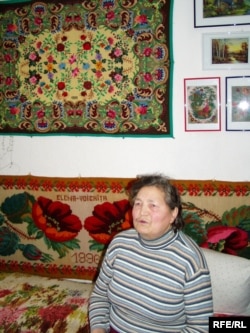 Spinei, surrounded by her handiworkThe richest merchants sit in glass enclosures. Others simply sit among the knee-high and thigh-high piles of rugs. Everywhere, hired muscle men flip back carpets as buyers look with on with calculators.
The Moldovan carpets are stacked up at one corner of the stand of the Turkish company Ozmelek Hali. They already have attracted the interest of a trio of buyers from Norway.
The Norwegians have a small catalogue company called Home and Cottage, south of Oslo. The company specializes in supplying the kind of rough, unvarnished furniture that looks like it has been stored in the family attic for generations.
One of the trio, Kaj Roger, says the Moldovan carpets fit well with Norwegian cottage decors.
"We have a lot of cottages in Norway and at the cottage it should be 'old style,'" Roger says. "It's a place to relax."
Does he mean the Moldovan carpets somehow represent the good old days, a grandmother's weavings, memories of lifetimes past?
The three Norwegians, who are entering middle age, do not object to any of these suggestions. Norway itself has lost so much of its traditional life that such furnishings have to come from elsewhere.
The longing of overworked, overstressed Western Europeans for simpler times represents an obvious market for Spinei, who has too much time on her hands. But the commercial isolation of Moldova makes it difficult for their two worlds too meet.
'Feeling Of Freshness'
Instead, the opportunities already are passing on to others. Not far from Ozmelek Hali, there is another small collection of Moldovan carpets hanging from the wall of the stand of an Indian carpet producer, Manglam Arts.
The company's owner, R.K. Rawat of Jaipur, says he first saw a Moldovan carpet five years ago and was immediately attracted by them. Now he produces about 50 a month.
"It's a feeling of freshness, you know, that always makes you think about a garden and flowers," Rawat says.
Rawat says getting Indian weavers to reproduce Moldovans was not easy.
"I found one particular village that was interested, and the weavers were very flexible, but it still took a few years because they had just some photos to work from," he says. "They didn't have the original piece in their hands."
Now, the Indian-woven Moldovans are on their way to filling a market niche that, in today's globalized world, belongs to whoever recognizes and satisfies it fastest.
Rawat says he plans to increase production in the months ahead to build on the success his carpets are already enjoying with buyers at this trade show and others.
And Spinei, who just hopes for better times, keeps weaving alone.
RFE/RL correspondents Charles Recknagel and Eugen Tomiuc contributed to this article from Prague
"One evening in Constanta, which I will never forget..."
She sings to relieve her solitude. And as she sings, she weaves.
She is weaving a carpet, and the loom takes up most of the room in which she lives during the winter.
One of her finished carpets is hanging on the wall above her bed. It is a colorful carpet, filled with roses that have deep red and pink colors and are scattered in bouquets over a cream background. The effect is cheery and dignified, and filled with the strength that comes from generations of tradition.
Carpet making has a long history here. By ancient custom, a bride had to include carpets that she had made by her own hand as part of her dowry. They were a measure of a girl's industriousness, her dexterity, and her artistic abilities.
The carpet would go into the "casa mare," the "big house" of a clan's compound. The clan's families had their own sleeping quarters nearby but every evening came together in this place. With its walls hung with the portraits of grandparents, parents, and children and decorated with the embroidery of successive generations, the big house was a memorial to the clan itself.
"I learned to weave from my mother," Spinei says. "You should be careful not to make mistakes, because it is very difficult to do."
Weaving Parties
Decades ago, her carpet weaving was not so solitary. The villagers organized parties where all the young girls and housewives sang songs and wove together. The group efforts were a major economic activity that helped to bring Badiceni, and hundreds of similar small villages, more than just what the fields produce.

Collectivization took a long time to reach this remote region squeezed between Ukraine and Romania. The area was annexed into the Soviet Union at the end of World War II.
Soviet ruler Josef Stalin sliced off parts and attached them to Ukraine. The rest became the Moldovan Soviet Socialist Republic. Moscow heavily industrialized the new republic's region east of Dniester River and encouraged Ukrainians and Russians to come work in its factories.
The market for private goods disappeared.
"At the beginning of the '70s there was an orchard in the collective farm and people went to work," Spinei says. "The villagers had no time to weave. Many of them gave up on weaving. Just some of them were weaving but now they had nowhere to sell them, so they wove them for themselves."
Migration Of Labor
Today, Moldova is independent and has a free market. But the economic situation is worse than before.
That is because of what happened on the day Moldova was granted membership in the United Nations in 1992. The region east of the Dniester River began a war of secession.
After four months of fighting, the Transdniestrian forces, boosted by Russian arms and Cossacks, carved out their own self-rule entity whose flag still bears the Soviet hammer and sickle. The riverside factories were no longer under Moldova's control and with them went the country's hopes for an industrial economy. The great out-migration of labor began.

"I have three nieces," Spinei says. "I taught all of them to weave, but I doubt if anyone weaves among my relatives."
She says she has periodically tried to find a market for her weavings, but without success.
She has exhibited some of her carpets in a few exhibitions that local craftsmen have organized in the district center.
And she donated one of the rugs she wove when she was young to a local museum. That was in hopes that passing tourists might appreciate her work.
No Demand For Handicrafts
But few tourists come. And in Moldova, there is almost no demand for handicrafts that take months to make. It is cheaper to buy the simple machine-made rugs that come in from China in search of the money your relatives send from the West.
Foreigners who do go to Moldova sometimes say it seems to be peopled only by children, old women, and policemen, like a country at war. The able-bodied are far away, fighting to make ends meet.
It is an irony of fate that Spinei is so isolated from the rest of the world. Because, in fact, there is a rich market for her weavings, if only she could connect with it.
Moldovan suitcase traders occasionally bring Moldovan carpets to Istanbul to sell. They go straight to the Grand Bazaar where the carpet sellers are. There, they unroll the rugs before the dealers, who pretend they have no interest but buy them anyway -- as if from charity.
It is easy to feign boredom when the suitcases open. The bazaar is full of rugs from every corner of the east, from colorful Turkish kilims for tourists, to luxurious Persian carpets for rich businessmen, to antique Turkmen weavings that only collectors can afford. Offering a simple Moldovan is like bringing a faded rose into a flower shop.
Still, the carpet merchants know the Moldovans have value. So, they forward them to Western Europe.
Attracting Interest In Germany
Some old Moldovan weavings recently came up for sale in Germany. An Istanbul dealer had brought a small stack of them to Domotex, the carpet world's largest trade show, which takes place every January in Hanover.
The fair is where hundreds of carpet producers from Turkey, Iran, India, Pakistan, Afghanistan, and China meet with the thousands of wholesalers who supply Europe's retail carpet shops. The hand-woven carpets fill five hangar-sized halls, creating a giant souk where millions of euros change hands in four days.
The Moldovan carpets are stacked up at one corner of the stand of the Turkish company Ozmelek Hali. They already have attracted the interest of a trio of buyers from Norway.
The Norwegians have a small catalogue company called Home and Cottage, south of Oslo. The company specializes in supplying the kind of rough, unvarnished furniture that looks like it has been stored in the family attic for generations.
One of the trio, Kaj Roger, says the Moldovan carpets fit well with Norwegian cottage decors.
"We have a lot of cottages in Norway and at the cottage it should be 'old style,'" Roger says. "It's a place to relax."
Does he mean the Moldovan carpets somehow represent the good old days, a grandmother's weavings, memories of lifetimes past?
The three Norwegians, who are entering middle age, do not object to any of these suggestions. Norway itself has lost so much of its traditional life that such furnishings have to come from elsewhere.
The longing of overworked, overstressed Western Europeans for simpler times represents an obvious market for Spinei, who has too much time on her hands. But the commercial isolation of Moldova makes it difficult for their two worlds too meet.
'Feeling Of Freshness'
Instead, the opportunities already are passing on to others. Not far from Ozmelek Hali, there is another small collection of Moldovan carpets hanging from the wall of the stand of an Indian carpet producer, Manglam Arts.
It's a feeling of freshness, you know, that always makes you think about a garden and flowers.
"It's a feeling of freshness, you know, that always makes you think about a garden and flowers," Rawat says.
Rawat says getting Indian weavers to reproduce Moldovans was not easy.
"I found one particular village that was interested, and the weavers were very flexible, but it still took a few years because they had just some photos to work from," he says. "They didn't have the original piece in their hands."
Now, the Indian-woven Moldovans are on their way to filling a market niche that, in today's globalized world, belongs to whoever recognizes and satisfies it fastest.
Rawat says he plans to increase production in the months ahead to build on the success his carpets are already enjoying with buyers at this trade show and others.
And Spinei, who just hopes for better times, keeps weaving alone.
RFE/RL correspondents Charles Recknagel and Eugen Tomiuc contributed to this article from Prague