

With the death last week of Russian Orthodox Patriarch Aleksy II, there has been a lot of talk about typical Russian views of the Orthodox Church and of religion. It is, of course, one of the unanswerable eternal (infernal) questions, but that just makes it all the more interesting. Aleksy, they say, rebuilt the church after the Soviet era, but who tore it down?
One of the best short musings on the topic that I've seen appeared on gazeta.ru today and was authored by "Vremya novostei" Deputy Editor in Chief Semyon Novoprudsky. He starts from the position that -- despite the protestations to the contrary of church officials and many national-conservative thinkers -- "Russia is not an Orthodox kingdom; it is not a spiritual empire; it is not the Third Rome."
Attitudes toward Orthodoxy in Russia, it seems, are a mile wide and an inch deep. Novoprudsky quotes an acquaintance who describes herself as Orthodox and then tells him that she worries that "a German or a Pole" might be named patriarch. After all, she says, that happened in Rome!
This type of thing is probably not far from typical in a country where, according to a recent poll Novoprudsky cites, 73 percent of respondents said they are Orthodox, but only 17 percent of those respondents said that religion means personal salvation and fellowship with God. A plurality of the self-described Orthodox in the survey said religion for them was a "national tradition."
"In these responses one can find the hidden answer to the paradox of why our 'God-fearing nation,' under the Bolsheviks, participated with such fervor in the destruction of churches and so zealously swore allegiance to the inhuman communist regime," he writes. "Because for many faith was not a personal choice, but a mere tradition. And when the question was posed as 'your faith or your life,' it was naturally pretty hard to choose faith."
Now, "the collective consciousness is pushing millions of Russians to abandon militant atheism for an outwardly active faith."
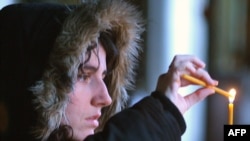
He argues that one sees precious few signs of a "godly life" among average Russians or among "our secular leaders who stand in churches holding candles on all the holidays." And he concludes that the "500-year effort to present Russia as the last true empire of Orthodoxy, as the kingdom of heaven on Earth, has failed."
But it is his last paragraph that is most interesting. Novoprudsky says that true faith can only be the result of free, personal choice, the action of an individual personality, rather than the result of collective pressure or national tradition. "In Russia," the essay concludes, "individual personality has been suppressed for centuries and continues to be suppressed today."
A lot of ink is spilled these days discussing the "pseudo" nature of the current Russian political system (as it was discussing it in the Soviet context) -- the idea that Russia is an authoritarian society lurking behind a thin veil of democratically oriented political theater. Novoprudsky's essay takes this discussion one step further.