




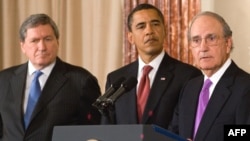
Veteran U.S. diplomat Richard Holbrooke sees his new assignment as the Obama administration's special envoy to Pakistan and Afghanistan as "daunting."
That may be an understatement. Regional experts say Holbrooke, who in a similar role brokered the Dayton Peace Accords in the mid-1990s, will face an even greater challenge than he did in the Balkans.
Introducing Holbrooke as Washington's special representative for Afghanistan and Pakistan, Secretary of State Hillary Clinton suggested he would fill the role of "super envoy," coordinating the government's efforts to realize its strategic goals in the region.
As if to underline the urgency of the problem, fresh reports on January 23 suggested unmanned U.S. aircraft had launched missile strikes on sites in Pakistan's lawless tribal belt, apparently the first such operations since Barack Obama took office three days earlier.
Clinton has suggested that Holbrooke will have a major say in the new administration's foreign-policy strategy.
She also has indicated that U.S. strategy in Afghanistan will take a new direction. "It has become clear that dealing with the situation in Afghanistan requires an integrated strategy," she told a gathering at the State Department on January 22. "[A strategy] that works with both Afghanistan and Pakistan as a whole, as well as engaging NATO and other key friends, allies, and those around the world who are interested in supporting these efforts."
While "The New York Times" reported that national security adviser General James Jones and Holbrooke himself had lobbied for Holbrooke to have direct access to the White House, Clinton gave assurances that "this effort will be closely coordinated" and involve the State Department, the Defense Department, the National Security Council, and the U.S. Agency for International Development (USAID).
'Infinite Complexity'
In his acceptance speech, Holbrooke outlined the challenges he sees in Afghanistan and Pakistan, which he called "two very distinct countries with extraordinarily different histories, and yet intertwined by geography, ethnicity, and the current drama." Holbrook maintained that there is a consensus that the war in Afghanistan has not gone well.
 Training Afghan police officers in Faizabad in September"As we speak here today, American men and women and their coalition partners are fighting a very difficult struggle against a ruthless and determined enemy without any scruples at all, an enemy that is willing to behead women who dare to teach in a school to young girls, an enemy that has done some of the most odious things on earth," Holbrooke said. "And across the border [in Pakistan] lurks the greater enemy still, the people who committed the atrocities of September 11, 2001."
Holbrooke called the situation in Pakistan "infinitely complex" and underscored the fact that "Pakistan has its own history, [and] its own traditions."
Husain Haqqani, Islamabad's ambassador in Washington, praised Holbrooke's appointment in an interview with "The Washington Post," saying he "brings tremendous experience and knowledge, and proven diplomatic skills."
Regional expert and author Ahmed Rashid, who has known Holbrooke for years, told RFE/RL by telephone from Pakistan that the U.S. envoy is a "highly competent but tough and uncompromising diplomat."
Rashid predicted that Holbrooke would be ready to take on the enormous responsibilities of his job from day one. "He is both charming and aggressive. He carries a lot of weight. He is always extremely well-briefed. He immerses himself in the subject that he is dealing with -- and the personalities that he is talking to," he said. "And we have seen already that in expectation of this appointment, he has immersed himself certainly in the politics of Afghanistan and Pakistan."
The 67-year-old Holbrook has received seven Nobel Prize nominations during his diplomatic career. He is an author, and has been a magazine editor, a university professor, and an investment banker. Aside from his diplomatic activities in the Balkans, he also served as an envoy to the United Nations.
Straight To The Source
Rashid thinks Holbrooke's appointment sends a "tough signal" to governments of Pakistan and Afghanistan -- both are riddled with internal divisions and considered weak and ineffective in dealing with the cross border Taliban and Al-Qaeda insurgency in their countries.
"The kind of criticism we have seen by the Democrats so far on [Afghan] President [Hamid] Karzai -- and the lack of good governance -- and insufficient dealings with the drugs problem and corruption -- we will see more of that from Holbrooke," Rashid said. "At the same time, I think, the Pakistani military is going to be very nervous about Holbrooke because, I think, equally with them, he is going to be tough."
Abdul Karim Haqanyar, a Sweden-based Afghan political commentator, told RFE/RL's Radio Free Afghanistan that Afghanistan has in the past been considered the center of all instability in the region. But that view has changed during the past seven years, because the international community is now heavily involved in Afghanistan and understands the regional context of its problems. "Obama understands that unless he tries to end the conflicts in Pakistan and Afghanistan simultaneously, these conflicts will never end," he said.
During his campaign, Obama declared Afghanistan and Pakistan the "central front" in the international counterterrorism effort. He reiterated that stance in his speech on January 22 and stressed the importance of diplomacy and development in both countries. Obama said that Holbrooke would "help lead our effort to forge and implement a strategic and sustainable approach to this critical region." He also stressed the need for "clear priorities in pursuit of achievable goals that contribute to our collective security."
"My administration is committed to refocusing attention and resources on Afghanistan and Pakistan and to spending those resources wisely," Obama said. "That's why we are pursuing a careful review of our policy. We will seek stronger partnerships with the governments of the region, sustain cooperation with our NATO allies, deeper engagement with the Afghan and Pakistani people, and a comprehensive strategy to combat terror and extremism."
Describing Holbrooke as a "juggler of complex situations," Rashid embraced Obama's choice as someone who could implement what is likely to be an evolving strategy that hinges on regional cooperation. "The Obama administration is going to pursue this regional strategy...to try and bring in all the regional countries to help stabilize Afghanistan, and also to try and resolve some of the regional problems that exist; such as India and Pakistan tensions; opening a dialogue between the Americans and Iran," Rashid said. "Holbrooke is going to be very effective in that because that is what he loves doing. That's what he did in the Balkans."
Holbrooke is expected to waste little time in making his first official trip to the region.
RFE./RL Radio Free Afghanistan correspondent Asmatullah Sarwan contributed to this story
That may be an understatement. Regional experts say Holbrooke, who in a similar role brokered the Dayton Peace Accords in the mid-1990s, will face an even greater challenge than he did in the Balkans.
Introducing Holbrooke as Washington's special representative for Afghanistan and Pakistan, Secretary of State Hillary Clinton suggested he would fill the role of "super envoy," coordinating the government's efforts to realize its strategic goals in the region.
As if to underline the urgency of the problem, fresh reports on January 23 suggested unmanned U.S. aircraft had launched missile strikes on sites in Pakistan's lawless tribal belt, apparently the first such operations since Barack Obama took office three days earlier.
Clinton has suggested that Holbrooke will have a major say in the new administration's foreign-policy strategy.
She also has indicated that U.S. strategy in Afghanistan will take a new direction. "It has become clear that dealing with the situation in Afghanistan requires an integrated strategy," she told a gathering at the State Department on January 22. "[A strategy] that works with both Afghanistan and Pakistan as a whole, as well as engaging NATO and other key friends, allies, and those around the world who are interested in supporting these efforts."
While "The New York Times" reported that national security adviser General James Jones and Holbrooke himself had lobbied for Holbrooke to have direct access to the White House, Clinton gave assurances that "this effort will be closely coordinated" and involve the State Department, the Defense Department, the National Security Council, and the U.S. Agency for International Development (USAID).
'Infinite Complexity'
In his acceptance speech, Holbrooke outlined the challenges he sees in Afghanistan and Pakistan, which he called "two very distinct countries with extraordinarily different histories, and yet intertwined by geography, ethnicity, and the current drama." Holbrook maintained that there is a consensus that the war in Afghanistan has not gone well.

Holbrooke called the situation in Pakistan "infinitely complex" and underscored the fact that "Pakistan has its own history, [and] its own traditions."
Husain Haqqani, Islamabad's ambassador in Washington, praised Holbrooke's appointment in an interview with "The Washington Post," saying he "brings tremendous experience and knowledge, and proven diplomatic skills."
Regional expert and author Ahmed Rashid, who has known Holbrooke for years, told RFE/RL by telephone from Pakistan that the U.S. envoy is a "highly competent but tough and uncompromising diplomat."
Rashid predicted that Holbrooke would be ready to take on the enormous responsibilities of his job from day one. "He is both charming and aggressive. He carries a lot of weight. He is always extremely well-briefed. He immerses himself in the subject that he is dealing with -- and the personalities that he is talking to," he said. "And we have seen already that in expectation of this appointment, he has immersed himself certainly in the politics of Afghanistan and Pakistan."
The 67-year-old Holbrook has received seven Nobel Prize nominations during his diplomatic career. He is an author, and has been a magazine editor, a university professor, and an investment banker. Aside from his diplomatic activities in the Balkans, he also served as an envoy to the United Nations.
Straight To The Source
Rashid thinks Holbrooke's appointment sends a "tough signal" to governments of Pakistan and Afghanistan -- both are riddled with internal divisions and considered weak and ineffective in dealing with the cross border Taliban and Al-Qaeda insurgency in their countries.
"The kind of criticism we have seen by the Democrats so far on [Afghan] President [Hamid] Karzai -- and the lack of good governance -- and insufficient dealings with the drugs problem and corruption -- we will see more of that from Holbrooke," Rashid said. "At the same time, I think, the Pakistani military is going to be very nervous about Holbrooke because, I think, equally with them, he is going to be tough."
Abdul Karim Haqanyar, a Sweden-based Afghan political commentator, told RFE/RL's Radio Free Afghanistan that Afghanistan has in the past been considered the center of all instability in the region. But that view has changed during the past seven years, because the international community is now heavily involved in Afghanistan and understands the regional context of its problems. "Obama understands that unless he tries to end the conflicts in Pakistan and Afghanistan simultaneously, these conflicts will never end," he said.
During his campaign, Obama declared Afghanistan and Pakistan the "central front" in the international counterterrorism effort. He reiterated that stance in his speech on January 22 and stressed the importance of diplomacy and development in both countries. Obama said that Holbrooke would "help lead our effort to forge and implement a strategic and sustainable approach to this critical region." He also stressed the need for "clear priorities in pursuit of achievable goals that contribute to our collective security."
"My administration is committed to refocusing attention and resources on Afghanistan and Pakistan and to spending those resources wisely," Obama said. "That's why we are pursuing a careful review of our policy. We will seek stronger partnerships with the governments of the region, sustain cooperation with our NATO allies, deeper engagement with the Afghan and Pakistani people, and a comprehensive strategy to combat terror and extremism."
Describing Holbrooke as a "juggler of complex situations," Rashid embraced Obama's choice as someone who could implement what is likely to be an evolving strategy that hinges on regional cooperation. "The Obama administration is going to pursue this regional strategy...to try and bring in all the regional countries to help stabilize Afghanistan, and also to try and resolve some of the regional problems that exist; such as India and Pakistan tensions; opening a dialogue between the Americans and Iran," Rashid said. "Holbrooke is going to be very effective in that because that is what he loves doing. That's what he did in the Balkans."
Holbrooke is expected to waste little time in making his first official trip to the region.
RFE./RL Radio Free Afghanistan correspondent Asmatullah Sarwan contributed to this story