



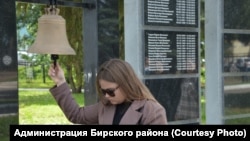
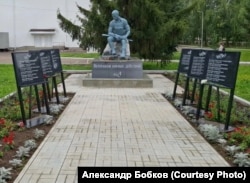
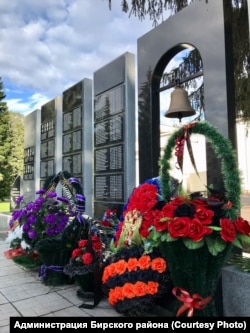
The 188 names engraved on a war memorial bear witness to the cost of war in Birsk, a town of 44,000 people in Russia's Bashkortostan region more than 1,000 kilometers east of Moscow.
While the names do not fill the granite block, there is a much larger blank area where others can follow. Bashkortostan appears to have suffered more casualties than any other region of Russia since Moscow launched the full-scale invasion of Ukraine in 2022, according to the patchy data available.
When the memorial reopened last August, following renovation work, it immediately attracted negative comments on social media.
"The empty columns (of names) are for future use," wrote one user who identified himself as Almaz Nuretdinov. "This is wrong."
Another user noted that the blank spaces would not be enough for all the names to come.
Counting The Dead
The casualty count in the Kremlin's war against Ukraine could reach 2 million by spring, with nearly 1.2 million Russian forces killed, wounded, or missing -- including some 325,000 dead -- the Center for Strategic and International Studies (CSIS) said in a report published late last month.
The casualties have been concentrated in areas with the most recruits, which tend to be poorer regions far from the economic and political centers of Moscow and St. Petersburg.
In Birsk, officer workers earn between $390 and $590 per month, while qualified staff at local factories earn $590-900, according to Gorodrabot.ru, a Russian jobs website. By contrast, military contracts with the armed forces can offer up to $5,700 a month, even after pay rates were reduced last year.
The 188 names on the war memorial amount to around 1 percent of the male working-age population of Birsk. The youngest man recorded there is Oleg Yezhov, who died aged 19. The majority are men in their 30s and 40s. The oldest casualty was 64-year-old Vladimir Kondratiev.
Even these spare details are unusual. War memorials in nearby towns tend to be abstract monuments without the names of individual soldiers who have been killed in Ukraine.
The stories behind the individual names also reveal the price paid by ordinary soldiers for joining Russia's invasion.
Eight Sons From One Family
Hussein Davlyatov was born in 1982 in Tajikistan, then part of the Soviet Union, and lived in Birsk. He signed a contract with the Russian military in March 2023 and died in Ukraine on May 12 the same year. A week later, he was buried in Birsk.
His father, Azam Davlyatov, told local TV in 2024 that eight of his 10 children had taken part in the war in Ukraine. He added that six had been injured and one killed.
Hussein's brother Said gave an interview to a local newspaper, Pobeda (Victory), in March 2024 while recovering from injuries and spoke of two brothers who were in Ukraine. Another brother, Shukhrat, told the same publication in January 2025 that Hussein's death had "shattered" their mother.
"All my brothers, sisters, and my father have one wish: that she gets well soon and the war ends as soon as possible, and that it does not take more loved ones from more families," he added.
Russia has not revealed the true number of casualties suffered, and the monument in Birsk does not contain the names of all the local men who have died. It only lists those whose bodies have been recovered.
The Davlyatov family's situation, with so many members joining the war, may be exceptional, but Hussein's death is not unusual.
On October 30, 2024, Viner Ziganshin, the chief editor of Pobeda, the publication that had focused on the Davlyatov family, also enlisted in the war. His date of death is recorded on the memorial as November 29 the same year.

