



Kazakhstan's cyberspace has learned an unexpected lesson: asking your followers a simple civic question comes at a cost. It also spurred creativity.
As authorities strictly enforced Article 120 of the Code of Administrative Offenses, polling public opinion on an upcoming constitutional referendum on March 15 was restricted to state-authorized entities, effectively barring ordinary citizens, journalists, and independent outlets from measuring public thought.
Faced with fines and blocked surveys, Kazakhstan’s digital community decided to go grocery shopping.
The word “referendum” quietly disappeared from social media posts. In its place appeared “smetana” -- sour cream.
On popular Telegram platforms users began posting photos of dairy aisles with captions along the lines of: “A new sour cream arrives on March 15. Does anyone know what’s in the ingredients?”
Everyone understood what the “ingredients” were: constitutional amendments many critics believed had been drafted with limited public debate.
The comment sections turned into coded political forums.
One widely shared remark read: “This sour cream has too long a shelf life. They clearly added preservatives.” It was a joke about dairy products, and a pointed jab at concerns that the new constitutional framework could extend presidential powers.
No political terminology. No banned keywords. Just food safety humor.
Coded Symbols Of Opposition
Threads and Instagram Stories soon joined the trend. Local community pages framed their polls innocently: “Are you going to the store on Sunday?”
The response options were equally domestic: “Yes, I need sour cream.” “No, the old one is better.” And the most popular: “I’m on a diet.”
“I’m on a diet” quickly became viral shorthand for an abstention or boycott -- a way to signal dissent without ever mentioning politics. In a country where discussing the referendum directly could trigger a fine, lactose intolerance became a political identity.
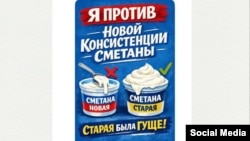
On Threads and Instagram, users have humorously protested the constitutional referendum by posting images comparing “new sour cream” (marked with a red X) to the “thicker old one” (green ✓), captioning them with phrases like “I am against the new consistency of sour cream,” while commenters chimed in with playful reactions such as “Class!,” “Old sour cream really is thicker than the new one,” and 🔥 emojis, turning grocery items into coded symbols of civic dissent.
Humor sharpened further when the referendum’s cost entered the conversation. The government allocated 20.8 billion tenge ($41.6 million) for the vote, a figure that circulated widely online.
One viral post asked: “Who is buying sour cream for 20 billion? We aren’t hungry for dairy; we need bread.”
'Concerning And Sad'
Gulmira Birzhanova, a lawyer from the Legal Media Center NGO, told RFE/RL’s Kazakh Service that the need people feel for this online “creativity” was very concerning.
“People who write these posts or create memes are thinking about their own safety. They fear that if they directly express their opinion, they may face legal consequences," she said. "So they hope that by presenting their opinion in a “creative” form, they might avoid accountability."
"This is very sad. The current constitution guarantees freedom of speech and creative expression in Article 20," Birzhanova added. "I hope the state does not respond by punishing people who are merely trying to circumvent direct restrictions, which would be absurd."
President Qasym-Dzhomart Toqaev launched the constitutional reform initiative as part of what he has repeatedly described as a transition toward a more open and responsive political system.

In public addresses, Toqaev has framed the referendum as a democratic milestone. He pledged that citizens would not merely observe the process but shape it.
“The opinion of every citizen will be taken into account,” he said, when announcing the reform package, emphasizing that the public would “actively participate” in building a “New Kazakhstan.”
But most Kazakhs see it differently.
Enforcement of Article 120 has been swift and goes far beyond fines.
Journalist Makpal Mukankyzy, an RFE/RL Kazakh Service correspondent, was fined roughly $90 for a social media poll. The Uralskaya Nedelya media outlet was penalized $260 for a similar Telegram survey.
But the crackdown has escalated from wallets to jail cells.
Activist Orazaly Yerzhanov was sentenced to 10 days of administrative detention for simply discussing a referendum boycott.
The crackdown also moved into the shadows of the web.
Independent voices reported a wave of digital sabotage, with social media accounts being hacked, disabled, or hit with coordinated mass reporting to vanish from public view. I
In the case of Yerzhanov, critical posts regarding the new constitution reportedly disappeared from his Facebook account immediately following his arrest.
By late February, the list of those punished had grown to include activists who dared to challenge the referendum’s legitimacy through direct action.
More than a dozen activists were placed in pretrial detention following attempts to organize peaceful gatherings, and an Almaty resident was fined approximately $170 for Facebook comments deemed to be "false information" simply for criticizing the proposed amendments.
The Pollsters Who Were Told No
The restrictions extended beyond individuals.
Demoscope, a public opinion monitoring bureau operating since 2012, sought permission to conduct a survey on how citizens perceived the proposed constitutional reforms. The request was denied by the Central Election Commission of Kazakhstan.
The justification was revealing.
Authorities cited Demoscope’s cooperation with the Konrad Adenauer Foundation, arguing that such cooperation constituted “indirect participation” by an international organization in referendum-related activities, which is prohibited by law.
With independent monitors sidelined, the public has been left with state-aligned numbers.
One official poll reported 78.8 percent support for the amendments. Another, commissioned by the ruling Amanat party, placed support as high as 86.5 percent.

