



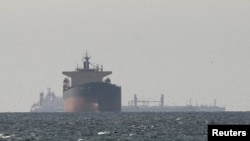
US President Donald Trump announced a two-week cease-fire with Iran after he said the Islamic Republic agreed to the opening of the Strait of Hormuz, a key chokepoint in the transit of oil, gas, and many other commodities and goods vital to the global economy.
Shortly after US-Israeli strikes against Iran began on February 28, Iran warned vessels in the strait that they would not be allowed to pass and began firing on them. Shipping via the strait fell drastically, immediately forcing oil and gas prices up.
Iran wants any peace deal to include a right for it to collect fees from ships passing through Hormuz, which handles some 20 percent of global maritime oil trade. Just 38 kilometers wide at its narrowest point, all ships transiting it must go via the territorial waters of either Iran or Oman.
Iranian officials told The New York Times that the fee could be as high as $2 million per ship, but that it would be split with Oman. With around 130 ships crossing the strait every day before the war, the toll would be a windfall for Iran. But would it be legal?
Under the UN Convention on the Law of the Sea (UNCLOS), ships must be allowed to go through the Strait of Hormuz for free. The convention does not allow countries to interfere with, or impose tolls on, ships transiting through straits that connect one part of the high seas, or an exclusive economic zone, to another. Iran has signed, but not ratified, the convention.
The United States is not formally a party to it, but recognizes most of its provisions as part of customary international law and not only tends to abide by them but actively enforces freedom of navigation as a principle.
The US military routinely conducts Freedom of Navigation operations, or FONOPS, to challenge what it calls “excessive maritime claims” by other countries -- including Iranian restrictions on transit passage through the Strait of Hormuz.
Some countries in control of other critical chokepoints do collect fees -- but the rules differ depending on how a chokepoint is classified. UNCLOS covers natural straits used for international navigation but says nothing about man-made canals, which are governed instead by their own specific treaties.
It also explicitly exempts straits that were already governed by a long-standing international convention before UNCLOS came into force. That leaves three categories: canals, grandfathered straits, and straits governed by UNCLOS -- and only the last one is required to be free.
Egypt collected about $4 billion in 2024 for 13,213 ships passing through the Suez Canal -- a man-made waterway governed not by UNCLOS but by the Convention of Constantinople of 1888, which allows Egypt to set fees for use of infrastructure it owns and operates. The Panama Canal works the same way.
Turkey collects fees for transit through the Bosphorus and Dardanelles, where passage is governed not by UNCLOS but by the Montreux Convention of 1936, which carves out the straits entirely from UNCLOS's transit passage rules.
Charging for passage through Hormuz would be a first among straits that fall under UNCLOS, and some countries in and outside the region, while welcoming the cease-fire, have voiced concerns about the imposition of tolls.
The Foreign Ministry of Qatar, one of the major exporters through the strait, stressed “the importance of insuring... the freedom of international navigation and trade in accordance with the rules of international law.” A European Commission spokesperson said freedom of navigation must be ensured with “no payment or toll.”
To pass through the Strait of Malacca, which sees about 22 percent of the world's maritime oil traffic, ships must enter the territorial waters of Singapore, Malaysia, or Indonesia.
Under UNCLOS, the strait is free to transit, and Singapore has declared it will not negotiate with Iran for passage through Hormuz. "There is a right of transit passage, it's not a privilege to be granted by the bordering state… It is not a toll to be paid," the country's foreign minister said on April 7.
If the US allows a toll to be charged for use of the strait, which President Trump says could be done as a “joint venture” between the US and Iran, it could signal a shift in decades-long American policy on freedom of navigation – and embolden countries like China, which has long sought more control over the South China Sea.

