

WASHINGTON -- As the geopolitical map of the Middle East and Eurasia undergoes a sometimes violent reshuffling, Washington is sharpening its focus on a critical "missing piece" of the democratic puzzle: the Republic of Georgia.
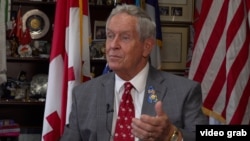
In an interview with RFE/RL, Congressman Joe Wilson, a Republican from South Carolina, warned that the South Caucasus has become a primary battleground in a global struggle between "dictators with the rule of gun" and "democracies with the rule of law."
To address this, Wilson and Congressman Steve Cohen, a Democrat from Tennessee, have recently introduced a bipartisan bill called the Countering China’s Control Of The Caucasus Act, a surgical legislative strike aimed at documenting the extent of the Kremlin and Beijing's reach into the Georgian state.
A New Intelligence Mandate
The new bill, H.R. 7668, reflects a growing anxiety in Washington that Tbilisi's current leadership -- the Georgian Dream party -- is drifting into an orbit controlled by the United States' primary adversaries.
The proposed legislation requires the US administration to produce a classified assessment of Russian and Chinese intelligence penetration in Georgia, including any overlap between the two.

It also mandates a five-year strategy review of US-Georgia relations, examining future funding and whether Tbilisi remains committed to deepening ties with the West.
"We must stand together...[with] forces of democracy around the world," Wilson told RFE/RL, framing the bill as a necessary defense against the "extraordinary and evil influence of the Chinese Communist Party" and its "goal of world domination."

The Battle For The Black Sea: Anaklia Port
Wilson pointed to the Anaklia Deep Sea Port, a project recently awarded to a Chinese-led consortium, as the strategic "center of gravity."

"The reason China is trying to control [the port] is to control the ability of rare earths and rare minerals from Central Asia," Wilson argued. "Georgia is right in the middle of everything."
He drew a direct parallel to the Panama Canal, noting that while the Chinese Communist Party nearly solidified control there, "pressure by President Donald Trump" successfully removed their influence.
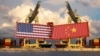
Wilson suggested that a similar playbook of "economic and civic encouragement" could be applied to Anaklia.
The 'MEGOBARI' Mandate
While the new China-focused bill is the latest move, Wilson emphasized that the MEGOBARI Act, earlier sanctions legislation targeting Georgian officials, remains what Wilson described as the "gold standard" of congressional intent.
Passing the House of Representatives last year with a resounding 349–42 vote, Wilson called the bipartisan margin "totally unprecedented."
"There's been no other legislation...that got 85 percent, maybe 90 percent [support]," Wilson said. "The 42 [who voted against] are isolationists.... They're not against the people of Georgia."
"What's not misleading is that 349 members -- Republicans and Democrats -- were supportive of MEGOBARI because they were inspired by the people of Georgia," he added.
Despite the bill stalling in the Senate due to procedural holds, Wilson remains optimistic, noting that the primary objector -- former Senator Markwayne Mullin -- has moved to the cabinet as Secretary of Homeland Security, potentially clearing a "lifeline" for the bill.
Taken together, the two legislative efforts reflect a dual-track approach of encouraging Georgia's Western path while applying pressure when it diverges from democratic standards.
"I've been inspired by the people of Georgia themselves," Wilson said, calling for "fair and free elections" as the foundation for deeper ties.
No 'Reset': Rubio's Warning To Totalitarians
The Georgian Dream government recently attempted to portray a phone call with the State Department involving Secretary of State Marco Rubio as a "reset" in relations. Wilson dismissed this interpretation.
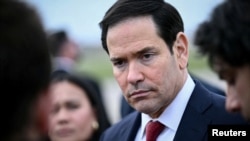
"Nobody has to explain to Marco Rubio what the consequence of totalitarianism is," Wilson said, citing Rubio's family history of fleeing Cuba. "Both Rubio and President Donald Trump want the best for the people...which is clearly fair and free elections."
Wilson's view is that engagement is not an endorsement of the current status quo, but a platform to demand "fair and free elections" as the "drift of world history" moves against autocrats.
Wilson cited the collapse of the Bashar al-Assad regime in Syria in late 2024 and recent leadership changes in Hungary, where outgoing Prime Minister Viktor Orban had faced years of criticism over democratic backsliding, as evidence for his assertion that "dictatorships are no longer in power."
Using The Financial Toolkit
While Congress legislates, experts suggest the United States can squeeze Chinese influence through the "plumbing" of international finance.
Laura Linderman, director of programs at the American Foreign Policy Council’s Central Asia-Caucasus Institute, told RFE/RL that Washington should leverage its influence within the World Bank and the Asian Development Bank (ADB).
"There are plenty of opportunities for Washington to influence the role of China in Georgia," Linderman said.
She urged the United States to ensure multilaterals "put conditions on any infrastructure projects" to prevent subcontracts from going to Chinese companies with "corrupt labor practices" or those that have been "proven bad actors in global trade."
The Iran Connection
Wilson also raised the alarm regarding reports of "intelligence sharing" between the "Tbilisi regime" and Tehran.
"It's a horrific situation," Wilson said. "For the Georgian Dream regime to show respect to the mass murderer [the late Iranian Supreme Leader Ayatollah Ali] Khamenei is really revealing.... This is not reflective of the wonderful and determined people of Georgia."

For Wilson, the path forward is a return to the democratic fold.
"War criminal Putin thought he could defeat Ukraine in 30 days. Four years later, the people of Ukraine are stronger than ever," he said. "Everything is leading to a movement worldwide for fair and free elections...and now we need them in the Republic of Georgia."

