


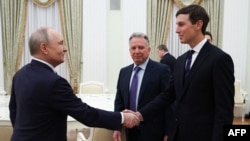
After three days of talks with Ukrainian and Russian negotiators and the presidents of both countries, US special envoy Jared Kushner said the diplomacy produced "meaningful progress" toward an elusive agreement to end Moscow's war against Ukraine.
But there was no public sign that Russia is ready to make concessions that could bring a deal closer. In fact, both President Vladimir Putin and his chief negotiator have sent at times extremely uncompromising signals on key issues, including demands on territory in Ukraine and a desired overhaul of the longstanding European security architecture.
Following two days of trilateral talks in Abu Dhabi and separate US meetings with Putin and Ukrainian President Volodymyr Zelenskyy on November 12, here is a look at Russia's stated positions on matters that could be crucial to concluding a peace pact.
The Donbas And A Lot More
For many months, Putin and other officials have emphasized that full Russian control over the Donbas, which encompasses the Donetsk and Luhansk regions of eastern Ukraine, is a prerequisite for any peace agreement.
Russia fomented war in the Donbas in 2014 after seizing the Crimean Peninsula, and it controlled portions of Donetsk and Luhansk long before Putin launched the full-scale invasion of Ukraine in February 2022.

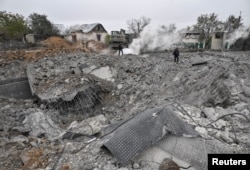
It now occupies virtually all of Luhansk and about 80 percent of Donetsk. But its forces have been unable to capture the rest of that region, including a "fortress belt" that includes the cities of Slovyansk and Kramatorsk, in years of deadly fighting.
Putin has repeatedly said Russia will take the rest of the region by force if it cannot gain it through diplomacy. Zelenskyy says Kyiv will not, formally or de facto, relinquish land its soldiers have fought hard to defend.
The Kremlin's appetite does not stop at Crimea and the Donbas, however. In September 2022, Moscow baselessly claimed that the Donetsk, Luhansk, Zaporizhzhya, and Kherson regions were all part of Russia.
Russia controls a majority of the Kherson and Zaporizhzhya regions, but it does not hold their eponymous capital cities. Its forces seized Kherson early in the full-scale war but were pushed out, back across the Dnieper River, in November 2022.
Borderlands
At times, Russia has sent mixed signals over whether it is willing to settle for partial control over Kherson and Zaporizhzhya or even potentially retreat from them as part of a peace deal.
There was no such ambiguity this week.
Meeting in the Kremlin on November 12 with Kushner and the other US envoy, Steve Witkoff, Putin claimed Kyiv had been "raising questions about gray zones" and added: "For us, there is only one line of demarcation: the line of the state border."
The actual state border, since the Soviet Union's collapse in 1991, is clear and puts all five regions that Russia claims inside Ukraine, no question.
But Putin wasn't talking about the actual border. He meant the border as Russia has seen it since 2022, and he meant Moscow wants a peace that would make those regions Russian in their entirety -- including the parts now held by Kyiv.
On Russian state TV, Moscow's chief negotiator Vladimir Medinsky made belligerent remarks on the same issue, saying that "wherever the Russian flag has been raised, it must not be lowered" and echoing a past comment by Putin that "wherever the foot of [a] Russian soldier has stepped, that is ours."
More specifically, he suggested that in addition to the regions Russia formally claims as its own, Moscow doesn't plan to relinquish its hold on territory along the state border in Ukraine's Kharkiv and Sumy regions, north of the Donbas. Along with Russian-occupied land in the Dnipropetrovsk region, these swaths of territory have been seen by observers as land Russia might cede as part of a compromise.
But Medinsky noted that Putin had ordered Russian forces to create a "security zone" along the border inside Ukraine, adding: "This zone is now quite substantial. It is expanding, and it will continue to expand. I don't see any possibility of exchanging these territories."
Rhetoric is rhetoric, and after the trilateral US-Ukraine-Russia talks in Abu Dhabi on November 10-11, a US negotiator speaking on condition of anonymity reported detecting "a little bit of flexibility" from both sides.
But whatever Moscow's intentions, the remarks set an uncompromising tone.
Putin's statement was "a clear reiteration of the hardline position on territory that has emerged over the last year" and "doesn't leave a lot of negotiating space — on this issue at least," Samuel Charap, senior political scientist at the Rand Corporation, wrote on X.
A ‘New, Modern Yalta'
Russian officials have also made clear what they want from talks on a subject that is now central to the US-led negotiation process: the potential creation of a new European security architecture.
On November 5, Trump spoke of prospects for a "big, beautiful agreement" that is "going to involve more than Ukraine." Kushner followed up by writing of what he said was "the need for a broader European security architecture that can help establish conditions for lasting peace."
While it has emerged only now as a focus of the talks, the idea is far from new for Russia. It goes back at least as far as Putin's ascent to power over a quarter-century ago, with Moscow seeking a reversal of its Cold War geopolitical losses and a restoration of its clout on the European continent.
Without going into detail, Medinsky sent a menacing message to Kyiv and Europe on the matter by telling Russian TV that Moscow's goal is to create a "new, modern Yalta and Potsdam" -- a reference to meetings in 1945 in which the United States, the USSR, and Britain decided the fate of parts of postwar Europe.
It comes amid Russian hopes for a summit between Putin, Trump, and Chinese President Xi Jinping at the November 18-19 APEC summit in China, which Zelenskyy warned could be a "redistribution of spheres of influence."
Medinsky said a comprehensive new security system could "preserve peace for decades, perhaps centuries." But the initiative has raised fears in Europe and Ukraine that larger powers could seek to decide their fate for them -- and that Russia, rather than being punished for its aggression, could be rewarded with broader influence.
No Troops Allowed
A clue to Russia's specific hopes can be found in the draft treaties it sent to Washington and NATO in December 2021, cast by Moscow as proposals but seen as ultimatums delivered as Russia amassed troops on Ukraine's borders. Western governments rejected some of them and offered to negotiate on others; Russia criticized this response and launched the full-scale invasion two months later.
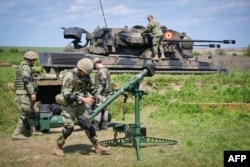
Russia's demands were dramatic, amounting to a reversal of some of the Cold War's outcomes. Agreement would have meant forswearing any further NATO enlargement, barring members from conducting military activity in Ukraine or other regional countries, and pulling military deployments back behind the borders of nations that were part of the alliance in 1997 -- before any former Soviet satellites joined.
Even at the time, before the death and destruction Moscow has caused with the full-scale invasion of Ukraine, it was astounding to many in the West that Russia would make such demands.
But it is now making them again: Kremlin aide Yury Ushakov said on November 12 that Putin, at his meeting with Kushner and Witkoff, described the positions set out in 2021 as the foundations of Russia's vision of an effective security architecture.
"The key provisions [are] the non-expansion of the NATO bloc; non-deployment of weapons systems that pose a threat to us near Russia’s borders; and a return of the alliance’s force posture to the configuration that existed" when a Russia-NATO agreement was signed in 1997, Ushakov said.
And on November 13, The New York Times reported that Russian officials circulated a paper this week that echoed the stance Moscow set out in the December 2021 documents, "sometimes word for word" -- including the call for a NATO troop pullback.
The Times said that it obtained a copy of the paper from a person involved in the talks, and that another person with knowledge of the negotiations confirmed its authenticity.
In some cases, it's unclear how close Russia's current positions in the talks hew to proposals it has made at previous talks during the war such as a call for the size of Ukraine's military to be strictly limited.
At a conference in Moscow on November 11, a Russian Foreign Ministry official described several types of agreements that could be part of a new European security system, Reuters reported, including a collective defense alliance and bilateral nonaggression or mutual assistance pacts between Moscow and individual NATO members.
Analysts say the Kremlin prefers dealing with European nations on a bilateral basis than with NATO or the EU in part because it enables Moscow to sow divisions.
Meanwhile, Russia has continued to demand Ukraine be barred from ever joining NATO. It has bristled at the idea of security guarantees for Kyiv that would amount to anything close to the alliance treaty's Article 5, which states an armed attack against one member is considered an attack against all.
And at his meeting with Kushner and Witkoff, Putin suggested any plans for Western troops to be deployed in Ukraine after a peace deal would be unacceptable to Russia, saying: "We have already talked about this: For us, they are a legitimate target, meaning the war [would] resume immediately."

