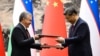
Data compiled by RFE/RL reveals how a surge in high-level diplomacy, economic engagement, and regional initiatives has elevated Beijing from a neighboring power to Central Asia’s leading economic partner.
China has overtaken Russia as the largest source of foreign direct investment in Central Asia, according to the Eurasian Development Bank. China’s accumulated investment in the region exceeded $35 billion in 2025, it said.
When Kazakhstan launched Central Asia’s first large-scale cloud-seeding program on May 17, it called it a high-tech response to drought, water scarcity, and accelerating desertification.
Russia is investing hundreds of millions of dollars to build schools and universities across Central Asia, reinforcing the use of the Russian language at a time when younger generations in the region are increasingly exposed to Western and Chinese influences.
Environmental activists in Kyrgyzstan are opposing plans to stage the UIM F1H2O World Championship on Lake Issyk-Kul this summer, warning that the high-speed powerboat races could harm one of Central Asia’s most sensitive ecosystems.
The coup trial of former security chief Kamchybek Tashiev signals a major shift in Kyrgyzstan’s political system. More than a criminal case, it reflects President Sadyr Japarov’s effort to eliminate his last major rival within the ruling elite and consolidate centralized presidential power.
Kyrgyzstan has taken sweeping action to clamp down on companies suspected of circumventing Western sanctions imposed on Russia following its full-scale invasion of Ukraine in 2022.
A major military museum in the western German city of Koblenz is denying entry to nationals from 26 countries, causing tense scenes with some visitors who arrive with children.
While diplomatic efforts struggle to stabilize access to the Strait of Hormuz amid tensions between the United States and Iran, Eurasian trade is increasingly being redirected toward overland alternatives, with the Middle Corridor emerging as a key diversification route in Eurasian logistics.
As expected, the launching of US and Israeli air strikes on Iran -- and retaliatory strikes by Tehran on targets in the Mideast -- has hit the economies of the region. But the shockwaves are arguably being felt just as much in Central Asian nations who rely on goods flowing through Iran.
A persistent and widening gap between trade data from Kyrgyzstan and China is raising concerns, exposing weaknesses in customs tracking, transit trade oversight, and potential corruption risks across a key Central Asian trade corridor.
In light of the unprecedented market uncertainty stemming from Iran's effective closure of the Strait of Hormuz, the strategic importance of Kazakhstan and Turkmenistan's energy reserves has never been greater.
Load more