


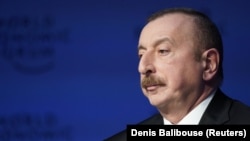

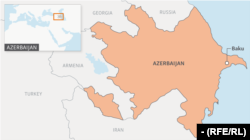
Barring an act of God, and despite a serious economic downturn in recent years, Azerbaijan's incumbent president, Ilham Aliyev, will almost certainly be reelected on April 11 with a landslide majority for a fourth consecutive term.
Since succeeding his late father, former Politburo member Heidar Aliyev, in 2003, Ilham Aliyev has systematically sidelined or jailed his political opposition and silenced independent media outlets, correctly assuming that his country's growing strategic importance as a supplier of natural gas to Europe would outweigh the misgivings of the international community.
Of the handful of opposition candidates who in a fair ballot might have posed a serious challenge to the incumbent, Republican Alternative (ReAl) movement head Ilqar Mammadov was jailed for seven years in 2014 for allegedly organizing a large-scale public protest.
In protest at the timing of the ballot, other prominent oppositionists decided not to participate. It was initially announced in mid-January that the election would take place on the third Wednesday in October, in line with the constitution.
Less than three weeks later, on February 5, President Aliyev brought the date forward without offering any explanation for doing so. Scheduling early presidential elections was one of the additional powers granted to the president under constitutional amendments adopted in a referendum in September 2016. At the same time, the presidential term was extended from five to seven years.
Outrage And Consternation
The scheduling of the early vote was met with outrage and consternation by prospective opposition candidates, who were thus left with just five weeks to collect the minimum 40,000 signatures in their support required for registration, the deadline for which was March 12.
The National Council of Democratic Forces (NSDS) formed in the run-up to the 2013 presidential ballot, and which unites prominent opposition figures, immediately declared its intention to boycott what its leader, Camil Hasanli, termed "a farce" and "flouting the institution of elections."
Arif Hacili, chairman of the opposition Musavat Party, which is one of the country's oldest and most respected, similarly branded the ballot illegal.
Hacili's predecessor as party chairman, Isa Qambar, placed second to Aliyev in the 2003 presidential ballot, which he claimed was rigged to deny him victory.
The Umid (Hope) party, for its part, decided not to field a candidate: its chairman, Iqbal Agazade -- who garnered under 3 percent of the vote in the 2008 and 2013 presidential ballots -- explained to the news portal Caucasian Knot that the party's statutes require it to convene a congress to select a presidential candidate, which was impossible given the time constraints.
ReAl and the youth organization Nida both announced that they will not acknowledge the election outcome as legitimate, Caucasian Knot reported, while in late March, the religious movement Muslim Unity, most of whose leaders are currently in prison, called on its members and supporters to boycott the vote.
A total of 15 hopefuls sought to register for the election, of whom only eight succeeded, including Aliyev. All but one of them have run for president at least once before.
The eight candidates are:
President Ilham Aliyev, nominated by the ruling Yeni Azerbaycan Party (YAP);
Social-Democratic Party leader Araz Alizade (polled 0.87 percent in 2013);
Parliamentarian and United Popular Front Party Chairman Qudrat Hasanquliyev (polled 0.55 percent in 2003, 2.28 percent in 2008, and 1.99 percent in 2013);
Parliamentarian and Party of National Rebirth Chairman Farac Quliyev (polled 0.86 percent in 2013);
Modern Musavat Party Chairman Hafiz Haciyev (polled 0.40 percent in 2003, 0.65 percent in 2008, and 0.66 percent in 2013);
Democratic Party of Azerbaijan nominee Serdar Calaloglu (polled 0.61 percent in 2013);
Independent candidate Zahid Oruc (polled 11.45 percent in 2013);
And Razi Nurullayev, a former deputy chairman of the opposition Azerbaijan Popular Front Party, which he quit in 2015.
Those refused registration, mostly on the grounds that some signatures in their support were invalid, were:
Citizen and Development Party Chairman Ali Aliyev (no relation to Ilham);
Liberal Democratic Party Chairman Fuad Aliyev (no relation to Ilham or Ali), who polled 0.78 percent in 2008;
Elsan Hasanov, who heads the unregistered Socialist Party;
Former Musavat Party youth wing head Tural Abbasli, who in 2016 founded the White Party;
And virtually unknown independent candidates Ramazan Bekirov and Asif Mamedov.
Classical Popular Front Party chairman Mirmahmud Miralioglu, who had announced in late January his intention of participating in the election, withdrew his candidacy two weeks after the revised date was announced. He argued that without a substantive revision of the electoral law and the release of political prisoners the elections could not be considered democratic.
Given that neither Ilqar Mamedov, Hasanli, nor Qambar are participating, there is every chance that President Aliyev will receive a higher proportion of the vote than ever before. In 2003, he polled 75.38 percent, with three influential oppositionists, Qambar, Lala-Sovket Haciyeva (Liberal Democratic Party), and Etibar Mammedov garnering 21.70 percent between them, and in 2013 he polled 84.55 percent (NSDS head Hasanli placed a distant second with 5.53 percent). By contrast, in 2008 when, as now, he faced no serious opposition challengers, President Aliyev won 89.04 percent of the vote.
President Aliyev's reasons for bringing the election forward by five months remain unclear. Presidential administration official Ali Hasanov told journalists that, since the presidential term has been extended by two years, the incumbent wanted to secure a vote of confidence from the electorate. Hasanov also cited a heavy schedule of important events later in the year, starting with the centenary in late May of the proclamation of the short-lived independent Azerbaijan Democratic Republic.
Tensions And Dissent
Analyst Togrul Cafarli, however, suggested that the real reason was tensions and dissent within the ruling YAP. President Aliyev has resorted before to wrong-footing potential rivals, most recently in 2016 when he scheduled at short notice the referendum on constitutional amendments that empowered him to appoint his wife, Mehriban, as vice president.
The actual election campaign, which kicked off only on March 19, has been muted. Hamstrung by a chronic lack of both financial means and organizational resources, opposition candidates had few possibilities for making their views known. True, state-controlled media outlets allocated free airtime, but it was confined to a series of one-hour debates among the candidates. Meanwhile, the cost of airtime on private channels was, to quote Calaloglu, "astronomical" -- up to 3,000-6,000 manats ($1,800 - $3,600) per minute of prime time.
Even President Aliyev was not campaigning energetically, having announced just days after setting the date of the ballot a 10 percent pay raise for all public employees at a cost of 40 billion manats ($23 billion). According to economist Qubad Ibadoglu, up to 2 million voters, or almost 40 percent of the total 5.2 million electorate, will benefit from that increase.
State-run media, meanwhile, gave extensive coverage to the president's engagements.
While the outcome of the ballot is a foregone conclusion, the geopolitical, economic, and domestic political context of this election nonetheless differs significantly from previous ones. The national currency has plummeted in value over the past three years, as have oil prices. Vahid Magerramli of the NSDS estimates that Azerbaijan's gross domestic product and budget are currently no more than $40 billion and $10 billion, respectively, compared to $75 billion and $25 billion three-four years ago.
Despite these obstacles, President Aliyev has managed to strengthen his position by removing from power several ministers with extensive private economic interests and replacing them with younger, Western-educated technocrats who, unlike their predecessors, are not tainted by allegations of corruption.
This approach, which essentially undercuts the influence of the country's oligarchs, allowing for the implementation of badly needed fundamental economic reform, is likely to continue after the election, Caucasian Knot quoted Turan News Agency director Mehman Aliyev as predicting.
In addition, the president-elect will nominate a new prime minister and government, a requirement that could bring about the retirement of Artur Rasizade, now 83, who has served as prime minister since July 1996, apart from a three month period in 2003 when Ilham Aliyev was maneuvered into that post to govern in the run-up to his father's death.