



Afghanistan
- By Ron Synovitz
Uzbekistan: U.S. Confirms End Of Air Base Agreement With Tashkent

31 July 2005 -- U.S. officials have confirmed that they have been asked to withdraw all U.S. military forces from the Karshi-Khanabad air base in southern Uzbekistan, which has served as a hub for U.S.-led coalition missions in Afghanistan since shortly after the terrorist attacks of 11 September 2001.
Some military experts have said the development increases the strategic importance of the Bagram Air Field north of Kabul. U.S. military engineers have been building up the infrastructure at Bagram for more than three years. They say the clearing of unexploded ordnance and the expansion of runway space at Bagram during the past 18 months could allow that facility to be used more extensively when the last U.S. soldiers leave K-2.
A report by "The Washington Post" newspaper says Uzbekistan will give the United States six months to move its aircraft, personnel, and equipment. Neither the Pentagon nor the State Department would comment on the reported timeline.
James O'Halloran, editor of the annual publication "Jane's Land Based Air Defence" and owner of the British-based firm Research Analyst Defense, said the closure could have significant impact on the way U.S. forces conduct and support combat and reconstruction operations in neighboring Afghanistan.
"The [K-2] airfield itself is a forward operating base [in the southern part of Uzbekistan] which, logistically, gives the U.S. a very good jumping off point into Afghanistan when it needs to move troops and logistics in that area," O'Halloran said.
Defense Department spokesman Glenn Flood said the U.S. military is working with the State Department to determine exactly what the note means for U.S. strategic interests in Central Asia. The White House declined immediate comment.
Flood suggested that the action could create logistical problems for U.S. military operations in Afghanistan as well as humanitarian relief workers in the region.
Washington has signaled in the past that it considers its bases in Uzbekistan and Kyrgyzstan as vital for operations in Afghanistan. But U.S. presence in Central Asia has caused tensions with Russia and China, which joined the five ex-Soviet Central Asian states this month to demand a deadline for leaving the bases.
O'Halloran said Tashkent's decision does not come as a surprise.
"I believe that the U.S. has expected to lose the K-2 base for some time now as political pressure has been applied through various sources to hold back the U.S. expansion, shall we say, into the former Soviet empire," he said. "A lot of people are saying that [the United States is] expanding a little too quickly now. They're over-stretching things. And I do believe it is politics which has forced the expected closure of K-2."
O'Halloran said he also thinks Russian President Vladimir Putin put political pressure on Uzbekistan to call for the U.S. withdrawal.
"There's no question that Moscow is involved in this and that Moscow is not comfortable with the U.S. expanding so closely to its borders and moving into the former Soviet empire," O'Halloran said. "I'm sure that Uzbekistan has accepted this from Mr. Putin, the president there, and in turn, has spoken to the U.S. about this -- and they've all agreed, politically, that this is probably a good move to make."
U.S. relations with Uzbekistan also have been strained by the Uzbek government's bloody suppression in May of a rebellion in the eastern Uzbek town of Andijon. That crackdown has drawn criticism from the United States. [For an RFE/RL archive of coverage of events in Andijon and the aftermath, click here.]
But O'Halloran said he does not think U.S. criticism played a significant role in Uzbekistan's decision.
"On the world scale of things, I don't think [the U.S. reaction to the Andijon crisis] played a major part in this," he said. "I think the politics coming out of Moscow probably has more to do with it than anything else."
"The New York Times" yesterday quoted one State Department official as saying that Uzbekistan's decision on K-2 is a response to a United Nations operation to take hundreds of Uzbek refugees from the region. Related statements have also been "highly critical of officials in Tashkent.
More than 400 people who fled to Kyrgyzstan after the May uprising were flown Friday to a refugee camp in Romania. The Uzbek government had sought their return.
U.S. Defense Secretary Donald Rumsfeld told reporters on 25 July that Tashkent and Washington still enjoy good relations.
Rumsfeld made the remarks during a visit to neighboring Kyrgyzstan. The Kyrgyz defense minister said the United States can keep a military presence in his country until stability returns to nearby Afghanistan.
Tajikistan also made a similar pledge during a recent visit there by Rumsfled. The Tajik government in Dushanbe has vowed to continue supporting international forces in Afghanistan.
Tajikistan has given U.S. planes refueling and overflight rights in conjunction with Afghanistan missions. Some 200 French air force personnel and two transport aircraft also are based at Dushanbe airport for Afghan operations.
(with additional wire reporting)
Related Stories:
Central Asia: Is It Time To Withdraw U.S. Troops?
Is Regional Turbulence Return Of The Great Game?
SCO -- Shoring Up The Post-Soviet Status Quo
[For more on events in the region, see our dedicated Central Asia In Focus archive.]
More News
Afghan Policemen Killed In Blast During Mission To Eradicate Poppy Crops
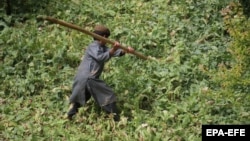
Three policemen were killed and five others injured when a bomb exploded near a police convoy on a mission to destroy illegal poppy crops in Afghanistan’s northeastern Badakhshan region, the country’s Taliban rulers said on May 8. Spokesman Ehsanullah Kamgar said explosives had been placed on a motorcycle when they were detonated. No group immediately claimed responsibility. Protests broke out on May 3-4 in the region when the Taliban attempted to forcefully eradicate the poppy crop. The Islamist group banned poppy cultivation in April 2022 after returning to power in August 2021. Afghanistan is the world's top producer of the poppy, from which opium and heroin are developed. To read the original story by RFE/RL’s Radio Azadi, click here.
'One-Party Rule': Taliban Wages Crackdown On Political Parties
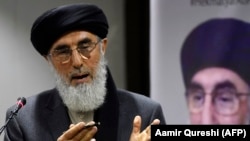
The Taliban is widening its crackdown on dissent by targeting political parties in Afghanistan.
The extremist group banned all political parties last year. But in recent months, the Taliban has clamped down on parties still deemed to be active.
Among the high-profile targets is the Hezb-e Islami party led by Gulbuddin Hekmatyar, one of Afghanistan's most notorious ex-warlords and a former militant leader.
The move comes as the Taliban intensifies its efforts to stifle opposing voices in Afghanistan, where scores of journalists and activists have been jailed since the militants’ takeover in 2021.
'Bad Policies'
Hekmatyar signed a peace deal with the former Afghan government in 2016, under which he was granted security and a government-funded residence in the capital, Kabul.
The 76-year-old initially welcomed the Taliban's resumption of control in Afghanistan. But he has grown increasingly critical of the group, which has monopolized power, severely curtailed women’s rights, and stamped out the free press.
In March, the Taliban forced Hekmatyar out of his government-funded residence and barred him from holding his Friday sermons. Members of his party were then prevented from meeting with him in his new residence in the capital.
In April, a TV station owned by Hezb-e Islami was shut down. Barya TV mainly aired Hekmatyar’s speeches and sermons.
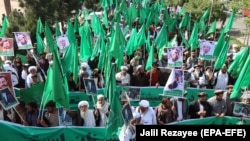
“Totalitarian regimes deeply believe in one-party rule,” said Obaidullah Baheer, a lecturer of politics at the American University of Afghanistan and Hekmatyar’s grandson.
Hezb-e Islami and the Taliban are both hard-line Islamist groups that are mostly made up of Pashtuns.
“Some Taliban followers revere Hekmatyar and agree with his criticism of the group’s bad policies, which the Taliban leader sees as a threat to his authority and the group’s unity,” Baheer said.
In August 2023, the Taliban formally banned all political parties in Afghanistan in a decree issued by Justice Minister Abdul Hakim Sharai.
Sharai, during a gathering in March, reiterated that “parties have no place in our political system.” He added that “even mentioning the name of a party is a crime."
The minister also claimed that the Taliban had shown “full respect” to Hekmatyar.
'Sacred Duty'
Hameed Hakimi, an Afghanistan expert at the Washington-based Atlantic Council think tank, said the ban on political parties is aimed at preventing any future political opposition.
“The disenfranchisement and disarming of Hekmatyar sends a signal to those like him,” said Hakimi.
Under the Taliban’s theocratic system, spiritual leader Mullah Haibatullah Akhundzada, who is the "Amir ul-Momineen," or the leader of the faithful, has the final say on all important matters.
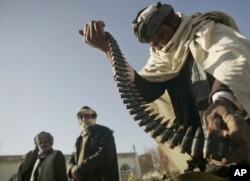
The Taliban sees “Afghans as subjects of Islamic law,” said Hakimi, adding that obedience to Akhundzada is seen as Afghans’ “sacred duty.”
"It is detrimental to the future of Afghanistan," Hakimi said. "And detrimental to any sense of pluralism."
Isa Ishaqzai, president of the Afghanistan National Congress party, said the Taliban is "terrified" at the prospect of Afghans raising their voices for “justice, human rights, and national interests.”
“Political parties can inform people,” Ishaqzai told RFE/RL’s Radio Azadi.
Iran Seeks To Tighten Crackdown On Afghan Refugees
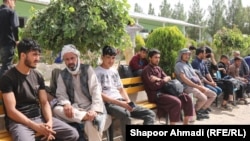
Iran says it has expelled some 1.3 million foreigners over the past year, highlighting a significant crackdown by the government on unauthorized migrants, primarily Afghan refugees.
Interior Minister Ahmad Vahidi told a press briefing that the efforts to regulate foreign nationals needs to be bolstered with legislative reforms to tighten border controls and prevent any future influx of unauthorized migrants.
"To stop unauthorized nationals from entering Iran, it is necessary to amend the relevant laws in parliament," Vahidi said in an indication the government doesn’t plan to heed calls from human rights groups to ensure a fair immigration policy.
Vahidi added that "effective” laws must be enacted to deal with expelled individuals who have managed to re-enter Iran after being deported. He did not elaborate.
Iranian officials typically use the term "unauthorized nationals" to refer to Afghan refugees and Vahidi’s statement is seen as an indication that the government plans to continue with its efforts to deport those who have fled the Taliban regime.
According to the United Nations Refugee Agency, Iran currently hosts around 3.4 million foreign refugees, with Afghans comprising the largest single group. The agency requested $114 million in aid for Iran last year to support refugee management, of which Tehran had received over $26 million by mid-2023.
This year, the refugee agency has sought $110 million in aid for Iran, with commitments from several countries, including Italy, Japan, Bulgaria, and Germany, to cover part of the sum.
Iran ranks alongside Turkey as one of the top host countries for refugees globally. The issue of Afghan migration has regained prominence following the Taliban's return to power in August 2021, leading to an increase in the number of refugees seeking safety outside their home country.
Recent government estimates suggest significant discrepancies in the number of unauthorized Afghan nationals in Iran, with figures ranging from 500,000 to 1.2 million, according to last year's assessment by the head of the National Immigration Organization.
Written by Ardeshir Tayebi based on an original story in Persian by RFE/RL's Radio Farda
- By AP
Taliban Rejects Claims Of Afghan Involvement In Recent Attacks In Pakistan
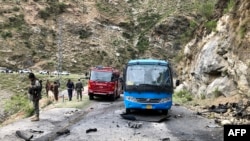
The Taliban has rejected claims of Afghan involvement in recent attacks in Pakistan, calling it “irresponsible and far from the reality.” Pakistan’s military said on May 7 that a suicide bombing which killed five Chinese engineers and a Pakistani driver in March was planned in neighboring Afghanistan and that the bomber was an Afghan citizen. Major General Ahmad Sharif, a spokesman for Pakistan’s army, has said that four men have been arrested. Enayatullah Khawarazmi, a spokesman for the Taliban’s Defense Ministry, said in a statement on May 8 that “blaming Afghanistan for such incidents is a failed attempt to divert attention from the truth of the matter and we strongly reject it."
To read the original story by AP, click here.
Pakistan Says Afghan-Based Extremists Killed 5 Chinese Engineers
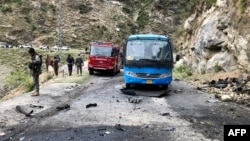
Pakistan’s military has again accused Kabul of providing sanctuary for militants, alleging on May 7 that a March 26 suicide bombing that killed five Chinese engineers and a Pakistani driver was planned in neighboring Afghanistan. Major General Ahmad Sharif, a Pakistani Army spokesman, said the bomber was an Afghan citizen. He said members of Tehrik-e Taliban Pakistan (TTP) -- a radical Islamist group designated as a terrorist organization by Washington -- are based in Afghanistan and have been conducting regular attacks inside Pakistan. Sharif alleged that Pakistan has shared "concrete evidence" with the Taliban government on the issue but that it hasn't been acted upon. To read the original story by RFE/RL’s Radio Mashaal, click here.
- By Ray Furlong
Muddy Floodwaters Surge Through Afghan Villages
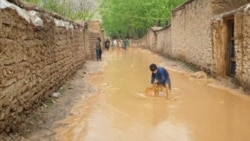

Surging brown waters were seen cascading through rural houses and shops in Afghanistan's Ghor Province in the latest flooding to hit the country. Taliban authorities say more than 1,000 families were forced from their homes by heavy rains in recent days. The calamity comes after Afghanistan also suffered heavy flooding that claimed more than 100 lives in March and April.
Locals Protest After Taliban Crackdown Roils Northeast Afghan Province
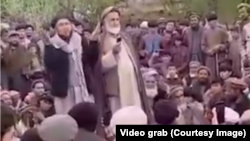
Residents of two remote districts in the northeastern Afghan province of Badakhshan have demanded more accountability and better treatment from the authorities after a Taliban crackdown on protests killed at least two people.
Protests broke on May 3 and 4 in the Darayim and Argo districts when the Taliban attempted to forcefully eradicate the poppy crop. The hard-line Islamist group banned poppy cultivation in April 2022 after returning to power in August 2021.
"People are willing to cooperate in eradicating their opium crops peacefully," Shamsuddin Mubarez, a young activist in Argo, told RFE/RL's Radio Azadi on May 6.
"People responsible for destroying the poppy crops should be locals from Badakhshan," he added while outlining their demands.
A resolution adopted by the residents of Argo also demands that Taliban authorities arrest and punish the perpetrators of the shooting that killed Abdul Basit, 23, a local farmer.
In Darayim, a resident speaking on condition of anonymity said that residents refused to talk to a Taliban delegation made up of provincial officials on May 5.
Nizamuddin, a farmer in Darayim's Qarlaq village, was killed. Three more protesters were injured after the Taliban fighters attempted to quell the protest that erupted after they began destroying the poppy crop on May 3.
"People want the Taliban government to hear our voice," a resident of Darayim told Radio Azadi. "But they acted dictatorially and didn’t listen to us."
Abdul Matin Qane, the spokesman for the Taliban-led Interior Ministry, told the BBC that local demands for prosecuting the Taliban security forces responsible for the killings in Badakhshan were "completely justified."
The Taliban government has appointed its army's chief of staff, Fasihuddin Fitrat, a native of Badakhshan, to head a delegation to negotiate with the protesting farmers in the province.
In a purported audio message on May 6, he urged locals to "urgently" end their protests because their agitation would be seen as a rebellion, which could prompt the Taliban to send security forces to quell any unrest.
At least one person was killed in similar protests in Badakhshan last year.
The Taliban ban has pushed the price of illicit opium in Afghanistan to $1,000. But it has pushed tens of thousands of impoverished farmers to extreme poverty because poppies were the best cash crop in the arid, mountainous country.
The Talibans internationally isolated government has so far failed to attract any significant international aid or investments to help Afghan poppy farmers.
Russia Inches Toward Marriage Of Convenience With Taliban In Terror Fight
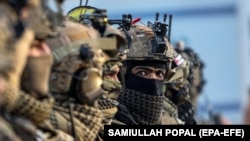
Shortly after the Taliban seized power, Russia addressed the question of whether it was time to review the militant group's status as a terrorist organization.
"It is very important to see what the Taliban's first steps in governing Afghanistan will be like," Kremlin spokesman Dmitry Peskov said on August 30, 2021. "Conclusions can be formed after this."
Two and a half years later -- despite the Taliban's failure to deliver on its promises to form an inclusive government, adhere to basic human rights norms, and prevent Afghan territory from becoming a safe haven for transnational extremist groups -- a mutual enemy appears to be forcing a decision.
Since a deadly terrorist attack claimed by the Islamic State (IS) extremist group near Moscow on March 22, Russia has increasingly talked up its relationship with the Taliban, which is battling the Islamic State-Khorasan (IS-K) offshoot in Afghanistan that is believed to have carried out the attack.
While the Taliban's government is globally unrecognized, Peskov said last month that Moscow has to resolve "pressing issues" that demand increased dialogue with the militant group, whose leaders are "actually the ones in power in Afghanistan."
Considering the importance Russia places on Afghanistan in maintaining regional security in the face of a rising IS-K threat, boosting engagement with the Taliban holds benefits for Moscow, observers say.
Alec Bertina of Militant Wire, a research outlet that tracks militant groups, says that Russia removing the Taliban from its terror blacklist could be the beginning of a "marriage of convenience."
"As much as it's kind of an amusing idea for Russia and the Taliban to get cozy, it's in their security interest to do so right now," Bertina said. "Given the mutual security threat, and that the Taliban can be used basically to take the hits and casualties that come with fighting IS, it's sort of a no-brainer."
When it emerged in Afghanistan a decade ago, IS-K staged attacks in Afghanistan and Pakistan. Its targets included Western forces in Afghanistan as well as the Taliban, which opposed the former Afghan government and vied with IS-K for influence among the dozens of extremist groups active in the country.
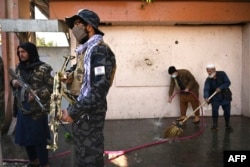
Since the Taliban took over, IS-K has maintained pressure on the Taliban, whose rule it rejects, and has worked to "make life as difficult as possible" for its de facto government, said Michael Kugelman, director of the South Asia Institute at the Wilson Center in Washington.
Its attacks against the Taliban, religious minorities, and foreign targets in Afghanistan were designed to "undermine the Taliban's legitimacy in order to convince the Afghan people that the Taliban is unable to provide peace and security in the country," Kugelman told RFE/RL's Radio Azadi.
IS-K has also openly challenged its rival in a sophisticated propaganda campaign, mocking the Taliban government's desire to be recognized by the international community and accusing it of adhering to an "ignorant" brand of Islam.
The group has also increasingly expanded its reach further abroad, including with deadly attacks in Iran, Russia, and Central Asia, a major recruiting ground for IS-K fighters.
"Its main bases are still in Afghanistan, most of its attacks are in Afghanistan, but this is a regional affiliate of Islamic State that has increasingly global goals," Kugelman said of IS-K.
As evidenced by the recent attack on a concert venue that killed more than 140 people and injured hundreds more -- the deadliest terrorist attack on Russian soil in two decades -- Moscow has reason to treat the IS-K with urgency and to forge greater cooperation with one of the group's main adversaries.
"Russian outreach and concessions to the Taliban are likely meant, at least in part, to signal Moscow's confidence in the Taliban's ability to degrade the IS-K threat," Kugelman told RFE/RL in written comments.
The Taliban was designated as a terrorist organization by Russia in 2003, two years after it was pushed from power by U.S.-led forces.
After returning to power, the Taliban initially dismissed the IS-K threat and has insisted that the group is not active on Afghan soil, even as it consistently developed its capabilities to confront the group and destroyed IS-K cells.
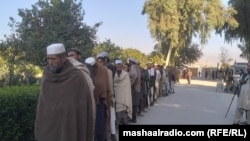
Most recently, in April, the Taliban reportedly ordered the creation of a special military unit to fight the IS-K.
But "whatever the Taliban has done against IS-K, it hasn't stopped IS-K from being able to conduct external operations in other countries," Bertina said, noting that it has proved incapable of preventing IS-K's recruitment efforts.
That, Bertina said, has led Russia and other countries to discuss "whether it may be of interest to help [the Taliban] out a little bit in their fight."
Moscow's de-listing of the Taliban from its terror blacklist, Bertina said, could pave the way for Russia to potentially "start giving the Taliban resources to better fight IS-K."
Bertina says he envisions a situation in which the Taliban would bear the brunt of the fighting on the ground in Afghanistan, with Russia providing intelligence. Russia would be unlikely to "be too vocal" about direct raids on IS-K in Afghanistan, "considering the uncomfortable history Russia has regarding counterterrorism operations when it comes to countries like Afghanistan."
Kugelman also sees value in Russia cooperating with the Taliban on the counterterrorism front, citing the Taliban's "willingness and capacity to carry out scorched-earth ground campaigns against IS-K."
Russia, while bogged down in its war against Ukraine, could potentially offer the Taliban "arms, money, and even training and advising to help the Taliban do more damage against the IS-K," Kugelman said.
- By AP
Afghanistan's Only Female Diplomat Resigns In India After Gold-Smuggling Allegations
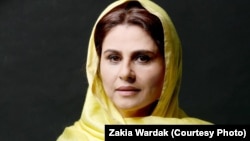
An Afghan diplomat in India, who was appointed before the Taliban seized power in 2021 and said she was the only woman in the country's diplomatic service, has resigned after being detained for allegedly smuggling gold. Zakia Wardak, the Afghan consul-general in Mumbai, announced her resignation on May 4 after Indian media reported she was briefly detained at the airport on allegations of smuggling 25 bricks of gold from Dubai. Reports said she wasn't arrested because of diplomatic immunity. Wardak said that "I am deeply sorry that as the only woman present in Afghanistan's diplomatic apparatus, instead of receiving constructive support to maintain this position, I faced waves of organized attacks aimed at destroying me."
The Azadi Briefing: Deadly Floods Wreak Havoc Across Afghanistan
Welcome to The Azadi Briefing, an RFE/RL newsletter that unpacks the key issues in Afghanistan. To subscribe, click here.
I'm Abubakar Siddique, senior correspondent at RFE/RL's Radio Azadi. Here's what I've been tracking and what I'm keeping an eye on in the days ahead.
The Key Issue
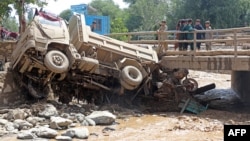
Flash floods caused by spring downpours have wreaked havoc in most provinces in Afghanistan.
The Taliban said at least 103 people were killed and over 60 injured in floods and heavy rains between March 21 and April 29.
The downpours have also damaged thousands of houses, while over 100,000 acres of farmland have been destroyed.
“Snow and hail have ruined my apricot, apple, and cherry trees,” Sayed Gul Badshah, a farmer in the central province of Maidan Wardak, told RFE/RL’s Radio Azadi.
Saed Akbar, a farmer in eastern Nangarhar Province, said heavy rain and hail have "utterly wrecked" his wheat and vegetable crops.
In the northern Faryab Province, farmer Abdul Qureshi said floods "washed away" scores of houses in the district of Pashtun Kot.
After a prolonged dry spell in autumn and winter, Afghanistan and its neighbors have been witnessing unusually heavy rains and snowfall in the spring.
Why It's Important: Afghanistan is one of the most vulnerable countries to climate change.
Experts say climate change has worsened the frequency and severity of extreme weather events -- from droughts and heat waves to floods and storms – around the world.
Afghanistan’s ability to adapt and difficulties in attracting international aid under the unrecognized Taliban government are seen as major obstacles to dealing with the situation.
Extreme weather conditions have exacerbated the humanitarian crisis in Afghanistan, the world’s largest.
What's Next: There are signs that the international community is responding to the crisis by empowering local Afghan communities to combat climate change.
But it is unclear if the initiatives will help mitigate against large-scale natural disasters caused in part by climate change.
Deadly floods and extreme drought in recent years have uprooted millions of Afghans, some of whom have been forced to flee abroad.
What To Keep An Eye On
Reporters Without Borders (RSF) has expressed alarm about the situation of scores of exiled Afghan journalists who are staying in neighboring Pakistan.
Celia Mercier, head of RSF's South Asia desk, on April 30 urged the Pakistani authorities and international community to help protect Afghan journalists who fled their homeland for fear of retribution by the Taliban.
Mercier told Radio Azadi that Afghan journalists living in Pakistan “should be able to utilize their journalistic skills” or be allowed to move to a third country willing to host them.
Most of the nearly 200 journalists fled after the Taliban’s return to power in 2021 and are now waiting to be relocated to Western countries.
RSF said that the journalists lack access to education, health care, and employment.
Mohammad Idris Sadat, one of the stranded journalists, said many are suffering from "mental health problems because they face uncertainty" as their immigration cases are taking too long.
Why It's Important: After returning to power, the Taliban has attempted to erase the once vibrant Afghan media landscape.
Fear of reprisals by the group has forced hundreds of reporters and media workers to flee the country. Those remaining have faced beatings, arrests, and harassment.
Hundreds of print and electronic media outlets have been either shut down by the Taliban or closed due to a lack of funding.
That's all from me for now.
I'm off next week. The next Azadi Briefing will appear on May 17.
Don't forget to send me any questions, comments, or tips that you have. You can always reach us at azadi.english@rferl.org
Until next time,
Abubakar Siddique
If you enjoyed this briefing and don't want to miss the next edition, subscribe here. It will be sent to your inbox every Friday.
- By RFE/RL
Eastern Europe, Central Asia See 'Spectacular' Rise In Media Censorship, RSF Says
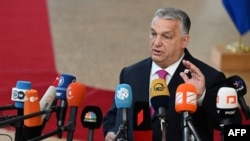
Suppression of press freedom rose over the past year in Eastern Europe and Central Asia, where governments with increasingly authoritarian tendencies have followed Russia's example of stifling and punishing free speech, media watchdog Reporters Without Borders (RSF) said.
Press Freedom Day
To mark World Press Freedom Day on May 3, RFE/RL has prepared the following stories about the plight of media in our broadcast area:
Highlighting the situation in in its annual media world ranking, published on May 3, RSF noted the worsening media situation in Belarus, where strongman Alyaksandr Lukashenka's regime persecutes reporters under the excuse of fighting “extremism”; Georgia, where the government has been pushing "foreign agent" legislation modeled on a Russian law, despite massive public protests; and in Kyrgyzstan.
"Media censorship has intensified in a spectacular mimicry of Russian repressive methods," RSF said.
Belarus dropped 10 positions to 167th in the world, while Georgia, at 103th, fell a whopping 26 places.
RSF said Russia, which ranked 162nd out of 180 countries, has continued its campaign against independent journalism, using the “foreign agent” or “undesirable” legislation to arbitrarily imprison remaining journalists as more than 1,500 have left the country since the start of the war. RFE/RL journalist Alsu Kurmasheva and Evan Gershkovich of The Wall Street Journal are currently imprisoned in Russia.
Azerbaijan fell 13 places to 164th mainly due to the authorities' crackdown on the media before its presidential election, RSF said.
The report pointed to the deteriorating situation in Serbia -- down seven positions to 98th place -- as an example of the Kremlin's long reach.
Press outlets affiliated with the pro-Russian government of Serbia relayed Moscow's propaganda, while anti-war Russian journalists who found refuge in Serbia after Moscow's invasion of Ukraine are being threatened with expulsion.
RSF notes as a positive development the 18-place jump made by Ukraine due to what it says are improvements in the security and political indicators. Political interference in Ukraine has fallen, with the country being currently ranked 61st, the report said.
In Eastern Europe, the report notes a "dangerous trend" by some governments to stifle independent journalism, which RSF calls "Orbanization," after Hungarian Prime Minister Viktor Orban. Orban, in power since 2010, has been accused of muzzling the free press. Hungary is currently in 67th place.
In Slovakia, ranked 29th, the situation is also deteriorating under Russia-friendly Prime Minister Robert Fico, RSF says.
In Central Asia, Turkmenistan, where independent reporting is completely banned, is listed 175th, while Kyrgyzstan is listed 120th.
Afghanistan, where the persecution of journalists has been "incessant" since the return of the Taliban to power in 2021, three journalists were killed and at least 25 were detained over the past year. Afghanistan dropped 26 places to 178th out of a total of 180 countries in the index.
This Is What It's Like To Be A Journalist Under Taliban Rule
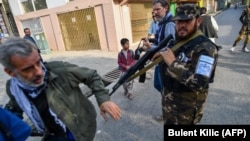
Afghan journalists are forbidden from broadcasting or publishing stories that are critical of the Taliban.
World Press Freedom Day 2024
To mark World Press Freedom Day on May 3, RFE/RL has prepared the following stories about the plight of media in our broadcast area:
Reporters who cross that red line have been arrested and jailed, beaten in custody, or threatened and harassed.
But journalists don't just face restrictions on which issues they can cover. They are also severely limited in how they report stories and who they can interview.
Women and girls are banned from appearing on TV or radio programs. Male reporters, meanwhile, are barred from interviewing women and vice versa.
This is what it is like to be a journalist in Afghanistan nearly three years after the Taliban seized power. The militants have transformed the once-vibrant media landscape in the war-torn country, where censorship is now rife and dissent has been largely stamped out.
"It is impossible to be a journalist under the Taliban," a female reporter based in central Afghanistan told RFE/RL's Radio Azadi.
The reporter, like others interviewed for this story, spoke on condition of anonymity for fear of retribution.
'Red Lines'
After regaining power in 2021, the Taliban initially promised to allow a free press. But its hard-line government soon waged a violent crackdown on independent media.
Scores of reporters and media workers have been imprisoned or physically attacked. The Taliban has shut down dozens of media outlets. Hundreds of journalists have fled the country out of fear.
Only a few independent media outlets still operate under the Taliban. But their journalists face severe restrictions and often resort to self-censorship.
Covering issues like "insecurity, human rights, and corruption" are off-limits, said a Kabul-based editor who works for a major broadcaster.
Taliban officials often instruct journalists to "report only on issues" that put them in a more positive light, the editor said.
The Taliban has also told broadcasters not to interview ordinary Afghans on the streets in a bid to prevent criticism of the group.
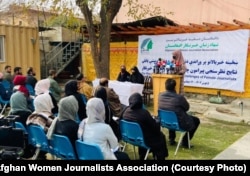
"We are also not allowed now to invite Afghans living abroad to participate in programs," the editor said. "It is forbidden to include the views of the Taliban's opponents."
A reporter based in northern Afghanistan says he tried to investigate reports of alleged sexual abuse in Taliban-run madrasahs, or Islamic seminaries, and the Taliban’s decision to award lucrative mining contracts to state-run companies. But he dropped the stories for fear of reprisals.
"Such issues are completely off-limits," he told Radio Azadi.
'I Can't Go Out'
The Taliban’s restrictions on the media have disproportionately affected women.
The militants have imposed severe restrictions on women's appearances, freedom of movement, and right to education and work.
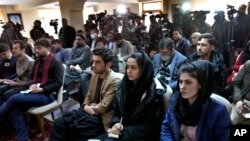
"I can't go out now and report," said the female reporter based in central Afghanistan, adding that she is barred from interviewing men and cannot travel far from home without a male chaperone.
Another female reporter from central Afghanistan says she was called in for questioning after reporting on a protest by women against the Taliban's repressive policies.
"I was asked why I report on such issues," she told Radio Azadi. "They asked me, 'Are you against the government?'"
She says the officials threatened her and said she would face "serious consequences" if she reported on any unsanctioned rallies again.
In broadcast media, there are even more restrictions.
Female TV presenters have been forced to wear a black robe and head scarf with only their eyes visible.
TV and radio stations have been banned from broadcasting female voices and accepting call-ins from women.
Growing Censorship
The Taliban's crackdown on journalists appears to be intensifying.
In recent months, the militant group has imposed new restrictions on female journalists' appearances, banned some women from accessing radio and TV programs, and prohibited the filming or photographing of Taliban officials.

On April 22, three radio journalists were detained in the southeastern province of Khost after they allegedly aired music and received calls from female listeners during broadcasts. They were all released on April 28.
The Taliban suspended the operations of two private TV stations based in Kabul on April 17 for violating "national and Islamic values."
The Taliban has issued "11 rules for journalists" that prohibit the publication or broadcasting of reports that are "contrary to Islam," and which discourage the reporting of news that has not been confirmed by Taliban officials.
The Taliban's message in clear, said a print journalist based in Kabul: Do not publish or broadcast "anything critical of the government."
The Kabul-based editor says the Taliban's ongoing persecution and harassment of journalists are forcing more journalists to abandon their professions or flee their homeland.
"Everyone I know just wants to escape abroad," they said.
7 Killed In Attack On Afghan Mosque
Seven people were killed in an attack on a Shi'ite mosque in Afghanistan's Herat Province late on April 29. Media reported that the attack took place at the Imam Zaman mosque in the Guzereh district of Herat. Among the dead are the imam of the mosque, a child, and five adult worshipers, reports said. No further details were immediately available. To read the original story by RFE/RL's Radio Azadi, click here.
Nationwide Anti-Polio Campaign Kicks Off In Afghanistan
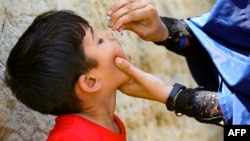
A nationwide polio vaccination campaign started on April 29 in Afghanistan, Taliban authorities announced. The Taliban-run Health Ministry said the four-day campaign will cover 31 of Afghanistan's 34 provinces, while immunizations will start later in the remaining three -- Ghor, Daikundi, and Bamyan -- due to heavy rains and cold weather. Besides vaccines, children will also receive doses of vitamin A to increase their resistance to the infectious disease, the ministry said. Pakistan and Afghanistan are the only countries in the world where polio has not been completely eradicated. To read the original story by RFE/RL's Radio Azadi, click here.
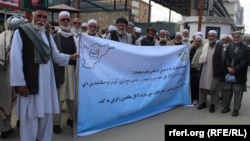
The Azadi Briefing: Afghans Protest Taliban's Decision To Abolish Pension System
Welcome to The Azadi Briefing, an RFE/RL newsletter that unpacks the key issues in Afghanistan. To subscribe, click here.
I'm Abubakar Siddique, senior correspondent at RFE/RL's Radio Azadi. Here's what I've been tracking and what I'm keeping an eye on in the days ahead.
The Key Issue
The Taliban has abolished the pension system in Afghanistan, which is gripped by a devastating economic and humanitarian crisis.
The move has triggered protests by retirees who say they cannot survive without state assistance.
Scores of retired civil servants and retired members of the armed forces staged a rally in Kabul on April 20. The protest was dispersed by the Taliban.
"We are just trying to claim our rights," Aafandi Sangar, the head of the Afghan Pensioners Association, told RFE/RL's Radio Azadi. "We are miserable because we have not received any payments for nearly three years."
An estimated 150,000 pensioners received a monthly payment of around $100 from the state before the Taliban seized power in 2021. Retirees say they have not been paid their pensions since then. Many of the pensioners served governments that had fought against the Taliban.
In early April, the Taliban's spiritual leader, Mullah Haibatullah Akhundzada, ordered his government to stop deducting retirement contributions from the salaries of civil servants, effectively dismantling the pension system. Akhundzada suggested that the system was "un-Islamic."
Why It's Important: The Taliban's decision to scrap pensions threatens the future of tens of thousands of current government employees.
The group's refusal to pay pensions since 2021 has also pushed many retirees and their families deeper into poverty. The decision this month dashed their hopes.
"How will we live now?" asked one retiree, speaking to Radio Azadi. "We used our pensions to provide for our families."
The Taliban has repeatedly promised to build a welfare state in Afghanistan. But the group's decision to scrap pensions suggests that it is unlikely to fulfil its pledges.
What's Next: The Taliban leadership has vowed to create a "pure" Islamic system in Afghanistan.
The group has used religious justification to scrap the pension system. Pensions involve interest, which the Taliban has said is forbidden under Islam.
The group's extremist interpretation of Islamic law is likely to continue shaping the decisions of its government.
What To Keep An Eye On
A senior cleric who was believed to be a close aide of the Taliban's spiritual leader has been killed in neighboring Pakistan.
Mullah Mohammad Omar Jan Akhundzada was shot dead in Quetta, the capital of Pakistan's southwestern Balochistan Province, on April 18.
The chief Taliban spokesman, Zabihullah Mujahid, said his death was an "irreparable loss."
Local police said the cleric possessed Pakistani citizenship and had lived in Quetta for many years.
Many Taliban leaders were believed to have lived in Quetta, near the Afghan border, during the group's nearly 20-year insurgency against Afghan government forces and international troops.
Why It's Important: Akhundzada's mysterious killing has raised questions.
Some have speculated that the Pakistani authorities could have been behind it.
Islamabad and the Taliban were close allies for decades. But the sides have fallen out in recent years, with Pakistan accusing the Taliban of sheltering the Tehrik-e Taliban Pakistan, an extremist group that has waged a deadly insurgency against Islamabad for years.
Islamabad has tried to use pressure tactics, including the mass deportation of Afghan refugees from Pakistan, to change Taliban policy, according to observers.
That's all from me for now. Don't forget to send me any questions, comments, or tips that you have. You can always reach us at azadi.english@rferl.org
Until next time,
Abubakar Siddique
If you enjoyed this briefing and don't want to miss the next edition, subscribe here. It will be sent to your inbox every Friday.
- By RFE/RL
With Conflicts Raging In Ukraine, Middle East, Amnesty Warns Rights Under Threat
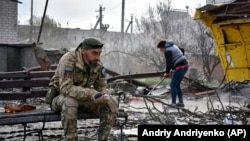
Rights watchdog Amnesty International has warned that world order is under threat amid a wave of international rule breaking, deepening global inequality, superpower rivalries, and accelerating climate change.
The group said in its annual report on the state of global human rights, released on April 24, that the world is "reaping a harvest of terrifying consequences" from the pressures of escalating conflict and "a near breakdown" of international law, with advances in artificial intelligence likely to exacerbate the situation.
Amnesty said its report "presents a stark assessment of the betrayal of human rights principles by today’s leaders and institutions," and that in the face of multiplying conflicts, "the actions of many powerful states have further damaged the credibility of multilateralism and undermined the global rules-based order first established in 1945."

"Alongside Russia's ongoing aggression against Ukraine, the growing number of armed conflicts, and massive human rights violations witnessed, for example, in Sudan, Ethiopia and [Burma] – the global rule-based order is at risk of decimation," said Amnesty Secretary General Agnes Callamard.
The report noted that the war in Ukraine, launched by neighboring Russia in February 2022, was another key contributor to the decline in the global human rights situation.
Amnesty called out indiscriminate attacks by Russian forces "on populated areas and civilian energy and grain export infrastructure."
"Both Russian and Ukrainian forces used cluster munitions despite their inherently indiscriminate nature and lasting risks for civilians," the report reads.
The report pointedly criticizes the United States for its "brazen use" of its veto power to "paralyze" the UN Security Council for months as it tried to mediate a halt in fighting between Israel and Hamas, which has been designated a terrorist organization by Washington and the European Union, in the Gaza Strip.
It also slams the "grotesque double standards" of European countries such as the United Kingdom and Germany, given their "well-founded protestations" about war crimes by Russia and Hamas, while they simultaneously bolster the actions of Israeli and U.S. authorities in this conflict.
The violence erupted after Hamas launched an attack on Israel on October 7 that killed some 1,200 people, mostly citizens, while around 240 others were taken back to Gaza as hostages. Since then, an Israeli offensive aimed at neutralizing Hamas has killed almost 35,000 people, according to the Hamas-led Health Ministry in Gaza.
“The confounding failure of the international community to protect thousands of civilians -- a horrifically high percentage of them children -- from being killed in the occupied Gaza Strip makes patently clear that the very institutions set up to protect civilians and uphold human rights are no longer fit for purpose. What we saw in 2023 confirms that many powerful states are abandoning the founding values of humanity and universality enshrined in the Universal Declaration of Human Rights,” Callamard said.
- By RFE/RL
U.S. Report Highlights Worsening Human Rights Abuses In Russia, Iran, Afghanistan
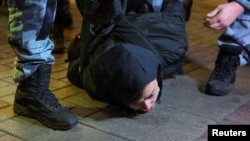
Russia has continued to show blatant disregard for human rights both in its unprovoked war against Ukraine and in the treatment of its own citizens over the past year, the U.S. State Department has said in its latest annual report on human rights around the globe, which also highlights the abuses committed by Iran's theocratic regime and the Taliban's mistreatment of Afghans -- especially its discrimination against women and girls.
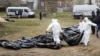
Russian troops continued to commit numerous abuses and atrocities, some amounting to war crimes, the report says, highlighting the issuance by the International Criminal Court of arrest warrants for Russian President Vladimir Putin and his children's rights commissioner, Maria Lvova-Belova, for their role in the forced deportation of Ukrainian children to Russia.
"There were credible reports of summary execution, torture, rape, and attacks killing and injuring civilians and damaging or destroying civilian infrastructure by Russia's forces in Ukraine, as well as war crimes, including those involving forced deportation or transfer of civilians, and the forced placement in foster care or adoption of Ukrainian children," the report notes.
At home, Russian authorities continued to step up the pressure on dissent and independent expression, imprisoning political opponents and anti-war protesters, clamping down on the media, prosecuting numerous people for expressing their opinions online, and forcibly closing down nongovernmental organizations.
More moves were made to persecute opposition politicians such as the sentencing of Vladimir Kara-Murza to 25 years in prison on charges including treason and the slapping of an extra 19 years for "extremism" on the already imprisoned Aleksei Navalny, who subsequently died under suspicious circumstances in February in a penitentiary in Russia's Arctic region.
"Tragically, as we saw with Aleksei Navalny's unjust imprisonment in a Russian penal colony, incarceration can come with horrific conditions -- with abuse, even death," Secretary of State Antony Blinken said on April 22 while presenting the report.

The report also highlights a multitude of other human rights abuses committed by Russian authorities on Russia's territory and abroad, such as, but not limited to, arbitrary or unlawful killings, including extrajudicial killings; enforced disappearances; pervasive torture or cruel, inhuman, or degrading treatment by the government; harsh and life-threatening prison conditions; arbitrary arrest or detention; and serious problems with the independence of the judiciary.
Harsh Punishments Meted Out In Iran
Brutal human rights abuses continue to take place and even worsen in Iran, where women and members of marginalized communities bear the brunt of the regime's human rights violations and abuses, the report says, highlighting the harsh punishment meted out to prisoners, including executions, for bogus or unjust reasons.
"Women continued to face discrimination, including through enhanced means for enforcing the mandatory dress code, which led to acts of civil disobedience," the report says, adding that many people have reportedly disappeared during extended protests that were triggered by the death of 22-year-old Mahsa Amini in the custody of morality police in September 2022.
The number of executions was up by more than one-third last year compared to 2022, with 798 people being put to death, some of them political dissidents.
"The government often charged political dissidents with vague crimes, some of which carried the death penalty, such as 'antirevolutionary behavior,' 'corruption on earth,' 'siding with global arrogance,' 'waging war against God,' and 'crimes against Islam,'" the report notes.
The Iranian regime is also guilty of serious violations outside its borders, which include enabling abuses by terrorist groups throughout the region by the Syrian government, Iran-aligned militia groups in Iraq, and Yemeni Huthi militants, as well as the unlawful recruitment or use of child soldiers, the document said.
Systemic Mistreatment, Discrimination In Afghanistan
In Afghanistan, the Taliban has resorted to systemic mistreatment of and discrimination against Afghanistan’s women and girls since it returned to power in August 2021 following the hasty withdrawal of U.S.-led forces.
"In Afghanistan, the Taliban have limited work opportunities for women, shuttered institutions found educating girls, and increasing floggings for women and men accused of, quote, 'immoral behavior,' end quote," Blinken said.
The report says Taliban authorities have issued more than 50 pieces of legislation "that effectively erase women from public life."
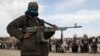
The Taliban authorities have shown continuous and widespread "disregard for the rule of law and official impunity for those responsible for human rights abuses," the document says, adding that both the Taliban and their current arch-foe, the Islamic State group, have been using child soldiers.
Taliban spokesman Zabihullah Mujahid on April 23 pushed back against the criticism, emphasizing the Taliban's commitment to upholding Shari'a law, which he argued defines and guarantees the rights of Afghan citizens based on their wishes.
"The Islamic Emirate of Afghanistan has a Shari'a and Islamic obligation to give the rights of its citizens," Mujahid said on state-controlled RTA Radio. "When America or other Western countries talk about rights, they should not impose Western culture on other countries. What is defined as rights in America may not be the same in Afghanistan."
Referring to the ongoing war in Gaza that was triggered by an October 7 attack on Israel by Hamas, which has been designated a terrorist organization by the United States and the European Union, the report notes "serious abuses...by Hamas and Israel."
It says those abuses include unlawful or widespread civilian deaths and harm, enforced disappearances or abductions, torture, as well as "violence or threats against journalists."
The Azadi Briefing: Taliban Deals Another Blow To Afghan Media
Welcome to The Azadi Briefing, an RFE/RL newsletter that unpacks the key issues in Afghanistan. To subscribe, click here.
I'm Abubakar Siddique, senior correspondent at RFE/RL's Radio Azadi. Here's what I've been tracking and what I'm keeping an eye on in the days ahead.
The Key Issue
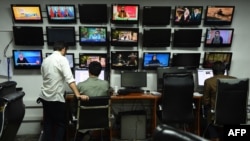
As part of its widening crackdown on the media, the Taliban’s hard-line government has shut down two television stations.
On April 16, the media complaints commission within the Taliban's Information Ministry ordered the immediate suspension of the broadcasts from the Noor and Barya channels.
Commission members said the stations were shut for "violating Afghan and Islamic values and journalistic principles.”
A Taliban court will now decide whether the suspension can be lifted or turned into a permanent ban.
Jamiat-e Islami owns Noor TV, while Hizb-e Islami runs Barya. Both are leading Islamist groups who have opposed the Taliban. These stations ran Islamic programs.
Since it emerged as a ragtag militia in the mid-1990s, the Taliban has opposed and fought against the two groups, which it held responsible for the vicious civil war following the demise of Afghanistan’s pro-Soviet socialist government in 1992.
Why It's Important: The ban is a clear manifestation of the Taliban’s intent to outlaw media that does not conform to its Islamist ideology and worldview.
With the suspension of the stations, the Taliban is indicating that there is no space even for media outlets that are ostensibly Islamic and which cannot be accused of immorality or debauchery.
"This is worrying,” Samia Walizadeh, the head of the Afghanistan Journalists Center (AFJC), an independent media watchdog, told RFE/RL'S Radio Azadi. “The reasons given by the [Taliban] commission for suspending the broadcasts of these two media outlets are unacceptable."
Saddiqullah Tohidi, a press freedom activist, agreed. He said that the Taliban closed the two stations without even bothering to first prove their accusations.
“In a country that lacks a constitution, how can you prove a violation of national interests and Islamic principles?” he asked. “Afghanistan has turned into one of the most censored nations.”
What's Next: The Taliban is forging ahead to create a media environment that only reflects its views and serves its interests.
The extremist Islamist group ultimately aims to replace all journalism with propaganda. It attempts to achieve this by closing or outlawing independent Afghan media and discouraging or banning international press outlets from covering Afghanistan.
Fading international interest in the country provides a more conducive atmosphere for the Taliban to achieve its ideological goals.
What To Keep An Eye On
Statistics issued by the Taliban-led government show a drop in Afghanistan's exports and an increase in imports.
On April 16, the Taliban’s National Statistics and Information Authority released figures showing a nearly 20 percent decline in exports in the first three months of this year -- to $134 million from $176 million during the same period last year.
The country’s imports, however, surged from $694 million during the first quarter of last year to $793 million this year.
A recent World Bank report on the Afghan economy recorded similar trends.
Experts attribute the decline to the Taliban’s tense relations with neighboring Pakistan, which is one of its leading trading partners. Islamabad also provides ports to the landlocked nation.
"Pakistan closed its border crossings while pomegranates and other fruit crops were ready for export," said Khan Jan Alakozai, a senior official of the Afghanistan-Pakistan Joint Chamber of Commerce.
He said coal prices also plummeted in the same period, impacting Afghanistan's export earnings.
Why It's Important: Afghan macroeconomic trends might continue to deteriorate if the Taliban's relations with Pakistan do not improve.
Tehran's ongoing standoff with Israel threatens the alternative import route the Taliban wants to build through Iran.
That's all from me for now. Don't forget to send me any questions, comments, or tips that you have. You can always reach us at azadi.english@rferl.org
Until next time,
Abubakar Siddique
If you enjoyed this briefing and don't want to miss the next edition, subscribe here. It will be sent to your inbox every Friday. You can always reach us at azadi.english@rferl.org
Dozens Dead From Flooding In Pakistan, Afghanistan
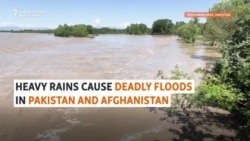
Heavy snowmelt and torrential rains have caused deadly floods around Pakistan's Peshawar and in Afghanistan's Farah Province. Dozens have died, crops were lost, and more than 2,000 homes were damaged or destroyed. The flooding follows an unusually mild winter.
Death Toll Mounts In Afghanistan, Pakistan As Heavy Rains Exacerbate Flash Flooding
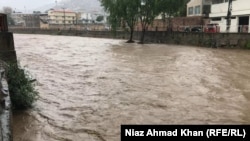
Flash flooding hits Pakistan's Swat Valley as torrential rains continued to fall.
Pakistan and Afghanistan are both struggling with rising rivers and flash flooding that killed nearly 140 people in four days.
The death toll continued to rise in Afghanistan and Pakistan from heavy rains and flash flooding that claimed nearly 140 lives in four days.
- By AFP
Taliban Pulls 2 TV Channels For 'Violating Islamic Values'
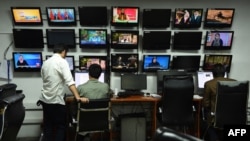
Two Afghan television channels have been taken off the airwaves for "violations against Islamic and national values," a spokesman for the Taliban-led government said on April 18. Rights monitors warn that the Taliban authorities have been cracking down on media freedoms since their return to power in 2021 as they enforce an austere vision of Islamist rule. Culture Ministry spokesman Khubaib Ghufran said the Barya and Noor TV channels had been suspended on April 16 for failing to abide by "journalistic principles." "They had programs creating confusion among the public and their owners are abroad," he told AFP. "The media violation commission suspended their operations."
Iran's Afghan Community Worried About Prospect Of War With Israel
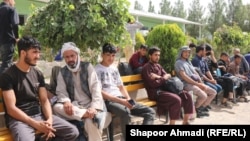
Many in Iran are worried about the prospect of a war with Israel and the possible impact on the country’s faltering economy.
That includes members of Iran’s large community of Afghan refugees and migrants, one of the most vulnerable groups in society.
Experts have warned that a full-scale war is a possibility in the wake of Iran’s unprecedented attack on Israel on April 13.
Afghans in Iran, speaking to RFE/RL’s Radio Azadi, described a wartime atmosphere in Iran since Tehran’s first-ever direct attack against Israel.
They also said the authorities have intensified their crackdown on undocumented Afghans, many of whom fled war, poverty, and persecution in Afghanistan.
"This situation is alarming for all Afghan migrants in Iran," said Omid Poya, an exiled Afghan journalist living in Iran. "Those who don’t have legal documents [to stay in Iran] don’t even leave their houses anymore.”
An Afghan migrant, who spoke on condition of anonymity for fear of retribution, said “Iranian cities are in an emergency-like situation” since the April 13 attack, referring to the deployment of additional law enforcement officers on the streets. This, he said, has “forced many of us to worry about our future.”
An estimated 4.3 million Afghans currently live in Iran, according to the UN. More than 1 million have been deported in the past year as part of Tehran’s plan to expel all undocumented Afghans.
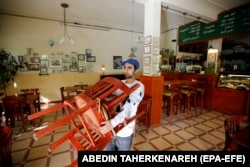
Afghans suffer widespread abuse and discrimination in Iran, where they have often been blamed for insecurity and unemployment.
Life More Difficult
Many Afghans are worried that a possible war between Iran and Israel will worsen the already dire economic situation in the Islamic republic, which has witnessed soaring inflation, rising unemployment, and growing poverty in recent years.
Following Iran’s April 13 attack, the national currency, the rial, plummeted to a new record low against the U.S. dollar.
That has had a direct impact on the livelihoods of Afghans and how much money they can send back to their families in Afghanistan.
"Life has become more difficult after the dollar rose against the Iranian currency," said Azizgul Afghan Beg, an Afghan living in Tehran. "Our main concern is where we will escape if a war breaks out here.”
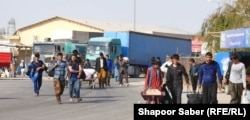
An estimated 70 percent of the estimated 3.6 million Afghans who have fled their homeland after the Taliban seized power in 2021 moved to Iran.
Afghans, including journalists, activists, and former soldiers and police officers, said they fear being forced to flee Iran and return to their homeland.
“Our lives will be in danger," Qadariah Rezaei, said an Afghan rights campaigner residing in Iran. Afghans would pay a “heavy price” if Tehran becomes embroiled in a conflict with Israel, she said.
Other Afghans say they are contemplating returning to Afghanistan.
"It is better to return to our homeland because of the mounting worries over war and the sharp slump in employment,” said Shamsul Rahman, an Afghan living in the southeastern city of Kerman.
Written by Abubakar Siddique based on reporting by RFE/RL’s Radio Azadi.
- By AFP
70 killed As Afghanistan Hit By Heavy Rains
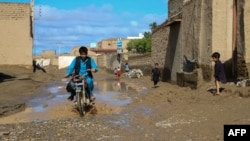
Around 70 people have been killed by heavy rains lashing Afghanistan over the past five days, the government's disaster management department said on April 17. Afghanistan was parched by an unusually dry winter, which desiccated the earth, exacerbating flash flooding caused by spring downpours in most provinces. Disaster management spokesman Janan Sayeq said "approximately 70 people lost their lives" as a result of rains between April 13 and April 17.
Flash Flooding Kills At Least 33 People In Kabul, Other Afghan Regions
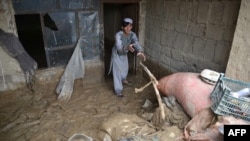
Flash flooding caused by heavy rains has destroyed hundreds of homes and killed at least 33 people over the past three days in the Afghan capital, Kabul, and across the country, the de facto Taliban rulers said on April 14. "Unfortunately, 33 people have been martyred and 27 injured as a result of the floods, while approximately 606 houses have been destroyed in villages," Taliban spokesman Mullah Janan Sayiq said. A resident of the village of Bast in Helmand Province who did not want to be identified told RFE/RL that "the floods have destroyed our agricultural lands and houses, our animals have been destroyed. Our area is between two rivers." To read the original story by RFE/RL’s Radio Azadi, click here.
- By Omid Marzban and
- Michael Scollon
Facebook Restrictions The 'Last Nail In The Coffin' For Free Speech In Afghanistan

Facebook users in Afghanistan fear the Taliban's plans to block or restrict access to the popular social-media platform will deal a death blow to what is left of free speech in the country.
It is unclear what exactly the "finalized" policy announced last week will entail or how it will be implemented and enforced, but Afghans are bracing for the worst-case scenario.
"This is really the last nail in the coffin of freedom of speech," Fatema, a Facebook user in Afghanistan, told RFE/RL's Radio Azadi.
"Facebook was the only source where most of the news that is censored in the Afghan domestic media was published without censorship," she said, providing only her first name due to fear of retribution from the Taliban's hard-line Islamist government.
In announcing the impending move to counter what it called the distracting influence of social media, the Taliban cited the need for young people to focus on their education.
"Our youth are in a situation where they are academically weak and the majority of them are illiterate, yet they continue to waste their time and spend money on these things to the benefit of the company and the detriment of the nation," Najibullah Haqqani, the Taliban's minister of telecommunications and information, said in an interview with the private Tolo News channel on April 6.
Facebook has emerged as a major social-media platform in Afghanistan, with an estimated 4.5 million users in the country of some 40 million people. Many rely on Facebook for unfiltered information and, particularly for women and girls, to continue their pursuit of an education denied to them by the Taliban.
WATCH: Two exiled Afghan women have told RFE/RL that the Taliban appears to be further tightening restrictions on women and girls in Afghanistan.
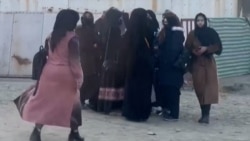
Media watchdogs say that any effort to curtail access to Facebook would have a devastating effect in an already heavily censored media landscape.
"The Taliban's plan to restrict or block access to Facebook would be a further blow to freedom of information in Afghanistan," Beh Lih Yi, Asia program coordinator for the Committee to Protect Journalists (CPJ), said in a statement. "Social-media platforms, including Facebook, have helped to fill a void left by the decline of the Afghan media industry since the Taliban's August 2021 takeover and the ensuing crackdown on press freedom."
The CPJ statement said that when questioned, Taliban spokesman Zabihullah Mujahid told the U.S.-based media watchdog that "Facebook will not be banned, but restrictions will be imposed on it."
In any event, the CPJ said, the proposal "highlights the worsening censorship by the Taliban."
The Taliban's Telecommunications and Information Technology Ministry did not respond to questions from Radio Azadi asking for specifics about the new policy and when it will come into force.
Since regaining power, the Taliban has reversed the free-media gains that were made after the first Taliban regime was ousted by the U.S.-led invasion in 2001.
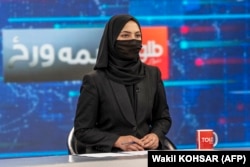
Despite its early promises to protect the independent media, the Taliban has waged a violent crackdown on dissent. Television and radio stations have encountered sustained pressure to end entertainment and educational programming that does not fit with the hard-line leadership's strict interpretation of Islamic law. Female television presenters are required to wear face masks on air and are barred from conducting interviews with male government officials or from participating in press conferences without a male chaperone.
Women and girls have meanwhile seen their access to education severely impeded, again despite the Taliban's early pledges. Girls are not allowed to attend school past the sixth grade, while women have been banned from going to university.
Female teachers are barred from teaching male students, and encounter difficulties leaving their homes for work at all due to the Taliban's restrictions on women being in public without a male escort.
With many teachers and journalists fleeing the country due to the obstacles to their work, many Afghans turned to inclusive radio and television programs that provided students a lifeline to continue their studies and for unrestricted media and discussion of social issues. Facebook, by providing access to outside news and educational courses often catered to women and girls, became a crucial tool.
The Taliban has already taken steps to curtail traditional media from continuing with such programming. In February, for example, police in the eastern Khost Province banned girls from contacting local radio and television stations and warned such outlets against taking calls from girls.
The Taliban cited the potential for such outreach to promote "inappropriate behavior" among audiences as justification for the move, which was enforced with warnings of punishment and shutdowns against media that did not comply.
Now the Taliban appears to have focused its attention on Facebook, which hosts a wealth of pages dedicated to women's rights and education, Afghan news and society, and allows for discourse among users.
Spozhmai Gharani, a Facebook user, said the social-media platform is one of the few ways for Afghan girls to continue their education, and "should not be shut down."
Homa Rajabi, from Kabul, said that without the ability to share views and collect information on Facebook, life in Afghanistan "will become more limited and narrow."
Kamal Sadat, who served as a deputy minister of information and culture in the previous, Western-backed government, told Radio Azadi that any restrictions on Facebook would be a "strong blow to freedom of expression."
The move, he said, would cut the Afghan people off from a crucial and increasingly rare way to "express their voices to the world, Afghan authorities, and international organizations."
Facebook has blacklisted the Taliban for years, and since the militant group took power in 2021, the platform has reportedly maintained a loose ban on Taliban content. References and posts that promote the Taliban are removed, while official Taliban posts that serve the public good, such as the de facto Health Ministry's directives related to natural disasters, have been allowed.
Asif Ashna, a frequent critic of the Taliban's unrecognized government, took to a social-media platform that the Taliban itself relies on heavily to promote itself to air his criticism of the new policy. Ashna suggested that the Taliban may have targeted Facebook in retaliation for restrictions the U.S.-based social-media company has placed on its content.
"Why is this ignorant group hostile to Facebook?" Ashna asked in a post that included a clip of Haqqani's Tolo News appearance. "The bottom line is that Facebook has blocked thousands of official and pseudonymous accounts related to the Taliban and put this group on its blacklist."
"Now the Taliban has decided to do the same thing to Facebook," Ashna wrote. "The rest of the arguments [made by the Taliban for targeting Facebook] are bullshit."
Whether the Taliban can actually succeed in banning or curtailing Facebook is open to debate.
Experts say that the Taliban does not have the technological infrastructure in place to cut Afghanistan off from the global Internet and force its citizens to use a domestically designed "intranet," as Iran and China have attempted to do.
"No, never. They cannot do that," Jamil Nematyar, a cybersecurity expert who worked for the former Afghan government told Radio Azadi in a video interview. "It is not possible for them. The existing infrastructure is not capable of this."
Instead, Nematyar and other experts say the Taliban must rely on pressuring private companies to enforce any policy decisions or laws that would target Facebook.
The Taliban's control over the country's telecommunications infrastructure does give its government leverage in this regard by forcing mobile telecoms operators or Internet service providers (ISPs) to block specific websites, and by filtering the domain name system (DNS) that determines specific Internet protocol (IP) addresses.
"It is common to use the worldwide web to control the flow of information" in Afghanistan, Agha Malok Sahar, founder of Darrak, a GPS tracking and software company that works in Afghanistan, told Radio Azadi.
There is precedent for banning foreign news outlets in the country, including the websites of Radio Azadi, the Afghan service of the congressionally funded RFE/RL. But as CPJ notes, the Facebook pages of Radio Azadi and other foreign news outlets such as Britain's BBC and Germany's Deutsche Welle are still accessible to readers inside the country despite being officially banned.
Sahar said that in the event of a complete ban, the Taliban authorities could also go after individuals and media outlets that are active on Facebook by "monitoring their activities, potentially harassing or penalizing them."
Such an approach, Sahar said, could "involve arrests or other forms of intimidation to discourage the use of Facebook" and be accompanied by Taliban propaganda efforts "to discredit these outlets or individuals."
But restricting or outright banning Facebook would be a tough task for the Taliban. "This would be a difficult law to actually enforce," Darren Linvill, co-director of the U.S. Clemson University's Media Forensics Hub, told RFE/RL in written comments.
"There are a large range of ways individuals have to skirt such restrictions. Any teenager can learn to pretend their computer is somewhere in the EU so that they can get different options out of Netflix," he said. "China has difficulty enforcing the Great Firewall. I'm sure Afghanistan would face similar problems."
Elsewhere around the world, people have found a workaround to local restrictions by using virtual private networks (VPNs) that allow users to mask the area or country they are in.
Ultimately, Nematyar said, "people will go to VPNs and it will make more headaches for the nation and the current regime" in Afghanistan.
"Facebook will be working, through VPNs," Nematyar said, although Afghans' use of the social-media platform might be closely followed by the Taliban authorities.
Written by Michael Scollon based on reporting by RFE/RL's Radio Azadi
RFE/RL has been declared an "undesirable organization" by the Russian government.
If you are in Russia or the Russia-controlled parts of Ukraine and hold a Russian passport or are a stateless person residing permanently in Russia or the Russia-controlled parts of Ukraine, please note that you could face fines or imprisonment for sharing, liking, commenting on, or saving our content, or for contacting us.
To find out more, click here.
Editor's Picks





Afghanistan/Pakistan Trending
What's Behind The Deadly Surge Of Violence In Pakistan's Balochistan?
2Russia Inches Toward Marriage Of Convenience With Taliban In Terror Fight
3Facebook Restrictions The 'Last Nail In The Coffin' For Free Speech In Afghanistan
4'One-Party Rule': Taliban Wages Crackdown On Political Parties
5Iran's Afghan Community Worried About Prospect Of War With Israel
6This Is What It's Like To Be A Journalist Under Taliban Rule
7Afghanistan's Only Female Diplomat Resigns In India After Gold-Smuggling Allegations
87 Killed In Attack On Afghan Mosque
9Flash Flooding Kills At Least 33 People In Kabul, Other Afghan Regions
10Taliban Pulls 2 TV Channels For 'Violating Islamic Values'
Subscribe