

The strike that changed the world began around dawn on 14 August 1980.
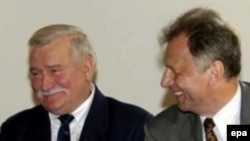
Some 17,000 workers seized control of the Lenin Shipyard in Gdansk to protest, among other things, a recent rise in food prices. Their leader, Lech Walesa, had narrowly avoided arrest by secret police that morning, and had managed to scale the shipyard gate and join the workers inside. Soon, workers in 20 other area factories joined the strike in solidarity.
Seventeen days later, after negotiations with Poland's Communist government, the burly, mustachioed Walesa appeared before the workers in the shipyard with an historic message: "We have an independent, self-governing trade union! [crowd cheers] We have the right to strike!"
Walesa and Poland's first deputy prime minister, Mieczyslaw Jagielski, had signed a deal granting the workers their main demands: the right to organize freely and to strike. Those were rights accorded under conventions by the International Labor Organization, of which Poland was a signatory. But this was the first time that any Communist government had put them into practice.
The workers had other demands, such as better wages and benefits, posted in a list of "21 postulates" on the shipyard door. But none was as crucial as the right to organize and strike.
Radek Sikorski, a former deputy foreign and defense minister of postcommunist Poland, was a high school student at the time of the Gdansk accord. He recalled the famous day in an interview with RFE/RL.
"[There was] tremendous hope and a kind of electricity between people. You know, it's said that we Poles become a nation once a generation, just like we did recently when the pope died, and that was one of those moments when, suddenly, millions of people felt that they wanted the same thing, which was free trade unions to represent them against the [Communist] Party. It gave people hope that perhaps communism could be reformed. We now know that it couldn't," Sikorski said.
In September 1980, the Independent Self-Governing Trade Union Solidarity -- or NSZZ Solidarnosc -- was officially formed. Over the next 15 months, the union's membership grew from 1 million to 9 million people -- a quarter of the country's population.
But across the Russian border, Poland's Soviet masters were growing increasingly alarmed. And in early December 1981, the Warsaw Pact issued a statement at a summit in Moscow stating "fraternal solidarity and support" with Poland's communist leaders in overcoming what it called the country's "present difficulties."
Days later, on 13 December, General Wojciech Jaruzelski, the Polish prime minister, declared martial law and outlawed Solidarity. The military, in a plan hatched over the previous months, arrested most of Solidarity's leaders, including Walesa.
Walesa would spend nearly a year in jail. And for the next seven years, he would be under constant watch and harassment by secret police. When he won the Nobel Peace Prize in 1983, he sent his wife to collect the award in Oslo, fearing he would not be let back into the communist country.
In the long, dark period leading up to the radical changes of 1989, Solidarity worked in the underground. But, as Sikorski recalls, it never wavered from one its key principles -- nonviolence.
"It was a peaceful movement which actually realized all its objectives and more. So I think the path of nonviolence is certainly an important Solidarity legacy. And if you look at what happened in other countries -- in the Czech Republic, and more recently in Serbia or in Ukraine -- that message has been successfully imitated," Sikorski said.
Solidarity's underground efforts were also greatly aided by financial help from American trade unions, as well as moral support from Pope John Paul II.
The pope published a major text -- the encyclical "On Human Work" -- and met with Walesa in 1983 for talks that made international headlines. Both acts, as well as the strategic partnership between the Polish Catholic Church and Solidarity, lent powerful legitimacy to the movement.
Bronislaw Geremek, now a member of the European Parliament, was one of the leading intellectuals of the Solidarity movement. In an interview with RFE/RL, Geremek noted that Solidarity's success was a result of a "new human relationship" in Polish society among church leaders, workers, farmers and intellectuals.
"One should see this phenomenon in the larger context. This context is first of all the lesson of the 1979 visit of Pope John Paul to Poland. Not only the message of John Paul -- ‘Don't be afraid,' which was a very powerful message -- but also the experience of the organization of the pope's visit. The organization was assured, in all cities in which the pope paid a visit, by civilians -- by a special guard formed by workers, people from the intelligentsia -- [who were] able to organize themselves," Geremek said.
Further moral support came from Western governments, in particular the United States and Britain, which along with international agencies refused to grant debt-ridden Poland economic aid until it legalized Solidarity.
The movement got a major morale boost in November 1988, when Jaruzelski hosted British Prime Minister Margaret Thatcher. A fierce anticommunist, Thatcher lashed out at Jaruzelski at a state banquet, saying Poland's depressed economy would improve only after freedom and liberty were restored.
She also visited outlawed Solidarity's leaders in Gdansk, telling 5,000 workers: "Nothing can stop you." And at a dinner with union leaders, Britain's "Iron Lady" urged them to forge a practical plan to freedom.
"How do you see the process from where you are now to where you want to be? Because whatever you want to do, it's not only what you want to do, but how, in a practical way, you see it coming about," Thatcher said.
But the reality was that Solidarity, and Polish society, had already found their way.
Faced with intense social and economic pressure, Jaruzelski finally agreed to talks with Solidarity in early 1989. Two months later, after historic roundtable talks, the two sides signed a 400-page agreement on sweeping political and economic reforms that officially recognized Solidarity.
In June 1989, in the first free elections ever in the communist bloc, Solidarity won the maximum number of seats allowed in both houses of parliament. And with two smaller parties, it formed the first non-Communist government in the Soviet bloc.
Six months later, the Berlin Wall came crumbling down.
See also:
Key Figure In Transition To Democracy Remembers Solidarity