



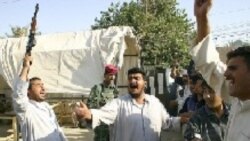
As al-Sadr publicly appealed for calm on 25 August, many began to question the apparently coordinated attacks that left the cleric's militia, the Imam Al-Mahdi Army, battling with police and militias supporting the two main Shi'ite political parties -- the Supreme Council for the Islamic Revolution in Iraq (SCIRI) and the Islamic Al-Da'wah Party.
Al-Sadr and his supporters were reportedly poised on 24 August to launch demonstrations across Iraq against the draft constitution, expected to be sent to referendum by the National Assembly. Al-Sadr spokesman Jalil Musawi discussed his group's position on the draft that day, saying: "We are ready by a single phone call within a minute to defeat the constitution by voting against it in six provinces: Al-Diwaniyah, Samawah, Al-Nasiriyah, Al-Amarah, Al-Basrah, and Sadr City in Baghdad," washingtonpost.com reported on 25 August.
The fighting that broke out appears to be more a coordinated push by al-Sadr and his supporters than a random spread of violence across Iraq's Shi'ite-dominated south. The timing of the incidents -- at least on the surface -- points to a concerted effort to thwart the constitutional process, particularly after some 21 parliamentarians and the Health and Transport ministers suspended their work and threatened to resign in protest against what they deemed attacks against al-Sadr and his followers.
However, in Al-Najaf, the clashes appear to derive from local residents' objections to the reopening of the Martyr Al-Sadr office. The office had been closed for nearly a year (see "RFE/RL Iraq Report," 27 August 2004) after Shi'ite Grand Ayatollah Ali al-Sistani put an end to al-Sadr's standoff against U.S. and Iraqi forces in the holy city in August 2004.
Demonstrators reportedly set fire to al-Sadr's office on 24 August, and the clashes spread to other cities -- with al-Sadr militiamen setting fire to SCIRI and Al-Da'wah offices in Baghdad and Al-Amarah. Clashes also erupted in Al-Basrah, Samawah, Al-Diwaniyah, Al-Nasiriyah, and Al-Hillah on 24 August; and in Ba'qubah on 25 August, RFE/RL's Radio Free Iraq (RFI) reported.
Al-Sadr has had a hostile relationship with SCIRI and Al-Da'wah since the fall of the Hussein regime, when the leaderships of both parties -- along with many of their supporters -- returned to Iraq in the days after the U.S.-led invasion of Iraq began. To al-Sadr, whose family remained in Iraq during Saddam Hussein's rule (his father and two brothers were reportedly killed on Hussein's order in 1999), SCIRI and Al-Da'wah were outsiders, aligned with the United States, and out of touch with the needs of Iraqis, and their leaders did not deserve the power awarded to them in the 2003 Governing Council and subsequent administrations.
SCIRI and Al-Da'wah also opposed al-Sadr's standoff against U.S. and Iraqi forces in Al-Najaf last year, and SCIRI's Badr forces played a role in spurring public protests against his militia's presence there and its control over the Imam Ali Shrine.
Moreover, al-Sadr has competed with the two groups -- but SCIRI in particular -- for public support and control over the streets in many southern Iraqi cities since 2003. Both groups have also tried to assert local control by infiltrating police and security forces in Iraq.
Al-Sadr And The Constitution
Al-Sadr stood opposed to the 2004 interim government and refused to take part in the January 2005 national elections on the grounds that they were carried out under occupation and therefore not legitimate. He did however, allow a number of his supporters to take part in the elections as independent candidates.
As details of the draft constitution began emerging in recent weeks, al-Sadr vehemently voiced his opposition to federalism. Al-Sadr aide Shaykh Abd-al-Zahrah al-Suway'idi told demonstrators who took to the streets of Baghdad's Al-Sadr City following Friday prayers on 19 August of the dangers of federalism, Baghdad's "Al-Furat" reported on 21 August. "We believe that the implementation of federalism will tear apart and divide Iraq, especially when Iraq is under occupation and in the presence of such incomplete sovereign Iraqi governments," al-Suway'idi told demonstrators. He also contended that the United States believes federalism will help it maintain its hold on Iraq, adding that the call for federalism in the draft constitution stands as an ominous sign that will lead to sectarian wars and ethnic sedition.
It appears that al-Sadr's core motive is to drive a wedge between the Shi'a in an effort to have the draft constitution shot down, thus providing an opportunity for a new constitution that is more in line with his own goals for an Islamist state in Iraq.
When speaking to reporters on 25 August, al-Sadr appealed to all Iraqi Muslims, saying: "I ask them not to serve Western plots that seek to divide Muslims, be they Sunnis or Shi'ites.... Iraq is going through a critical phase involving the so-called interim constitution, which is not an Islamic constitution if I may say so.... The occupation prevents us from pursuing any political activities or activities that benefit the Iraqi people because the occupation sows sedition amongst the faithful."
The Sunni Factor
While al-Sadr stands opposed to the former Ba'athist regime, he has built a relationship with the Sunni opposition on the common ground of opposition to the occupation and to the ongoing political process in Iraq. Al-Sadr supporters have worked alongside Sunnis in Kirkuk to reject Kurdish demands for a return of Kurds displaced from Kirkuk under the Hussein regime, and against Kurdish attempts to incorporate Kirkuk into the Kurdish region.
For al-Sadr, the alliance brings power vis-a-vis the other Shi'ite groups, and facilitates his goal of becoming the strongest Shi'ite leader in Iraq.
Sources in Iraq have confirmed to RFE/RL the existence of an alliance between al-Sadr and Sunnis in other areas of the country. For Sunnis, al-Sadr is a pawn in their attempt to break SCIRI and Al-Da'wah's political stronghold. Such techniques were the modus operandi of the Hussein regime -- maintaining control through the manipulation and fractionalization of opposing groups.
Abd al-Salam al-Kubaysi, a Sunni leader and member of the influential Muslim Scholars Association, confirmed that group's relationship with al-Sadr during a 24 August press briefing (see "RFE/RL Newsline," 25 August 2005). "Yes, there is coordination [with al-Sadr]," he told reporters. "A meeting was held...[on 23 August] to coordinate this issue. This shows that there are two categories in Iraq. The first is with occupation and the second is against occupation. The [second] includes Shi'ites, Kurds, Sunnis, and Turkomans." Al-Kubaysi also cited a meeting he held with al-Sadr last week in Al-Najaf in which al-Sadr voiced his opposition to the constitution.
Reports surfaced last year that al-Sadr was also connected with the Ansar Al-Sunnah Army. Ansar leader Abu Abdallah al-Hassan bin Mahmud told the Beirut political weekly "Al-Muharrir" in an August 2004 interview that the cooperation was based on a directive from al-Sadr's father, Grand Ayatollah Muhammad Sadiq al-Sadr, that said if he was martyred his sons should "follow the fatwas of Al-Sayyid [Kazim] al-Ha'iri and Shaykh Ahmad al-Kubaysi. You must unite with the Sunnis." Subsequently, the Ansar al-Sunnah and the Imam Al-Mahdi Army reportedly exchanged personnel. "Therefore, the relationship can be described as intimate," Abu al-Hassan said (see "RFE/RL Iran Report," 13 September 2004).
Al-Sadr And The Iran-Syria Nexus
Muqtada al-Sadr reportedly has close ties with Iran and, by default, Syria as well. The cleric traveled to Iran in 2003, and met with Expediency Council Chairman Ayatollah Ali-Akbar Hashemi-Rafsanjani (see "RFE/RL Iran Report," 9 June 2003). The relationship between the regime and al-Sadr has since been kept largely under wraps, but the U.S. State and Defense departments, as well as military officials, have said that money, arms, and even personnel were funneled to al-Sadr from Iran last year (see "RFE/RL Iran Report," 27 September 2004).
Al-Sadr supporter and Transportation Minister Salam al-Maliki -- one of the ministers who suspended his work in support of al-Sadr on 25 August -- defended Syria while in Damascus this week, telling reporters that Syria has no role in Iraq's insurgency.
Last week, the website Sawt Al-Iraq (http://www.sotaliraq.com) published a report citing an unidentified senior ex-officer from the Hussein regime as saying that Iran and Syria are preparing to launch a coup in Iraq at the start of Ramadan this October.
The officer claimed that the action is to begin with a surge of suicide bombings and the targeting of power and water networks, along with demonstrations against the al-Ja'fari government. Agents of Iran and Syria, along with former Iraqi intelligence, are to don police uniforms and infiltrate police units on the streets -- opening fire on demonstrators -- in an effort to spark more demonstrations, according to the website.
The infiltrators, wearing police and National Guard uniforms, are to then enter the Green Zone, "get it under control, kill everyone there, and establish a military government." The report, while unsubstantiated, supports the two states' goals toward self-preservation, and their desire to use whatever means -- be it an alliance with the Shi'a or an alliance with former Ba'athists -- to obstruct any progress in Iraq.
Al-Sadr and his supporters were reportedly poised on 24 August to launch demonstrations across Iraq against the draft constitution, expected to be sent to referendum by the National Assembly. Al-Sadr spokesman Jalil Musawi discussed his group's position on the draft that day, saying: "We are ready by a single phone call within a minute to defeat the constitution by voting against it in six provinces: Al-Diwaniyah, Samawah, Al-Nasiriyah, Al-Amarah, Al-Basrah, and Sadr City in Baghdad," washingtonpost.com reported on 25 August.
The fighting that broke out appears to be more a coordinated push by al-Sadr and his supporters than a random spread of violence across Iraq's Shi'ite-dominated south. The timing of the incidents -- at least on the surface -- points to a concerted effort to thwart the constitutional process, particularly after some 21 parliamentarians and the Health and Transport ministers suspended their work and threatened to resign in protest against what they deemed attacks against al-Sadr and his followers.
However, in Al-Najaf, the clashes appear to derive from local residents' objections to the reopening of the Martyr Al-Sadr office. The office had been closed for nearly a year (see "RFE/RL Iraq Report," 27 August 2004) after Shi'ite Grand Ayatollah Ali al-Sistani put an end to al-Sadr's standoff against U.S. and Iraqi forces in the holy city in August 2004.
The timing of the incidents -- at least on the surface -- point to a concerted effort to thwart the constitutional process.
Demonstrators reportedly set fire to al-Sadr's office on 24 August, and the clashes spread to other cities -- with al-Sadr militiamen setting fire to SCIRI and Al-Da'wah offices in Baghdad and Al-Amarah. Clashes also erupted in Al-Basrah, Samawah, Al-Diwaniyah, Al-Nasiriyah, and Al-Hillah on 24 August; and in Ba'qubah on 25 August, RFE/RL's Radio Free Iraq (RFI) reported.
Al-Sadr has had a hostile relationship with SCIRI and Al-Da'wah since the fall of the Hussein regime, when the leaderships of both parties -- along with many of their supporters -- returned to Iraq in the days after the U.S.-led invasion of Iraq began. To al-Sadr, whose family remained in Iraq during Saddam Hussein's rule (his father and two brothers were reportedly killed on Hussein's order in 1999), SCIRI and Al-Da'wah were outsiders, aligned with the United States, and out of touch with the needs of Iraqis, and their leaders did not deserve the power awarded to them in the 2003 Governing Council and subsequent administrations.
SCIRI and Al-Da'wah also opposed al-Sadr's standoff against U.S. and Iraqi forces in Al-Najaf last year, and SCIRI's Badr forces played a role in spurring public protests against his militia's presence there and its control over the Imam Ali Shrine.
Moreover, al-Sadr has competed with the two groups -- but SCIRI in particular -- for public support and control over the streets in many southern Iraqi cities since 2003. Both groups have also tried to assert local control by infiltrating police and security forces in Iraq.
Al-Sadr And The Constitution
Al-Sadr stood opposed to the 2004 interim government and refused to take part in the January 2005 national elections on the grounds that they were carried out under occupation and therefore not legitimate. He did however, allow a number of his supporters to take part in the elections as independent candidates.
As details of the draft constitution began emerging in recent weeks, al-Sadr vehemently voiced his opposition to federalism. Al-Sadr aide Shaykh Abd-al-Zahrah al-Suway'idi told demonstrators who took to the streets of Baghdad's Al-Sadr City following Friday prayers on 19 August of the dangers of federalism, Baghdad's "Al-Furat" reported on 21 August. "We believe that the implementation of federalism will tear apart and divide Iraq, especially when Iraq is under occupation and in the presence of such incomplete sovereign Iraqi governments," al-Suway'idi told demonstrators. He also contended that the United States believes federalism will help it maintain its hold on Iraq, adding that the call for federalism in the draft constitution stands as an ominous sign that will lead to sectarian wars and ethnic sedition.
It appears that al-Sadr's core motive is to drive a wedge between the Shi'a in an effort to have the draft constitution shot down, thus providing an opportunity for a new constitution that is more in line with his own goals for an Islamist state in Iraq.
When speaking to reporters on 25 August, al-Sadr appealed to all Iraqi Muslims, saying: "I ask them not to serve Western plots that seek to divide Muslims, be they Sunnis or Shi'ites.... Iraq is going through a critical phase involving the so-called interim constitution, which is not an Islamic constitution if I may say so.... The occupation prevents us from pursuing any political activities or activities that benefit the Iraqi people because the occupation sows sedition amongst the faithful."
The Sunni Factor
While al-Sadr stands opposed to the former Ba'athist regime, he has built a relationship with the Sunni opposition on the common ground of opposition to the occupation and to the ongoing political process in Iraq. Al-Sadr supporters have worked alongside Sunnis in Kirkuk to reject Kurdish demands for a return of Kurds displaced from Kirkuk under the Hussein regime, and against Kurdish attempts to incorporate Kirkuk into the Kurdish region.
For al-Sadr, the alliance brings power vis-a-vis the other Shi'ite groups, and facilitates his goal of becoming the strongest Shi'ite leader in Iraq.
Sources in Iraq have confirmed to RFE/RL the existence of an alliance between al-Sadr and Sunnis in other areas of the country. For Sunnis, al-Sadr is a pawn in their attempt to break SCIRI and Al-Da'wah's political stronghold. Such techniques were the modus operandi of the Hussein regime -- maintaining control through the manipulation and fractionalization of opposing groups.
Infiltrators, wearing police and National Guard uniforms, are to enter the Green Zone, "get it under control, kill everyone there, and establish a military government."
Abd al-Salam al-Kubaysi, a Sunni leader and member of the influential Muslim Scholars Association, confirmed that group's relationship with al-Sadr during a 24 August press briefing (see "RFE/RL Newsline," 25 August 2005). "Yes, there is coordination [with al-Sadr]," he told reporters. "A meeting was held...[on 23 August] to coordinate this issue. This shows that there are two categories in Iraq. The first is with occupation and the second is against occupation. The [second] includes Shi'ites, Kurds, Sunnis, and Turkomans." Al-Kubaysi also cited a meeting he held with al-Sadr last week in Al-Najaf in which al-Sadr voiced his opposition to the constitution.
Reports surfaced last year that al-Sadr was also connected with the Ansar Al-Sunnah Army. Ansar leader Abu Abdallah al-Hassan bin Mahmud told the Beirut political weekly "Al-Muharrir" in an August 2004 interview that the cooperation was based on a directive from al-Sadr's father, Grand Ayatollah Muhammad Sadiq al-Sadr, that said if he was martyred his sons should "follow the fatwas of Al-Sayyid [Kazim] al-Ha'iri and Shaykh Ahmad al-Kubaysi. You must unite with the Sunnis." Subsequently, the Ansar al-Sunnah and the Imam Al-Mahdi Army reportedly exchanged personnel. "Therefore, the relationship can be described as intimate," Abu al-Hassan said (see "RFE/RL Iran Report," 13 September 2004).
Al-Sadr And The Iran-Syria Nexus
Muqtada al-Sadr reportedly has close ties with Iran and, by default, Syria as well. The cleric traveled to Iran in 2003, and met with Expediency Council Chairman Ayatollah Ali-Akbar Hashemi-Rafsanjani (see "RFE/RL Iran Report," 9 June 2003). The relationship between the regime and al-Sadr has since been kept largely under wraps, but the U.S. State and Defense departments, as well as military officials, have said that money, arms, and even personnel were funneled to al-Sadr from Iran last year (see "RFE/RL Iran Report," 27 September 2004).
Al-Sadr supporter and Transportation Minister Salam al-Maliki -- one of the ministers who suspended his work in support of al-Sadr on 25 August -- defended Syria while in Damascus this week, telling reporters that Syria has no role in Iraq's insurgency.
Last week, the website Sawt Al-Iraq (http://www.sotaliraq.com) published a report citing an unidentified senior ex-officer from the Hussein regime as saying that Iran and Syria are preparing to launch a coup in Iraq at the start of Ramadan this October.
The officer claimed that the action is to begin with a surge of suicide bombings and the targeting of power and water networks, along with demonstrations against the al-Ja'fari government. Agents of Iran and Syria, along with former Iraqi intelligence, are to don police uniforms and infiltrate police units on the streets -- opening fire on demonstrators -- in an effort to spark more demonstrations, according to the website.
The infiltrators, wearing police and National Guard uniforms, are to then enter the Green Zone, "get it under control, kill everyone there, and establish a military government." The report, while unsubstantiated, supports the two states' goals toward self-preservation, and their desire to use whatever means -- be it an alliance with the Shi'a or an alliance with former Ba'athists -- to obstruct any progress in Iraq.