



Maskhadov proved unable to rein in renegade former fellow commanders who in the summer of 1999 invaded neighboring Daghestan and proclaimed an independent North Caucasus Islamic republic, and in October 1999 Russia launched a new war against Chechnya in the name of stamping out Islamic terrorism.
In an April 23 interview with RFE/RL's North Caucasus Service, Ivan Rybkin discussed at length and in detail the preparations for and consequences of the signing of the May 1997 agreements, in which he played a key role as secretary of the Russian Security Council.
In October 1996, Rybkin took over that position from Aleksandr Lebed, who had negotiated and signed with Maskhadov the cease-fire agreement ending the war and the subsequent Khasavyurt accord on structuring future relations between Chechnya and the federal center.
Rybkin told RFE/RL that he still considers the signing of the treaty on peace and bilateral relations a positive development. He recalled that the signing was preceded by what he termed "months of painstaking work" by the two delegations, dismissing the view that it was enough, as in Russian fairy tales, "to stamp your feet twice and clap your hands twice" and all problems were solved as if by magic.
Difficult Negotiations
Rybkin himself headed the Russian negotiating team, which also included his deputies Boris Berezovsky, Colonel General Leonid Mayorov, and Boris Agapov; Nationalities Minister Vyacheslav Mikhaylov; State Duma first deputy speaker Aleksandr Shokhin; and high-level Russian Foreign Ministry officials.
The Chechen team comprised Akhmed Zakayev, Movladi Udugov, Khozh-Akhmet Yerikhanov, and Said-Khasan Abumuslimov.

Russian President Boris Yeltsin (right) meeting in the Kremlin with Aslan Maskhadov (TASS)
Zakayev too stressed the atmosphere of trust established between the two sides. He told RFE/RL that successive rounds of talks to negotiate the text of the treaty and accompanying intergovernmental agreement took place partly in Ingushetia, at the country residence of President Ruslan Aushev (a close ally of Maskhadov), partly in Chechnya, and partly in Russia.
Rybkin did not explain why it took the negotiating teams six months to agree on a peace treaty that comprised just a few sentences. On April 1, 1997, five months after the negotiations got under way, Maskhadov was quoted as telling journalists the talks were deadlocked because the Russian side was attempting to link political and economic issues and objected to the term "peace treaty" as implying that Chechnya was an independent state.
Zakayev explained to RFE/RL's North Caucasus Service that one reason the negotiating process took so long was because Russia refused to recognize the Chechen Declaration of Independence. As Russian law and Chechen law were at odds, Zakayev continued, there was no legal basis on which to structure bilateral relations, and the treaty was therefore intended to serve as such a basis.
'Accomplish The Impossible'
Zakayev said that initially, despite their agreement to "try to accomplish the impossible" and reconcile their conflicting view points, both sides were reluctant to give ground, but that in the end Moscow agreed to recognize Chechen independence, even though the logical next step -- the establishing of formal diplomatic relations -- was never taken.
The final document was indeed entitled "Peace Treaty and Principles of Inter-relations." The two sides agreed to abjure forever the use of force or threat of force in resolving disputed issues, and to build bilateral relations "on the generally recognized principles and norms of international law." To that extent, the treaty was a triumph for the Chechen side. The treaty was complemented by a longer (three to four pages) intergovernmental agreement signed the same day by Maskhadov and Russian Prime Minister Viktor Chernomyrdin.
Zakayev, who was present at the signing ceremony together with Maskhadov and Udugov, told RFE/RL's North Caucasus Service that Yeltsin proposed at the last minute altering the planned text, and Maskhadov agreed. Yeltsin, who according to Zakayev disliked Lebed intensely, insisted on striking out from the preamble the words "developing the Khasavyurt accords." That phrase was crossed through in the Russian text -- the one that Yeltsin and Maskhadov signed -- but not in the Chechen translation of the treaty.
Maskhadov was quoted as saying at the May 12 ceremony that the treaty would deprive unnamed hardliners in Moscow "of any basis to create ill-feeling between Moscow and Grozny" and thus heralded a new political era for "Russia, the North Caucasus, and the whole Muslim world." And the signing on May 12 was greeted with jubilation in Grozny.
Optimism Erodes
But that optimism soon proved misplaced. Russia failed to provide funding from the federal budget to restore Chechnya's war-shattered infrastructure and create jobs for the thousands of demobilized former fighters. Some resistance groups took to crime, while Maskhadov's rival Shamil Basayev and other prominent field commanders systematically set about undermining his authority. Zakayev told RFE/RL that although on May 12 he was optimistic that the treaty would facilitate the albeit long and difficult process of cementing a new chapter in Russian-Chechen relations, within three to four months he began to have doubts.
In February 1998, Yeltsin named Rybkin deputy prime minister responsible for CIS affairs, and his designated successor as Security Council secretary, Andrei Kokoshin, announced that the council would no longer deal with Chechnya, responsibility for which, Rybkin explained to RFE/RL, was offloaded onto Ramazan Abdulatipov in his capacity as a deputy prime minister. But Abdulatipov had no staff other than two secretaries, which limited what he could accomplish.

Ivan Rybkin (AFP)
Precisely when Chechnya reached the point of no return after which a new war became inevitable remains a matter for debate. Nor is it clear when, by whom, and in what circumstances the decision was made in Moscow to plan for new hostilities. What is undeniable, however, is that unlike Yeltsin, President Vladimir Putin consistently ruled out the option of negotiations with Maskhadov to end the ongoing resistance and reach a new political settlement that would give Chechnya "conditional independence" under an international administration. Rybkin has challenged Putin repeatedly, in an open letter in June 2002 and again in interviews with RFE/RL's North Caucasus Service in August 2005 and June 2006, to "start peace talks or resign."
Instead, Putin chose to delegate to hand-picked Chechen quislings responsibility first for terrorizing the Chechen civilian population into acquiescence and then for planning and overseeing the reconstruction process. The adoption in a referendum in April 2003 of a new constitution affirming that the Chechen Republic is a subject of the Russian Federation paved the way for elections for a new parliament (to replace that elected in 1997) and for the post of pro-Moscow republic head.
Meanwhile, the Chechen resistance quietly expanded its presence across the North Caucasus, liaising with and providing training and financial backing for militant jamaats in Daghestan, Ingushetia, Kabardino-Balkaria, and Karachayevo-Cherkessia. Those groups have launched two major assaults on Russian police and security facilities, in Ingushetia in June 2004 and Nalchik, the capital of Kabardino-Balkaria, in October 2005.
New Leader, New Fronts
In May 2005, Maskhadov's successor as president, Abdul-Khalim Sadulayev, announced that the resistance will no longer be bound by the constraints imposed by Maskhadov to confine military operations to the territory of Chechnya, and he appointed a series of amirs, or commanders, for the various North Caucasus sectors.
One year later, veteran commander Doku Umarov, who in turn succeeded Sadulayev in June 2006 as president and resistance commander, announced the creation of resistance fronts in the Volga and Urals regions. Those groups have already targeted a key gas-export pipeline, and say they plan to do so again.
In short, while the treaty of May 12, 1997, was intended to create a legal basis for equitable and mutually beneficial relations between Moscow and Chechnya, the lack of commitment on both sides to implementing and complying with its provisions has not only cost up to 100,000 lives and wreaked unimaginable devastation: it has served as the catalyst for a broader wave of Islamic militancy that may prove impossible to isolate and contain.
The Chechnya Conflict
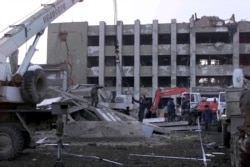 The aftermath of a December 2002 Chechen resistance attack on the main government building in Grozny (epa)
CHRONOLOGY
The fighting in Chechnya has raged, with short breaks, since 1994. It has brought misery, death, and destruction to the North Caucasus republic and to Russia as a whole. View an annotated timeline of the conflict.