


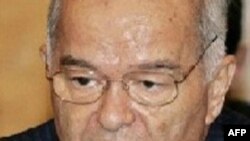
The head of the Central Election Commission announced the approval of Karimov and three other aspirants' candidacies at a brief news conference on November 19.
A Tashkent-based journalist who was in attendance said Chairman Mirzoulugbek Abdusalomov read a prepared statement and immediately left the room. The whole event lasted less than 10 minutes and there have been no official comments since.
The announcement was hardly unexpected, given Karimov's long-time stranglehold on power. But even experienced observers were surprised by the casual manner in which the commission brushed aside a clause in the country's constitution limiting the president to two terms.
Muhammadbobur Malikov is a former Uzbek justice minister and ambassador to Washington. Speaking from his U.S. exile, Malikov claims there is no rule of law in Uzbekistan and that Karimov calls all the shots. "The law there is nothing but window-dressing. President Karimov is in office now. That means his word is law. And laws are merely words," Malikov says.
Legal Hurdles Bypassed
Karimov's strongest critics point to the expiration of his seven-year term in January 2007 as marking the end of any true legitimacy. But official silence was maintained well into September, even as authorities flouted a requirement that the presidential election be announced at least three months in advance.
In the end, Karimov did what critics predicted and ignored any legal obstacle to a third term.
Opposition groups have expressed outrage at Karimov's registration as a presidential candidate and what it says about Uzbek institutions.
"According to the constitution and other electoral legislation, Karimov cannot be reelected for the third term," says the deputy chairman of the Birlik opposition party, Polat Okhunov. "But there is no rule of law in Uzbekistan. [Officials] do what they want. What can our reaction be to this illegal act? Of course we condemn it. What else?"
"By violating the constitution, the Central Election Commission has become a criminal body," says Otanazar Oripov, the secretary-general of the unregistered opposition party Erk. "Now, on December 23, each voter should choose one candidate from the list on the ballot. Do they have a right to vote for Islam Karimov? Voting for someone who violates the constitution is also a crime. In addition to turning itself into a criminal body, the Central Election Commission wants the whole population to be turned into criminals as well."
Human rights activist Abdullo Tojiboy Ogli was nominated as a presidential hopeful earlier this year by an unregistered group called the Alliance of Human Rights Defenders of Uzbekistan. The election commission rejected his candidacy, citing a failure to muster the required number of signatures.
"The Central Election Commission's chairman committed a crime," Ogli says. "That's what I call it: a crime. We are going to sue him in [an] international court."

Showing the way? Tajik President Emomali Rahmon (epa file photo)
But some ordinary Uzbeks are also expressing discontent over Karimov's insistence on staying in power.
RFE/RL's Uzbek Service spoke with one of the millions of Uzbeks who have gone abroad in search of work amid high unemployment and poverty among Uzbekistan's 26 million people.
"My attitude is negative, because [Karimov's reelection] means we will have to stay and work in Russia, [or] in Kazakhstan, without being able to return," said the woman, who works illegally in Russia and asked to remain anonymous. "Karimov's reelection will only mean that unemployment and poverty will continue just as before."
A Tajik Recipe For Success?
The 69-year-old Karimov was nominated by one of Uzbekistan's five registered political parties, the Liberal Democrats.
Three other candidates registered with the election commission are all regarded as loyal to Karimov. Opposition groups argue they will serve as window-dressing in polls that are being held simply to present a veneer of democracy in Uzbekistan.
It is a strategy akin to what critics say President Emomali Rahmon of neighboring Tajikistan accomplished in November 2006, when five lightweight presidential challengers got little airtime or respect from the state-dominated media.
Karimov's challengers are Asliddin Rustamov, from the pro-government People's Democratic Party; Dilorom Toshmukhamedova, the country's first-ever female presidential candidate, who was nominated by the Adolat (Justice) Social Democratic Party; and Akmal Saidov, who chairs a parliamentary commission on democratization and civil society and heads the National Human Rights Center. Saidov was put forward as candidate by a citizens' group.
No Uzbek poll since independence from the Soviet Union in 1991 has been judged by Western election observers to be free and fair.
Central Asia In Focus

THE COMPLETE STORY: Click on the icon to view a dedicated webpage bringing together all of RFE/RL's coverage of Kazakhstan, Kyrgyzstan, Tajikistan, Turkmenistan, and Uzbekistan.