


Police spokesman Sayat Shirinian did not say if the dead were police or protesters, but added that 33 officers were wounded.
The protesters, who have rallied for 12 straight days, accuse the government of rigging last month's presidential election.
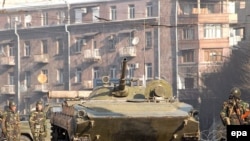
RFE/RL's Armenian Service reports that troops and armored vehicles are patrolling the main streets of Yerevan.
Armenian President Robert Kocharian declared a 20-day state of emergency following similar clashes on March 1. Just hours after Armenian police and Interior Ministry troops used truncheons, tear gas, and electric stun guns to disperse opposition supporters from a central Yerevan square, thousands who regrouped for a second rally were again met with force by the authorities.
Riot police fired tracer bullets into the air and tear gas to disperse the crowd of 15,000, and some demonstrators hurled rocks and Molotov cocktails at police. Several vehicles were set on fire or destroyed in the course of the day.
Human Rights Watch has charged the Armenian police with using “excessive force and violence” to disperse demonstrators.
As part of the state of emergency, mass gatherings have been banned, and media outlets are required to only use official information when reporting on the domestic political situation. The movement of citizens has been restricted and the authorities will be allowed to search vehicles.
The Armenia parliament on March 2 voted to confirm the state of emergency. Eighty-one of the 131 lawmakers present cast their votes in favor.
The Organization for Security and Cooperation in Europe (OSCE) is sending a special envoy to Yerevan to offer help in mediating the crisis. Ambassador Heikki Talvitie is to meet with both President-elect Serzh Sarkisian and opposition leader Levon Ter-Petrossian, the second-place finisher in the February 19 election. Ter-Petrossian claimed victory in the poll.
The European Union's foreign-policy chief, Javier Solana, has spoken to Kocharian and EU special envoy Peter Semneby has arrived in Yerevan to attempt to defuse the crisis, sources familiar with the situation tell RFE/RL.
Arman Musinian, a spokesman for Ter-Petrossian, told RFE/RL that the opposition has three demands -- "to annul the election, to punish those who rigged the elections, and to free all political detainees."
House Arrest
Ter-Petrossian told RFE/RL after the initial early-morning crackdown on March 1 that he had been placed under house arrest, and that a number of his followers were detained.
Daily rallies following the contentious vote attracted tens of thousands of protesters to Armenia's Liberty Square, where they voiced their belief that the elections were marred by fraud. A tent camp was set up and participants vowed to remain on the square until their demands for a new election were met.
But after Sarkisian secured key support for the formation of a coalition government on February 29, the authorities made good on their earlier threats to break up the rallies.
Hundreds of police and Interior Ministry troops surrounded the square at 7 a.m. local time on the morning of March 1, and moved in to break up the crowd.

A police vehicle burns following the violence (RFE/RL)
RFE/RL's Armenian Service reported that opposition figure and member of parliament Armen Martirosian was hospitalized for injuries received during the crackdown.
Ter-Petrossian described the events that led to the initial clash during an interview with RFE/RL.
"People were sleeping quietly. [Security forces] came in large numbers with truncheons and started beating. At that time I was near the microphone and I called on people to stay calm," he said. Security forces "didn't start the beating immediately. First they stood in front of people and I urged people not to get in contact with them and to stay quiet to see what they want. But nobody told us anything, nothing was negotiated. And they suddenly attacked people with truncheons and electric stun guns."
Violence Condemned
Within hours of the morning police action, OSCE Chairman in Office Ilkka Kanerva condemned the use of force against peaceful demonstrators.
"I urge the authorities to use maximum restraint," Kanerva said. "I am troubled that there are reports of casualties. I urge the authorities to release those detained, and I again call on the government and the opposition to engage in dialogue."
The police said in a statement issued on March 1 that they took action to disperse the protesters after learning that they were waiting to receive "large amounts of firearms, grenades, metal rods, and truncheons," which they believed would be used "to stage provocations and stir up mass disturbances."
The authorities said after the initial raid that police officers were wounded and that weapons were found in the protesters' camp.

Protesters tend to a fellow demonstrator (Photolur)
Protesters later regrouped in front of the French Embassy for a planned rally as units of riot police arrived on the scene, setting the stage for the violence later in the day.
Opposition supporters had been protesting daily in Liberty Square since Sarkisian was elected to replace his ally, Robert Kocharian, as president. Official results gave Sarkisian nearly 53 percent of the vote, with Ter-Petrossian getting 21.5 percent.
Ter-Petrossian is claiming that he is the rightful first-round winner, and that Sarkisian used ballot stuffing and intimidation to steal victory. Sarkisian has denied the charges.
In its initial assessment, the election-monitoring arm of the OSCE declared the election "mostly in line" with Armenia's international commitments, while also noting the need for "further improvements."
The elections have been endorsed by the European Union and the U.S. State Department has congratulated the Armenian people on an "active" and "competitive" election.
Calls For Restraint Ignored
Authorities had warned on February 29 that their patience with the protests in Yerevan was running out, and alleged that those behind the rallies plan to seize power illegally.
The Council of Europe and the OSCE had called on the Armenian authorities to exercise restraint. The U.S. mission to the OSCE said Washington was "very concerned" about the postelection arrests of opposition politicians, as well as reports that authorities have forcibly closed opposition offices.
At least six prominent opposition figures close to Ter-Petrossian have been placed in pretrial custody on a number of criminal charges, including illegal arms possession and assault.
Sarkisian's efforts to gain acceptance for his victory received a boost on February 29 when he reached a deal on the formation of a coalition government with the third-place finisher in the elections.
Before agreeing to become Security Council secretary in the next government, Orinats Yerkir party leader Artur Baghdasarian had decried the election as deeply flawed. Baghdasarian also accused Ter-Petrossian of trying to rig the election.
RFE/RL Caucasus Report

SUBSCRIBE For weekly news and in-depth analysis on Armenia, Azerbaijan, Georgia, and Russia's North Caucasus by e-mail, subscribe to "RFE/RL Caucasus Report."