

Ahead of that deadline, David Kakabadze, director of RFE/RL's Georgian Service, spoke with Denis Corboy, head of the Caucasus Policy Institute at King's College in London and a former EU ambassador to Tbilisi, about the "great challenge" facing Georgia, the failures of Western diplomacy regarding Russia, and why the war was a wakeup call for the EU.
RFE/RL: European Union monitors began patrolling Georgian territory on October 1 and Russian troops allowed some of them into a buffer zone around South Ossetia, despite earlier warnings from Moscow that they would be blocked. How do you evaluate that gesture -- could Russia be softening its stance?
Denis Corboy: I think, in the first place, that it looks likely, particularly after [Russian President Dmitry] Medvedev's statement [last week], that the Russian troops will withdraw from the so-called "buffer zones" by October 10. I think that will be achieved.
But I think the great challenge for Georgia today is to get back to normality, to settle down. It's going to be difficult. But our objective must be to establish stability, to get the economy restored, to get the business climate back. And I think it has to be viewed as a step-by-step exercise. I really feel that the lessons of recent weeks has been that Georgia has to build a closer relationship with the EU, frankly. And I think that close relationship would also provide a degree of security and could be a surer path to economic progress.
But the problem as we see with Russia -- and it very much affects the Geneva meeting on October 15 -- is, of course, that they are insisting that Abkhazia and South Ossetia are there as recognized states. This, of course, presents a lot of difficulties. I mean, we all have no doubt that South Ossetia and Abkhazia will remain on the international agenda for quite some time. This reminds me, you know, looking back on the Baltic states -- after the Soviet Union occupied the Baltic states, after World War II, the occupation was never recognized by the Western world. But we still had to go ahead and have dealings with the Soviet Union. Just as now, the Western world, and the whole West and the outside community has to keep having its dealings and its very important dealings -- indeed they are -- with the modern Russian Federation.
I fear very much that Russia now has got this foothold, for the first time, in the south of the Caucasus. And I think it's going to be...very, very difficult.
Corboy: I fear very much that Russia now has got this foothold, for the first time, in the south of the Caucasus. And I think it's going to be, in the real world -- and please, I think our dear Georgia must come back into the real world -- it's going to be very, very difficult. But I don't think we should give up, because you are quite right, it took a very long time for the Baltic states to be free. But then we were dealing with a different kettle of fish, if you like.
There isn't this major ideological divide between Moscow and the West as there was [between] the Soviet Union and the West. But I still think we do have to have a relationship with Moscow where we can find a better solution to these problems. And that will take time. I have very little doubt that there is no magic wand that we can promise Georgia -- be [it] the United States, NATO, or EU -- in regard to solving the Abkhaz and South Ossetian problems.

Corboy: I don't think Russia will pay much attention to the Council of Europe. Very regrettably, the Council of Europe doesn't have the muscle to gain the attention of the present-day Moscow. I think it's good that this resolution has [been] adopted; I thought the whole debate about whether the Russian vote should be denied, I thought that was an interesting one in the Council of Europe. But I'm afraid it does not have teeth, as in the American expression "all hat and no cattle." It's difficult to see anything that the Council [of Europe] can really deliver in the sense of carrying some clout. This is rather regrettable. But I do believe that the EU has clout with Russia.
RFE/RL: What kind of role can and should the EU play to contribute to stability in the Caucasus? And what must it do to be taken seriously by Russia? Is the option of using economic sanctions still on the table?
Corboy: I don't think sanctions is a realistic course to take because you can't isolate a country like Russia. You can isolate, for example, a Zimbabwe or a North Korea, but you cannot isolate a country as big and covering such a vast landmass and having such important resources, nuclear weapons, and it has an enormous influence with a veto in the United Nations, with its influence in different parts of the world, in particular the Middle East. You can't isolate Russia.
But what one can do is return to the interdependence between the EU. Russia needs the EU to export its energy and its minerals. There's an interdependence there which we have to work on. Bearing in mind, always -- as one did with the Soviets and the Baltic states after the war -- that there is an obligation on us to keep reminding the international world that this was a land grab, which is not justified in international law; and I'm afraid we have to try to keep it in people's minds, and some day we will be able to sit down and negotiate something which, [however], won't be entirely to Georgia's satisfaction. We can't deliver back South Ossetia and Abkhazia on a plate, in spite of all the ethnic cleansing, all the injustice, all the terrible things that were done. We will have to work at it over a period of time.
What has happened is a wake-up call. But Europe is a project in the making, you know. It's going to take a very long time to build a really effective united Europe.
Corboy: We've been trying -- it's nothing to do with Georgia and this particular war -- but we've been trying for some time to bring about a common energy policy, and I think there will be more pressure for that now. Because I suppose we have learned certain lessons, and the biggest lesson of all is that we are overdependent on oil and gas and overdependent on Russian oil and gas. And I think that lesson has been borne out, and I think you'll see a shift in policy in that regard. I think you are going to see a greater support for projects such as Nabucco.
What has happened is a wake-up call. But Europe is a project in the making, you know. It's going to take a very long time to build a really effective united Europe. Look at all the problems we have with the Lisbon Treaty and getting this adopted. That will be sorted out, but it is going to take another year or a year and a half. It's a project for the long term. And remember we have 27 member states at the moment. They are learning to live together, they are growing together, and, as I say, you have to see this in decades and presumably in centuries eventually. It'll take some time to get a more clear single voice on all these issues. It's a new kind of international animal, and that's what's so exciting about it -- and that's why it attracts so many people. Why does everybody want to join the European Union? This is a vote of confidence in the idea of Europe.
RFE/RL: There are at least two other conflicts on the territory of the former Soviet Union, where Russia – at least formally – plays the role of a broker: Transdniester in Moldova and Nagorno-Karabakh in Azerbaijan. Given the Georgian experience, do you think the EU should engage more actively in the negotiation process?
Corboy: I've believed this for some time. I think we should, because the EU has a voice and has an influence which can be brought to the table. There's been considerable progress, as you know, in regard to Nagorno-Karabakh in recent weeks and months, and I think both Azerbaijan and Armenia are drawing lessons also from what happened in Georgia. I think there is perhaps a greater sense that this has to be resolved in some way -- the Karabakh problem. And certainly the region of Armenia, I think, feels that it needs to open its border with Turkey very much more. It has also become very, very dependent on its northern big neighbor.
I think there's a rethink going on in the whole southern Caucasus. And I believe that this will be a stimulus to finding some solution to Karabakh. I have a feeling now that Azerbaijan would realize that a military attempt to take back Karabakh would not be on the agenda. A lot of people in Baku would have said up to some months ago -- yes, maybe we will get the chance of taking back Karabakh. I think now they will think again.
So we have to look at how things are shaping out in the South Caucasus, and in the region in general. But one thing is certain -- we will need cooperation with Russia. And that we have to balance against not giving up on the principles that were breached and the violations which occurred in the forcible military occupation of Abkhazia and South Ossetia.
RFE/RL: Russia has so far failed to convince its closest allies -- former Soviet republics -- to recognize the independence of South Ossetia and Abkhazia. Can we take this as an indication that Russia's neighbors are trying to retain at least some degree of sovereignty? And can the recent visit of Armenian President Serzh Sarkisian to Tbilisi be seen as proof of that?
Corboy: I think yes. You know, Russia didn't realize it had overstepped the mark. It's a red line for so many of these new states -- all these republics that were part of the Soviet Union and are now independent states. And they value their sovereignty, and they value, above all, territorial integrity of those countries. And this really was a breach of a fundamental red line for them. I don't think we will see -- no matter how much arm-twisting might go on -- those countries recognizing South Ossetia or Abkhazia. It's rather instructive that the only country so far is Nicaragua. This is not serious politics.
I think it's been a failure of Western diplomacy not to keep to a much greater degree Russia on sight.
Corboy: I would say "consult" is probably too strong a word. But I saw the point of that article; it's an interesting article. By the way, all this talk about isolating Russia that they dealt with at the beginning is not really relevant, because we can't really go down the road of isolating Russia. But it does make these points rather well.
I think it's been a failure of Western diplomacy not to keep to a much greater degree Russia on sight. I mean this misunderstanding about the missile shield in Poland and the Czech Republic has clearly kind of no effect whatever on Russia. It's clearly intended -- and Russia has been offered to have its people there, observing it, there were all sorts of offers made. But there's been a failure to properly communicate with the Russian government and Russian diplomats. And I think that's been a failure perhaps largely of the present American administration. Not keeping a dialogue, a sufficiently clear and honest dialogue open, so as to remove some of these misunderstandings and fears. Because it looks as if we go on this road, we will be creating Cold War attitudes. And that [dialogue] is something that I think we should strive for. I mean, the present administration in Moscow won't be there forever. And one must hope that there will be a different kind of Russia after a certain period of time.
RFE/RL: But the current leadership enjoys significant support from Russian society....
Corboy: It does, and it's perfectly understandable, after all Russia has been through. Russia has been through an extraordinary humiliating experience to its idea of itself, the identity of Russia, since the breakup of the Soviet Union. And it'll take time to come to terms with that. There will be these irredentist, revisionist approaches that they will want to go back to some of that, but that we have to deal with as best we can.
And I think the best way of dealing with that is dialogue and in creating better understanding -- at the same time not compromising on one's principles. That's very important, too. That article by the two former secretaries of state did, I think, flag an important point in the failure to be sufficiently sensitive to the Russian feelings. And I must say I say, I'd say the same of Georgia and our friends in Georgia. Very often, the rhetoric was not very helpful to the relationship at all, and I think there was far too much aggressive language towards Russia. I think it would have been better to have held one's tongue now and then, and talked quietly, in the diplomatic way, and built up allies in diplomacy, not in megaphone diplomacy.
So I think there's a lesson there, but at the same time not compromising one's principles.
RFE/RL: Your diplomat colleague, former U.S. Ambassador to Russia Jack Matlock, recently said that NATO membership for Georgia and Ukraine is not in Washington's or the alliance's interest. Some European countries also have doubts about the enlargement policy, and some analysts have even blamed it for helping provoke the war between Russia and Georgia. What is your comment on that?
Corboy: My feeling is that the practical point of view is I don't think any progress can be made on the NATO [Membership Action Plan] application until there is a new administration in Washington. That's the first point. Second point, I think, is that NATO has said that the door will be opened to Georgia and to Ukraine. Let's leave it there for a moment, and proceed with other things, because it is a great irritant to Russia, and I don't think it needs to be, if these things are handled correctly.
But I think for the moment I would focus on the relationship with the EU, and to build on developing the Georgian economy. On the big political stuff, I think we should go a little slower. And therefore I would tend to agree with the Kissinger-Shultz piece in the "Herald Tribune." I think one has to go a bit more slowly there. But it doesn't mean that we can't take the problems we have in Georgia at the moment and solve them and proceed with building a more prosperous country, closely linked with the EU. And that's the relationship we should be focusing on, in my opinion.
Crisis In Georgia
Crisis In Georgia
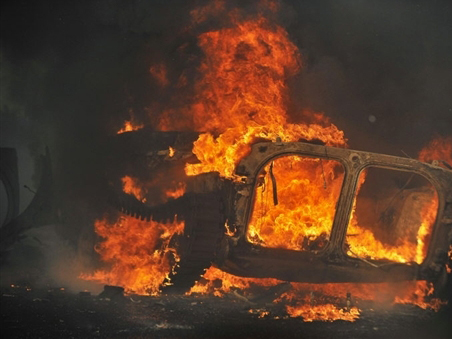 For RFE/RL's full coverage of the conflict that began in Georgia's breakway region of South Ossetia, click here.