



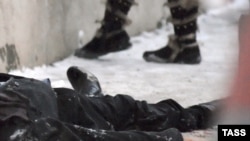
Stanislav Markelov took on a lot of cases most lawyers in Russia wouldn't dare touch. He represented terrorism suspects, muckraking journalists, and Chechen civilians who accused the Russian military of abuse.
After Markelov was shot dead in broad daylight in downtown Moscow on January 19, many of his colleagues said they were certain it was this habit of challenging the authorities in the courts that cost him his life.
"I see this as an assassination that was clearly politically motivated. I don't know if this was an act of vengeance, a warning for others, or something else," Yury Shmidt, a prominent Russian defense attorney who has represented his share of Kremlin opponents, tells RFE/RL's Russian Service.
"But I have no doubt that this assassination is strictly associated with his professional activities."
Markelov was killed after holding a press conference decrying the early release of former Russian Army Colonel Yury Budanov, who had been imprisoned for strangling to death an 18-year-old Chechen woman, Elza Kungayeva, during an interrogation nearly nine years ago. Markelov had represented Kungayeva's family.
Also killed in the attack was Anastasia Baburova, a journalist for the liberal opposition weekly "Novaya gazeta."
Journalists who dare challenge the Kremlin have long been the targets for harassment, imprisonment, and assassination in Russia. Now, observers say that defense attorneys who irritate the authorities also appear to be at risk.
 Will lawyers join journalists in the crosshairs?"It is a disgusting symbol of our times that a lawyer and a journalist were killed at the same time," says Igor Yakovlenko, head of the Russian Journalists' Union. "Lawyers and journalists don't go along with [Russia's authoritarian] regime of 'sovereign democracy.' They are two new categories of outcasts."
In recent months, the Kremlin has made a series of moves to bring the judicial system under greater political control. The State Duma has passed legislation eliminating jury trials for a series of crimes including terrorism, hostage taking, the organization of illegal armed formations, mass disturbances, treason, espionage, sedition, armed rebellion, and sabotage. Legislation is also in the works to significantly broaden the definition of treason and espionage.
Independent defense attorneys, as well as lawyers who represent Kremlin opponents in civil cases, have long been an irritant for the Russian authorities.
Analysts have been expecting a Kremlin crackdown that would turn defense attorneys into the de facto servants of the state -- as in the Soviet period -- rather than advocates for the accused. In a recent article in the online magazine "Yezhednevny zhurnal," Soviet-era dissident Aleksandr Podrabinek wrote that he expects "the Kremlin to come up with some legislative initiatives to restrict the rights and capabilities of lawyers quite soon."
A Lot Of Enemies
It's still unclear who was behind Markelov's assassination, but he certainly had his share of enemies.
Some analysts have suggested he was killed by nationalist supporters of Budanov, who has denied involvement in the shooting. Others say it could be connected to the 2006 assassination of "Novaya gazeta" journalist Anna Politkovskaya, who Markelov once represented.
Markelov also represented Mikhail Beketov, editor of the newspaper "Khimki pravda" in the Moscow region. In November, Beketov was severely beaten and later fell into a coma.
Beketov had been campaigning against the destruction of the Khimki forest, which is being cut down to make room for homes for the elite, shopping centers, and a new Moscow-St. Petersburg highway. Markelov was also helping Beketov gather evidence that the forest was being destroyed illegally, threatening the business interests of those involved in the development projects.
Also among Markelov's clients was Yana Neserkhoyeva, a Chechen woman who was a hostage in the 2002 Nord-Ost siege at Moscow's Dubrovka theater. Neserkhoyeva was detained after she spoke Chechen in a hospital where she was delivered unconscious, and accused of assisting the militants.
Visa Kungayev, the father of Elza Kungayeva, says Markelov's assassination leaves him and others defenseless against the authorities.
"Stas Markelov was like a son to me. I am so upset that I can hardly talk. If lawyers who defend our rights are shot in broad daylight and journalists who try to tell the truth are killed, then I don't know how we will go on," Kungayev tells RFE/RL's North Caucasus Service.
At Markelov's funeral in Moscow on January 23, human rights activist Lev Ponomaryov assailed President Dmitry Medvedev for not speaking out about the assassination.
"Hundreds of people came here, and the state be damned because the president has not said one word. This is amazing," Ponomaryov said. "The president always talks about superiority of the law. A lawyer was killed carrying out his duties and the president, a lawyer himself, could not even find one word to say."
They're Trying To Scare Us
The fact that Markelov's assassin -- described by witnesses as a man in a green ski mask -- was able to carry out the hit on a crowded Moscow street in midday and then escape into a metro station without being stopped by police, has led to suspicion of official involvement, or at least acquiescence.
 Stanislav Markelov had many enemies among the rich and powerful.Yakovlenko calls the killing "a political assassination," in that it is the result of a political atmosphere where crossing the authorities is not tolerated.
"I am certain that this killing was not planned in the corridors of power," Yakovlenko says. "But the authorities created the conditions that made [such assassinations] possible. They are not only possible, they are also widespread, unpunished, frightening -- and effective."
Markelov's assassination came just months after another prominent Russian defense attorney, Karina Moskalenko, fell ill after finding a substance similar to mercury in her car.
At the time of the incident, which took place in October, Moskalenko was in Strasbourg, France, where she represented clients before the European Court of Human Rights. Her clients include the jailed former Russian oil tycoon, Mikhail Khodorkovsky, and the family of Politkovskaya.
"Journalists and lawyers are being killed, and these aren't the first cases. They are trying to scare us but we must not be afraid," Moskalenko told RFE/RL's Russian Service in a recent interview.
"We need to work professionally and make sure law enforcement investigates these things effectively."
Attorneys have also been subject to what rights activists call politically motivated prosecutions.
In July 2007, for example, prominent defense attorney Boris Kuznetsov fled the country after Russian prosecutors accused him of divulging state secrets.
Kuznetsov had been defending Levon Chakhmakhchyan, a former member of the Federation Council, against embezzlement charges. Part of the state's case against Chakhmakhchyan was based on illegal wiretaps conducted by the Federal Security Service. When Kuznetsov brought the wiretaps to light, he was charged.
Kuznetsov represented the families of the 118 sailors killed in 2000 on the "Kursk" nuclear submarine, and scientist Igor Sutyagin, who was jailed on espionage charges.
Whether these incidents foreshadow a widespread crackdown on lawyers is still unclear. But given the climate of fear, many observers say a formal pressure campaign against attorneys might not even be necessary:
"I don't think the authorities will initiate a fierce crackdown on journalists and lawyers," Yakovlenko says. "They have created the conditions in which journalists and lawyers can be killed. They have created the conditions for censorship, especially the censorship by Kalashnikov that we saw [on January 19]."
RFE/RL's North Caucasus and Russian services contributed to this report
After Markelov was shot dead in broad daylight in downtown Moscow on January 19, many of his colleagues said they were certain it was this habit of challenging the authorities in the courts that cost him his life.
"I see this as an assassination that was clearly politically motivated. I don't know if this was an act of vengeance, a warning for others, or something else," Yury Shmidt, a prominent Russian defense attorney who has represented his share of Kremlin opponents, tells RFE/RL's Russian Service.
"But I have no doubt that this assassination is strictly associated with his professional activities."
Markelov was killed after holding a press conference decrying the early release of former Russian Army Colonel Yury Budanov, who had been imprisoned for strangling to death an 18-year-old Chechen woman, Elza Kungayeva, during an interrogation nearly nine years ago. Markelov had represented Kungayeva's family.
Also killed in the attack was Anastasia Baburova, a journalist for the liberal opposition weekly "Novaya gazeta."
Journalists who dare challenge the Kremlin have long been the targets for harassment, imprisonment, and assassination in Russia. Now, observers say that defense attorneys who irritate the authorities also appear to be at risk.

In recent months, the Kremlin has made a series of moves to bring the judicial system under greater political control. The State Duma has passed legislation eliminating jury trials for a series of crimes including terrorism, hostage taking, the organization of illegal armed formations, mass disturbances, treason, espionage, sedition, armed rebellion, and sabotage. Legislation is also in the works to significantly broaden the definition of treason and espionage.
Independent defense attorneys, as well as lawyers who represent Kremlin opponents in civil cases, have long been an irritant for the Russian authorities.
Analysts have been expecting a Kremlin crackdown that would turn defense attorneys into the de facto servants of the state -- as in the Soviet period -- rather than advocates for the accused. In a recent article in the online magazine "Yezhednevny zhurnal," Soviet-era dissident Aleksandr Podrabinek wrote that he expects "the Kremlin to come up with some legislative initiatives to restrict the rights and capabilities of lawyers quite soon."
A Lot Of Enemies
It's still unclear who was behind Markelov's assassination, but he certainly had his share of enemies.
Some analysts have suggested he was killed by nationalist supporters of Budanov, who has denied involvement in the shooting. Others say it could be connected to the 2006 assassination of "Novaya gazeta" journalist Anna Politkovskaya, who Markelov once represented.
Markelov also represented Mikhail Beketov, editor of the newspaper "Khimki pravda" in the Moscow region. In November, Beketov was severely beaten and later fell into a coma.
Beketov had been campaigning against the destruction of the Khimki forest, which is being cut down to make room for homes for the elite, shopping centers, and a new Moscow-St. Petersburg highway. Markelov was also helping Beketov gather evidence that the forest was being destroyed illegally, threatening the business interests of those involved in the development projects.
Also among Markelov's clients was Yana Neserkhoyeva, a Chechen woman who was a hostage in the 2002 Nord-Ost siege at Moscow's Dubrovka theater. Neserkhoyeva was detained after she spoke Chechen in a hospital where she was delivered unconscious, and accused of assisting the militants.
Visa Kungayev, the father of Elza Kungayeva, says Markelov's assassination leaves him and others defenseless against the authorities.
"Stas Markelov was like a son to me. I am so upset that I can hardly talk. If lawyers who defend our rights are shot in broad daylight and journalists who try to tell the truth are killed, then I don't know how we will go on," Kungayev tells RFE/RL's North Caucasus Service.
At Markelov's funeral in Moscow on January 23, human rights activist Lev Ponomaryov assailed President Dmitry Medvedev for not speaking out about the assassination.
"Hundreds of people came here, and the state be damned because the president has not said one word. This is amazing," Ponomaryov said. "The president always talks about superiority of the law. A lawyer was killed carrying out his duties and the president, a lawyer himself, could not even find one word to say."
They're Trying To Scare Us
The fact that Markelov's assassin -- described by witnesses as a man in a green ski mask -- was able to carry out the hit on a crowded Moscow street in midday and then escape into a metro station without being stopped by police, has led to suspicion of official involvement, or at least acquiescence.

"I am certain that this killing was not planned in the corridors of power," Yakovlenko says. "But the authorities created the conditions that made [such assassinations] possible. They are not only possible, they are also widespread, unpunished, frightening -- and effective."
Markelov's assassination came just months after another prominent Russian defense attorney, Karina Moskalenko, fell ill after finding a substance similar to mercury in her car.
At the time of the incident, which took place in October, Moskalenko was in Strasbourg, France, where she represented clients before the European Court of Human Rights. Her clients include the jailed former Russian oil tycoon, Mikhail Khodorkovsky, and the family of Politkovskaya.
"Journalists and lawyers are being killed, and these aren't the first cases. They are trying to scare us but we must not be afraid," Moskalenko told RFE/RL's Russian Service in a recent interview.
"We need to work professionally and make sure law enforcement investigates these things effectively."
Attorneys have also been subject to what rights activists call politically motivated prosecutions.
In July 2007, for example, prominent defense attorney Boris Kuznetsov fled the country after Russian prosecutors accused him of divulging state secrets.
Kuznetsov had been defending Levon Chakhmakhchyan, a former member of the Federation Council, against embezzlement charges. Part of the state's case against Chakhmakhchyan was based on illegal wiretaps conducted by the Federal Security Service. When Kuznetsov brought the wiretaps to light, he was charged.
Kuznetsov represented the families of the 118 sailors killed in 2000 on the "Kursk" nuclear submarine, and scientist Igor Sutyagin, who was jailed on espionage charges.
Whether these incidents foreshadow a widespread crackdown on lawyers is still unclear. But given the climate of fear, many observers say a formal pressure campaign against attorneys might not even be necessary:
"I don't think the authorities will initiate a fierce crackdown on journalists and lawyers," Yakovlenko says. "They have created the conditions in which journalists and lawyers can be killed. They have created the conditions for censorship, especially the censorship by Kalashnikov that we saw [on January 19]."
RFE/RL's North Caucasus and Russian services contributed to this report
RFE/RL Russia Report
RFE/RL Russia Report
