

SPLIT/BELGRADE (RFE/RL) -- To an outsider, a phrase like Shakespeare's famous line, "A rose by any other name would still smell as sweet" sounds much the same regardless of who in the western Balkans is saying it.
In the Balkans, language and politics are closely intertwined, and a region that was once seen as speaking a single common language now argues that it has as many as four native tongues -- Serbian, Croatian, Bosnian, and Montenegrin.
Never mind that a Serb from Banja Luka and a Croat from Dubrovnik can carry on a conversation and understand each other perfectly.
If asked in each other's company what language they are speaking, they'd be likely to answer: "our language" -- the nation-neutral answer that has become a form of courtesy in the ethnically divided region. Privately, however, everyone acknowledges the differences.
As the former Yugoslavia has broken down into individual, ethnically based countries, federations, and districts, the single composite language once known as Serbo-Croatian has broken down into what its speakers say are individual, ethnically based languages.
The distinctions sometimes reach extremes even locals find absurd. Streets signs often give multiple versions of the same designation, to accommodate all likely users. Bookworms look for translated works by writers from neighboring states. Films produced in Serbia are released elsewhere in the Balkans with subtitles.
Similar, But Different
Croatians long objected to the artificial pairing of their language with Serbian during the Yugoslav era, often referring to the official tongue as Croatio-Serbian.
Zhivko Bjelanovic, a linguist based in Split, on Croatia's Dalmatian coast, says to the trained eye, the languages are fundamentally distinct.
"Serbs and Croats can understand each other on the level of basic communication. But when experts start to actually analyze the languages, there are in fact a lot of differences -- in grammar, syntax, and every other way," Bjelanovic says.
The post-Yugoslav period of heightened national awareness has seen an evolution in the local languages.
Croatians have coined entirely new words, Bosniaks have peppered their speech with Turkic terms and phrases, and Serbs throughout the region remain committed to using the Cyrillic alphabet instead of Latin script.
The changes have proved a bureaucratic challenge both inside and outside the region. The International Criminal Tribunal for the former Yugoslavia in The Hague, which has examined hundreds of cases involving Croatian, Bosnian, and Serbian suspects, uses a default language called BCS, or Bosnian-Croatian-Serbian.
Many people in the Balkans consider the formulation tasteless; others see it as merely practical.
August Kovacec, a member of the Croatian Academy of Sciences and Art, says it is unlikely the people of the region will ever agree to return to a unified language.
"The people of Bosnia -- meaning Bosniaks, Croats, and Serbs -- could each say they're speaking their own, individual language. They say that it's their national language, and that it's not for Europe, Belgrade, or Zagreb to decide differently," Kovacec says.
"The same is true for Montenegrins. If they think Montenegrin is a distinct language, then basically it is. If on the other hand they decide to share a language with Serbs or Croats, that would work just as well. But the tendency here is to see each of these languages as special and distinct."
The issue becomes even more complicated as the western Balkans looks toward European integration. Entry into the European Union entitles member states to have their languages recognized as official tongues, obligating the EU to provide translations in all formal settings.
Politics Of Language
The eventual accession of Bosnia, Montenegro, Croatia, and Serbia would therefore put Brussels in the position of institutionalizing the differences, which could contribute to the further fragmentation of the Balkans along national lines.
Egon Fekete, a linguist in Belgrade, says most academics still say a single language is spoken in the Balkans -- albeit one with numerous dialects. But he says the issue is more about politics than it is about language.
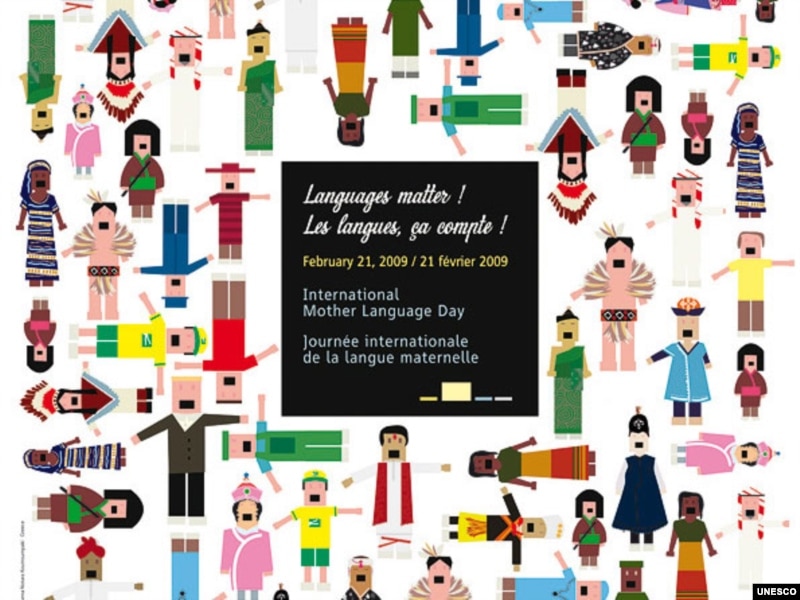
 The UN has observed International Mother Language Day since 2000
"In our region, political concerns outweigh everything else, and because of that, everyone has to have their own nation, religion, language, and alphabet. And that's not good," Fekete says.
"Many nations, in Europe and elsewhere, don't accept that fact. And the fact that we say 'our language' doesn't support it. We're talking about variations on a language, that that alone proves we're not talking about two or more individual languages. If you take a scientific approach, you can't accept that there are distinct Serbian, Croatian, Bosnian, and Montenegrin languages."
Others say the differences in "our language" are there to be celebrated and enjoyed -- by everyone in the region.
Zoran Hamovic, the director of Clio, a Belgrade-based publishing house, says he refuses to provide translations of outside Balkan authors just to suit local book-buyers who say they prefer to read in Serbian.
"Now the languages have different names, but they're still all the same language. It's a language we all understand perfectly well," Hamovic says.
"We shouldn't have such strong political barriers, because it would be a disaster for our publishing house. When we publish books by Croatian and Bosnian authors, we publish them in the language in which they were written."
In the Balkans, language and politics are closely intertwined, and a region that was once seen as speaking a single common language now argues that it has as many as four native tongues -- Serbian, Croatian, Bosnian, and Montenegrin.
Never mind that a Serb from Banja Luka and a Croat from Dubrovnik can carry on a conversation and understand each other perfectly.
If asked in each other's company what language they are speaking, they'd be likely to answer: "our language" -- the nation-neutral answer that has become a form of courtesy in the ethnically divided region. Privately, however, everyone acknowledges the differences.
As the former Yugoslavia has broken down into individual, ethnically based countries, federations, and districts, the single composite language once known as Serbo-Croatian has broken down into what its speakers say are individual, ethnically based languages.
The distinctions sometimes reach extremes even locals find absurd. Streets signs often give multiple versions of the same designation, to accommodate all likely users. Bookworms look for translated works by writers from neighboring states. Films produced in Serbia are released elsewhere in the Balkans with subtitles.
Similar, But Different
Croatians long objected to the artificial pairing of their language with Serbian during the Yugoslav era, often referring to the official tongue as Croatio-Serbian.
Zhivko Bjelanovic, a linguist based in Split, on Croatia's Dalmatian coast, says to the trained eye, the languages are fundamentally distinct.
"Serbs and Croats can understand each other on the level of basic communication. But when experts start to actually analyze the languages, there are in fact a lot of differences -- in grammar, syntax, and every other way," Bjelanovic says.
In our region, political concerns outweigh everything else, and because of that, everyone has to have their own nation, religion, language, and alphabet. And that's not good
The post-Yugoslav period of heightened national awareness has seen an evolution in the local languages.
Croatians have coined entirely new words, Bosniaks have peppered their speech with Turkic terms and phrases, and Serbs throughout the region remain committed to using the Cyrillic alphabet instead of Latin script.
The changes have proved a bureaucratic challenge both inside and outside the region. The International Criminal Tribunal for the former Yugoslavia in The Hague, which has examined hundreds of cases involving Croatian, Bosnian, and Serbian suspects, uses a default language called BCS, or Bosnian-Croatian-Serbian.
Many people in the Balkans consider the formulation tasteless; others see it as merely practical.
August Kovacec, a member of the Croatian Academy of Sciences and Art, says it is unlikely the people of the region will ever agree to return to a unified language.
"The people of Bosnia -- meaning Bosniaks, Croats, and Serbs -- could each say they're speaking their own, individual language. They say that it's their national language, and that it's not for Europe, Belgrade, or Zagreb to decide differently," Kovacec says.
"The same is true for Montenegrins. If they think Montenegrin is a distinct language, then basically it is. If on the other hand they decide to share a language with Serbs or Croats, that would work just as well. But the tendency here is to see each of these languages as special and distinct."
The issue becomes even more complicated as the western Balkans looks toward European integration. Entry into the European Union entitles member states to have their languages recognized as official tongues, obligating the EU to provide translations in all formal settings.
Politics Of Language
The eventual accession of Bosnia, Montenegro, Croatia, and Serbia would therefore put Brussels in the position of institutionalizing the differences, which could contribute to the further fragmentation of the Balkans along national lines.
Egon Fekete, a linguist in Belgrade, says most academics still say a single language is spoken in the Balkans -- albeit one with numerous dialects. But he says the issue is more about politics than it is about language.
"Many nations, in Europe and elsewhere, don't accept that fact. And the fact that we say 'our language' doesn't support it. We're talking about variations on a language, that that alone proves we're not talking about two or more individual languages. If you take a scientific approach, you can't accept that there are distinct Serbian, Croatian, Bosnian, and Montenegrin languages."
Others say the differences in "our language" are there to be celebrated and enjoyed -- by everyone in the region.
Zoran Hamovic, the director of Clio, a Belgrade-based publishing house, says he refuses to provide translations of outside Balkan authors just to suit local book-buyers who say they prefer to read in Serbian.
"Now the languages have different names, but they're still all the same language. It's a language we all understand perfectly well," Hamovic says.
"We shouldn't have such strong political barriers, because it would be a disaster for our publishing house. When we publish books by Croatian and Bosnian authors, we publish them in the language in which they were written."