





In the midst of the bitter winter of a failing global economy, the United Nations is calling the world's citizens to recognize the plight of the most vulnerable: slaves.
It's fitting that on the birthday of Abraham Lincoln, the Great Emancipator, the UN Office on Drugs and Crime (UNODC) launched its first assessment of the scope of human trafficking, the modern-day form of slavery.
The findings are grim. Based on data from 155 states, the "Global Report on Trafficking in Persons" includes country-specific information on legislation and criminal-justice responses to global patterns and criminal network flows. While the number of countries that have moved toward implementing the UN Protocol Against Trafficking in Persons (2000) has doubled since 2006, two of every five countries in the study have not convicted a single person on trafficking charges -- that's more than half of the UN member states.
True, the number of convictions worldwide is increasing each year, but not in proportion to the growing incidence of the crime. Governments are either unequipped or, worse, unwilling to attack the fastest-growing criminal industry in the world.
One of the greatest barriers to progress is the misleading term "trafficking," which implies movement. There's nothing magic about moving a girl from Kyiv to Paris, or from Dallas to Boston. In either case, when children are exploited for pornography, or terrified adults work for miniscule pay, it's enslavement.
Troubling Figures
The UNODC study estimates that 80 percent of slaves are sold for sex, while the remaining 20 percent are forced to toil in fields, homes, and sweatshops. Worldwide, children make up 20 percent of victims, with estimates as high as 100 percent in some areas of West Africa.
The report provides much-needed data and brings us closer to understanding the depth, breadth, and scope of trafficking; but as UNODC Executive Director Antonio Maria Costa admits, "We don't know much about the size of the iceberg that lies beneath." No UNODC figures for the total number of victims exist, but the International Labor Organization estimates that it is growing by 2 million people every year -- if you don't count those who have died or been rescued. Countries documented only 22,500 victims rescued in 2006. That means that only one in 100 victims is freed from bondage.
"Are we making some progress? I wish we were," Costa lamented during the New York release of the report. "Twenty-two thousand rescued; 2 million in the pool; 99 percent of the victims are still victimized -- I would like member states to take this more seriously. This is a very strong message." It's a message the United States and Europe, in particular, must not ignore.
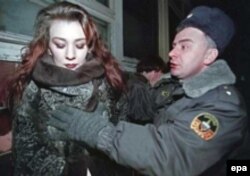 Some countries have had success in arresting the customers, rather than the prostitutes themselves.I've just returned from a six-city swing, mostly in Eastern Europe, examining antitrafficking strategies. So I was not surprised by the finding that, although European countries (with the exception of Estonia) have legislation against trafficking, there is a decrease in the number of investigations in Western and Central Europe. The number of people being trafficked within and between European countries is growing, but it seems political interest is declining.
On a positive note, Eastern Europe and Central Asia registered a steady increase in convictions between 2003 and 2007. Although this could be attributed to pressure from the international community, countries such as Moldova, the Russian Federation, and Ukraine should be commended for taking tangible steps to root out trafficking. During my travels, I was amazed to discover that the government of Ukraine has created a unit within the Interior Ministry to target trafficking, with no less than 600 personnel.
Negative Trends
Perhaps the most troubling finding from the report was that a significant number of arrested members of trafficking networks are women. And often, women trafficking victims accept an offer of greater freedom and less abuse in exchange for trapping others. Has Europe failed its women twice over, creating appalling situations where women are compelled to be both victims and victimizers?
Perhaps the real picture is that male criminals in the upper echelons of the hierarchy use women to carry out the most visible tasks, in the same way that drug lords use women as "mules." As terrorists may use female suicide bombers because they seem less threatening, women recruiters can more easily build trust with the young women they're luring into the sex trade. And once caught, women don't have the same "boys' networks" that allow them to buy off corrupt police and judges as easily as their male counterparts.
After the Iron Curtain fell, rural villages in Eastern Europe were emptied of their women, who were shipped like chattels to the United States, Canada, and Western Europe. Although European children, women, and men are still being exported and exploited, the UN identified Europe as the destination for victims from other parts of Europe, but also Africa, Latin America, and Asia. Prague is one of the 20 top sex-tourism destinations in the world, and the infamous red-light district of Amsterdam has become a den of illegal trade in flesh. The economic crisis will probably push more women to desperation as the only thing they have left to sell is themselves.
Attacking Demand
We need to find ways to attack the problem at its core -- by eradicating demand. Yes, it's crucial to help rescue victims of trafficking. However, unless we deal with the market, trafficking will continue to grow. It's more likely that we can curb the demand for commercial sex and labor before we solve the social inequities that contribute to the supply.
Although Europe overall is a leading driver of demand, individual countries are taking the lead in tackling demand, at least for commercial sex. Last year, I traveled to Scandinavia with Lina Sidrys Nealon, manager of the modern-day slavery project at Hunt Alternatives Fund, to examine the innovative ways in which Sweden and Norway are fighting the sex trade. Originally ridiculed yet now lauded around the world, Sweden's 1999 "Sex Purchase Law," which criminalized buying sex and decriminalized selling sex, is rendering trafficking almost nonexistent in that country.
Norway recently made it illegal for its citizens to purchase any sex act anywhere in the world. In Lithuania, Greece, Ireland, and Finland, it's a crime to buy sex from trafficked persons. Britain's Home Office has taken it one step further, introducing a law in December that made it an offense to pay for sex with someone "controlled for another person's gain," including pimps, traffickers, and drug dealers who force addicts into prostitution to repay them.
Even in Amsterdam, a third of the red-light-district brothels were closed in 2008 due to their involvement in illicit trafficking. Communities in the Czech Republic, Italy, and England have shifted law enforcement energies to arresting customers, while providing the sellers of sex with social services rather than taking them to court, in contrast to the ineffective practice we see in the United States of arresting women and girls in the sex trade, while ignoring the men.
The UN calls trafficking "a crime that shames us all." When our fellow human beings are treated as commodities, our own humanity is diminished. Let us turn shame into action and remove this stain from our soil, from our souls.
Swanee Hunt served as U.S. ambassador to Austria from 1993 to 1997. She is Eleanor Roosevelt Lecturer in Public Policy at Harvard's Kennedy School of Government, and president of Hunt Alternatives Fund, which includes a project focused on fighting the demand for sex trafficking. The views expressed in this commentary are her own, and do not necessarily reflect those of RFE/RL
It's fitting that on the birthday of Abraham Lincoln, the Great Emancipator, the UN Office on Drugs and Crime (UNODC) launched its first assessment of the scope of human trafficking, the modern-day form of slavery.
The findings are grim. Based on data from 155 states, the "Global Report on Trafficking in Persons" includes country-specific information on legislation and criminal-justice responses to global patterns and criminal network flows. While the number of countries that have moved toward implementing the UN Protocol Against Trafficking in Persons (2000) has doubled since 2006, two of every five countries in the study have not convicted a single person on trafficking charges -- that's more than half of the UN member states.
True, the number of convictions worldwide is increasing each year, but not in proportion to the growing incidence of the crime. Governments are either unequipped or, worse, unwilling to attack the fastest-growing criminal industry in the world.
One of the greatest barriers to progress is the misleading term "trafficking," which implies movement. There's nothing magic about moving a girl from Kyiv to Paris, or from Dallas to Boston. In either case, when children are exploited for pornography, or terrified adults work for miniscule pay, it's enslavement.
Troubling Figures
The UNODC study estimates that 80 percent of slaves are sold for sex, while the remaining 20 percent are forced to toil in fields, homes, and sweatshops. Worldwide, children make up 20 percent of victims, with estimates as high as 100 percent in some areas of West Africa.
The report provides much-needed data and brings us closer to understanding the depth, breadth, and scope of trafficking; but as UNODC Executive Director Antonio Maria Costa admits, "We don't know much about the size of the iceberg that lies beneath." No UNODC figures for the total number of victims exist, but the International Labor Organization estimates that it is growing by 2 million people every year -- if you don't count those who have died or been rescued. Countries documented only 22,500 victims rescued in 2006. That means that only one in 100 victims is freed from bondage.
"Are we making some progress? I wish we were," Costa lamented during the New York release of the report. "Twenty-two thousand rescued; 2 million in the pool; 99 percent of the victims are still victimized -- I would like member states to take this more seriously. This is a very strong message." It's a message the United States and Europe, in particular, must not ignore.
On a positive note, Eastern Europe and Central Asia registered a steady increase in convictions between 2003 and 2007. Although this could be attributed to pressure from the international community, countries such as Moldova, the Russian Federation, and Ukraine should be commended for taking tangible steps to root out trafficking. During my travels, I was amazed to discover that the government of Ukraine has created a unit within the Interior Ministry to target trafficking, with no less than 600 personnel.
Negative Trends
Perhaps the most troubling finding from the report was that a significant number of arrested members of trafficking networks are women. And often, women trafficking victims accept an offer of greater freedom and less abuse in exchange for trapping others. Has Europe failed its women twice over, creating appalling situations where women are compelled to be both victims and victimizers?
Perhaps the real picture is that male criminals in the upper echelons of the hierarchy use women to carry out the most visible tasks, in the same way that drug lords use women as "mules." As terrorists may use female suicide bombers because they seem less threatening, women recruiters can more easily build trust with the young women they're luring into the sex trade. And once caught, women don't have the same "boys' networks" that allow them to buy off corrupt police and judges as easily as their male counterparts.
After the Iron Curtain fell, rural villages in Eastern Europe were emptied of their women, who were shipped like chattels to the United States, Canada, and Western Europe. Although European children, women, and men are still being exported and exploited, the UN identified Europe as the destination for victims from other parts of Europe, but also Africa, Latin America, and Asia. Prague is one of the 20 top sex-tourism destinations in the world, and the infamous red-light district of Amsterdam has become a den of illegal trade in flesh. The economic crisis will probably push more women to desperation as the only thing they have left to sell is themselves.
Attacking Demand
We need to find ways to attack the problem at its core -- by eradicating demand. Yes, it's crucial to help rescue victims of trafficking. However, unless we deal with the market, trafficking will continue to grow. It's more likely that we can curb the demand for commercial sex and labor before we solve the social inequities that contribute to the supply.
Although Europe overall is a leading driver of demand, individual countries are taking the lead in tackling demand, at least for commercial sex. Last year, I traveled to Scandinavia with Lina Sidrys Nealon, manager of the modern-day slavery project at Hunt Alternatives Fund, to examine the innovative ways in which Sweden and Norway are fighting the sex trade. Originally ridiculed yet now lauded around the world, Sweden's 1999 "Sex Purchase Law," which criminalized buying sex and decriminalized selling sex, is rendering trafficking almost nonexistent in that country.
Norway recently made it illegal for its citizens to purchase any sex act anywhere in the world. In Lithuania, Greece, Ireland, and Finland, it's a crime to buy sex from trafficked persons. Britain's Home Office has taken it one step further, introducing a law in December that made it an offense to pay for sex with someone "controlled for another person's gain," including pimps, traffickers, and drug dealers who force addicts into prostitution to repay them.
Even in Amsterdam, a third of the red-light-district brothels were closed in 2008 due to their involvement in illicit trafficking. Communities in the Czech Republic, Italy, and England have shifted law enforcement energies to arresting customers, while providing the sellers of sex with social services rather than taking them to court, in contrast to the ineffective practice we see in the United States of arresting women and girls in the sex trade, while ignoring the men.
The UN calls trafficking "a crime that shames us all." When our fellow human beings are treated as commodities, our own humanity is diminished. Let us turn shame into action and remove this stain from our soil, from our souls.
Swanee Hunt served as U.S. ambassador to Austria from 1993 to 1997. She is Eleanor Roosevelt Lecturer in Public Policy at Harvard's Kennedy School of Government, and president of Hunt Alternatives Fund, which includes a project focused on fighting the demand for sex trafficking. The views expressed in this commentary are her own, and do not necessarily reflect those of RFE/RL