


August can be a sleepy month in the Northern Hemisphere. Not in Russia. Amid the fading glow of summer, a heart-stopping bolt of news invariably gets in the way. Russia-watchers call it the "August surprise," and plan their vacations accordingly for July or September.
There was the "Kursk" submarine disaster 10 years ago. In 2004, twin suicide bombings downed two passenger planes departing Moscow, killing 89 people. (The horrifying Beslan school siege followed a week later, at the start of September.) Four years later, there was the Russia-Georgia war. And this year, of course, there are the fires.
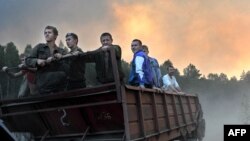
The worst of the wildfires may be over, but the full measure of their devastation may take weeks or months to grasp. The official death toll from the fire itself stands at more than 50, but the number is expected to climb. At the peak of the crisis, the capital, Moscow, was losing as many as 700 people a day -- twice the summertime average -- as residents succumbed to stifling heat and toxic smog.
Tens of thousands of hectares of pristine birch and pine forests have been destroyed in the fires. Countless homes have burned to the ground, and the fires threatened even more dangerous territory -- the contaminated regions surrounding the Chornobyl nuclear zone.
The summer inferno, fueled by a record-breaking heat wave and unremitting drought, is a natural disaster with long-reaching consequences -- including a dismal harvest forecast that will rob the country of export revenue and send bread prices soaring.
Official Interference
But like many of Russia's natural disasters, the fires have been compounded by unnatural forces -- a government that has systematically bled the country's emergency services dry, only to be caught flat-footed in the face of a large, but initially manageable, crisis.
 Prime Minister Vladimir Putin speaks with President Dmitry Medvedev while touring a fire-damaged region near Nizhny Novgorod.Take the example of the country's forest rangers. In the Soviet era, Russia maintained a healthy force of rangers and other ecological workers who were assigned specific tracts of forest and were equipped for rapid response to any outbreak of fire. At its strongest, the State Forestry Service employed 70,000 rangers and 200,000 additional staff to protect the country's 775 million hectares of forested land.
But the notion of forest preservation proved unsustainable in post-Soviet Russia. Goaded by the timber lobby and land developers, then-President Vladimir Putin dismantled in a stroke the entire forest-protection service with the 2007 Forestry Code.
The few remaining rangers are suddenly much in demand. Aleksandr Rovnov, a grizzled ranger with a smoke-blackened cross dangling from his neck, manages a team of just four firefighters -- down from 20 two years ago.
Rovnov and his men are responsible for a stretch of 34,000 hectares in the Vyksunsky district of Nizhny Novgorod Oblast, one of the areas worst hit by the fires. Their equipment -- a fire engine and several tractors -- are old and nearing collapse. "Now the government is screaming at us that we have to do everything," he says wearily. "But there's no one to do anything."
The government's negligence has not gone unnoticed. Putin -- now prime minister -- has taken pains to portray himself as a man of action, co-piloting a fire-fighting plane over burning forests and comforting victims with promises of rebuilt homes. But if the Russian masses were once devout in moments of proximity to power, the worm appears to have turned.
A recent video on YouTube captured the astonishing sight of a distinctly uncomfortable Putin surrounded by a voluble crowd of Vyksunsky residents distraught by the loss of their homes and unable to control their anger. The popularity of Putin and President Dmitry Medvedev had already begun to sink in polls taken before the fires. It's likely they'll sink far deeper in the weeks to come.
Russians Rediscover Solidarity
But a tarnished Kremlin may not be all to rise from the ashes. This August surprise comes with a sweetener in the tail -- a massive outpouring of public support from ordinary Russians who have rushed to fill the gap left by floundering state officials.
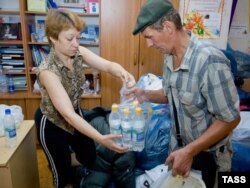 Volunteer help distribute food and water at an emergency shelter.Dozens of Moscow charities, empowered by an increasingly sophisticated Internet community, have sent food, medical supplies, and premade shelters to the fire-ravaged oblasts surrounding the capital. Young people are buying shovels and gas masks and volunteering to join in firefighting efforts.
Natalya Avilova, a coordinator at Fair Help, a medical charity, says hundreds of people come to her office each day to offer what they can -- some as little as a toothbrush, some as much as a car trunk packed full of food and bottled water.
The group's initial goal was to help just one village in the Moscow suburbs. Now, they've branched out to dozens of villages in Moscow, Ryazan, and Vladimir oblasts. "We've never had this kind of disaster in Russia," says one Fair Help volunteer, a lawyer who says she has put her practice temporarily on hold. "People are simply helping each other."
Olga Serebryanaya, an Internet observer who has watched the remarkable efficiency with which the country's web community has responded to the crisis, says her compatriots are finally repairing the ties that were broken during the chaotic transition years. In reaching out in a time of calamity, she says, people are experiencing not only a need to help, "but a need to experience solidarity."
Such displays of human connection can seem surprisingly rare in a country like Russia, no stranger to tragedy. Indeed, there is often the sense that collective fatigue -- and intimidation -- have stunted the country's capacity for civic responsibility and good works.
"The thing that will bury us is that we simply have no compassion for each other," a Russian friend once told me. "We never have, and we never will." Maybe the outpouring of people power in the face of government impotence will prove this year's true August surprise.
Daisy Sindelar is an RFE/RL correspondent covering Russian and Eastern European affairs. The views expressed in this commentary are the author's own, and do not necessarily reflect those of RFE/RL
There was the "Kursk" submarine disaster 10 years ago. In 2004, twin suicide bombings downed two passenger planes departing Moscow, killing 89 people. (The horrifying Beslan school siege followed a week later, at the start of September.) Four years later, there was the Russia-Georgia war. And this year, of course, there are the fires.
The worst of the wildfires may be over, but the full measure of their devastation may take weeks or months to grasp. The official death toll from the fire itself stands at more than 50, but the number is expected to climb. At the peak of the crisis, the capital, Moscow, was losing as many as 700 people a day -- twice the summertime average -- as residents succumbed to stifling heat and toxic smog.
Tens of thousands of hectares of pristine birch and pine forests have been destroyed in the fires. Countless homes have burned to the ground, and the fires threatened even more dangerous territory -- the contaminated regions surrounding the Chornobyl nuclear zone.
The summer inferno, fueled by a record-breaking heat wave and unremitting drought, is a natural disaster with long-reaching consequences -- including a dismal harvest forecast that will rob the country of export revenue and send bread prices soaring.
Official Interference
But like many of Russia's natural disasters, the fires have been compounded by unnatural forces -- a government that has systematically bled the country's emergency services dry, only to be caught flat-footed in the face of a large, but initially manageable, crisis.

But the notion of forest preservation proved unsustainable in post-Soviet Russia. Goaded by the timber lobby and land developers, then-President Vladimir Putin dismantled in a stroke the entire forest-protection service with the 2007 Forestry Code.
The few remaining rangers are suddenly much in demand. Aleksandr Rovnov, a grizzled ranger with a smoke-blackened cross dangling from his neck, manages a team of just four firefighters -- down from 20 two years ago.
Rovnov and his men are responsible for a stretch of 34,000 hectares in the Vyksunsky district of Nizhny Novgorod Oblast, one of the areas worst hit by the fires. Their equipment -- a fire engine and several tractors -- are old and nearing collapse. "Now the government is screaming at us that we have to do everything," he says wearily. "But there's no one to do anything."
The government's negligence has not gone unnoticed. Putin -- now prime minister -- has taken pains to portray himself as a man of action, co-piloting a fire-fighting plane over burning forests and comforting victims with promises of rebuilt homes. But if the Russian masses were once devout in moments of proximity to power, the worm appears to have turned.
A recent video on YouTube captured the astonishing sight of a distinctly uncomfortable Putin surrounded by a voluble crowd of Vyksunsky residents distraught by the loss of their homes and unable to control their anger. The popularity of Putin and President Dmitry Medvedev had already begun to sink in polls taken before the fires. It's likely they'll sink far deeper in the weeks to come.
Russians Rediscover Solidarity
But a tarnished Kremlin may not be all to rise from the ashes. This August surprise comes with a sweetener in the tail -- a massive outpouring of public support from ordinary Russians who have rushed to fill the gap left by floundering state officials.
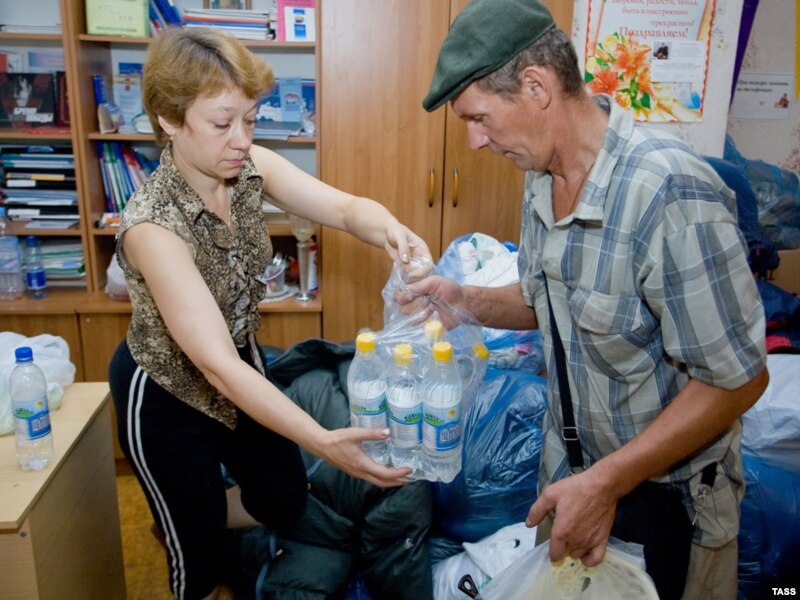
Natalya Avilova, a coordinator at Fair Help, a medical charity, says hundreds of people come to her office each day to offer what they can -- some as little as a toothbrush, some as much as a car trunk packed full of food and bottled water.
The group's initial goal was to help just one village in the Moscow suburbs. Now, they've branched out to dozens of villages in Moscow, Ryazan, and Vladimir oblasts. "We've never had this kind of disaster in Russia," says one Fair Help volunteer, a lawyer who says she has put her practice temporarily on hold. "People are simply helping each other."
Olga Serebryanaya, an Internet observer who has watched the remarkable efficiency with which the country's web community has responded to the crisis, says her compatriots are finally repairing the ties that were broken during the chaotic transition years. In reaching out in a time of calamity, she says, people are experiencing not only a need to help, "but a need to experience solidarity."
Such displays of human connection can seem surprisingly rare in a country like Russia, no stranger to tragedy. Indeed, there is often the sense that collective fatigue -- and intimidation -- have stunted the country's capacity for civic responsibility and good works.
"The thing that will bury us is that we simply have no compassion for each other," a Russian friend once told me. "We never have, and we never will." Maybe the outpouring of people power in the face of government impotence will prove this year's true August surprise.
Daisy Sindelar is an RFE/RL correspondent covering Russian and Eastern European affairs. The views expressed in this commentary are the author's own, and do not necessarily reflect those of RFE/RL