





SUKHUMI -- A row of Russian and Abkhaz flags flutter in the Black Sea breeze in front of the stately government headquarters in the Abkhaz capital. Along the winding beachfront promenade, locals point out the properties rumored to be earmarked for Russian investors.
It's a poignant vista for this separatist territory that has long been trying to convince the world -- and itself -- that it is an independent country.
There was euphoria here 10 months ago when Moscow recognized Abkhazia's independence from Tbilisi following the five-day Russia-Georgia war. But as Russian troops, cash, and influence pour into this tiny and picturesque Black Sea region, many Abkhaz worry that rather than winning their coveted autonomy last August they may have simply traded one overlord for another.
Sipping iced tea in an outdoor cafe overlooking Sukhumi's beaches and ramshackle piers, local journalist Inal Khashig, founder and editor of the opposition newspaper "Chegemskaya pravda," says Sukhumi's independence bid was supposed to "mean independence not only from Georgia but from any other country as well."
But that dream, he says, appears to be quickly slipping away.
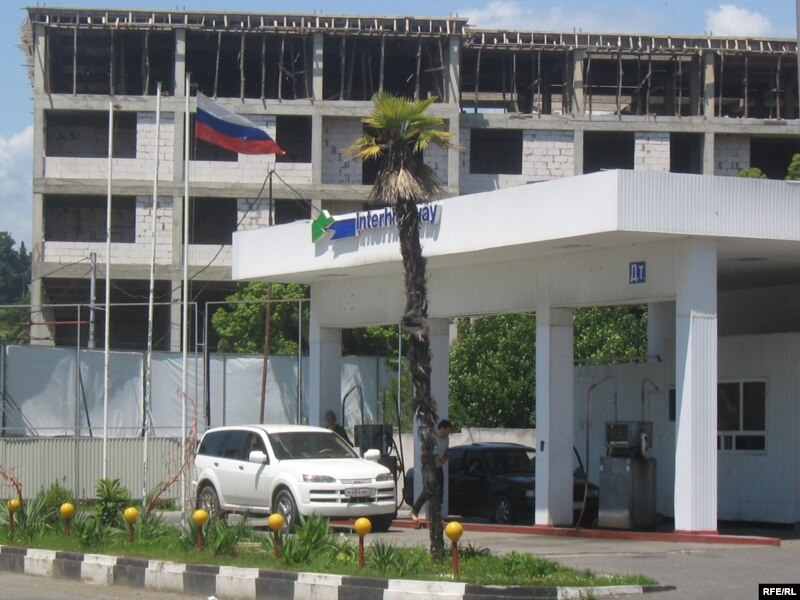
 Russian flags are common in Sukhumi, even at gas stations."We had a poor understanding of what was going on that day, August 26, when Russia recognized us," Khashig says.
"It was an emotional wave. Only later did we figure out that we were not getting what we wanted. Earlier, even though nobody recognized us, we were truly independent. Now, after recognizing Abkhazia, Russia is swallowing us. This is happening economically, politically, militarily, and socially. Every day we are becoming more and more dependent."
This dependence is visible in the most basic ways. Most Abkhaz residents carry Russian passports. The Russian ruble is their official currency. They communicate predominantly in the Russian language. And at least 3,800 Russian troops are based on their territory, including many on their frontiers.
Even some gas stations in Sukhumi fly Russian flags. Russian television dominates the airwaves and Russian newspapers are ubiquitous.
Resisting Assimilation
Russia's presence extends far beyond flags and border guards. Moscow has pledged $68 million in aid for Abkhazia since the war; hundreds of millions of dollars in foreign investment are flowing in as well. Russia's state-run oil giant Rosneft has already signed an agreement with Abkhazia to explore and develop the territory's maritime oil fields.
A aerial view of Abkhazia. The video was filmed by RFE/RL on June 8 from aboard one of the last United Nations flights into the breakaway territory.
The boom could have benefits in a region seems mired in a post-Soviet economic funk. But some here fear it could also provoke a backlash.
"We are worried that the expansion of Russian capital, which our authorities are actively assisting, could lead to society thinking that property here is not something for Abkhaz citizens," says Beslan Bartelia, an opposition member of Abkhazia's de facto parliament.
"This could lead to the growth of anti-Russian sentiments and we don't want that."
Mindful of such concerns, Abkhaz leader Sergei Bagapsh has said his territory will defend its statehood and resist assimilation. But he has nevertheless agreed to grant Russia control over Abkhazia's borders, airport, and railway system.
 Russian investors are eyeing Sukhumi's prime beachfront real estate.Moscow has plans to house a naval base in the port of Ochamchire, close to the cease-fire line separating Abkhazia from Georgia proper. A controversial provision will give Russian soldiers serving in Abkhazia the right to purchase property, which many here fear could lead to a further Russification of the province.
Some of the agreements with Russia have sparked howls of protest from opposition Abkhaz lawmakers, who have vowed to review and amend them during the ratification process.
"We are turning over to Russia all our responsibilities for building this state. This is very bad," Kashig says.
"When half the budget is financed by Russian subsidies, when Russians need to guard our borders, when we can't run our own railways and airport and turn them over to the Russians, this says we are losing hope. If we can't do this ourselves, it means we have doubts over whether we chose the right path in setting up our own state."
To be sure, growing pains are in evidence. Abkhaz officials frequently betray inexperience with basic international norms. UN officials -- whose 16-year observer mission in Abkhazia was shuttered this week after Russia vetoed a Security Council resolution to extend its mandate -- say Abkhaz border guards have attempted to examine the contents of their diplomatic pouch, a violation of international confidentiality laws.
Isolation Anxiety
Still, fears of Russian domination are far from unanimous. And even when they do exist, they are tempered by an even deeper animosity toward Georgia, which considers Abkhazia and a second breakaway region, South Ossetia, part of its sovereign territory.
"The situation is normal. It's better than normal. I'm not afraid we'll be assimilated by Russia. Over the past 200 years we've had experience with the Russians and we've had experience with the Georgians. We know where the danger comes from," says Batal Kobakhia, who chairs the human rights committee in the de facto parliament.
 Batal Kobakhia, chairman of the Human Rights Committee in Abkhazia's de facto parliament, isn't worried about Russian influence.
A powerful anti-Georgian current, fed by Russian media, runs through Abkhazia, where bitter memories still remain of the 1992-93 post-Soviet war for independence with Tbilisi. More than 15,000 people died in the 13-month campaign, and 250,000 ethnic Georgians, who made up the largest ethnic group in Abkhazia, were expelled.
The displaced Georgians, Kobakhia says unapologetically, "will never be able to return."
Similar declarations can be heard from virtually every Abkhaz, regardless of political stripe. The West doesn't fare much better, with many Abkhaz complaining the international community has failed to engage the territory.
Nicaragua is the only country, besides Russia, to recognize Abkhazia's independence. International aid organizations and Western investors have kept their distance. Even commercial ventures, like the clothing giant Benetton, cancelled plans for a store in Abkhazia amid protests from Georgia.
Liana Kvarchelia, the codirector of the Center for Humanitarian Programs think-tank in Sukhumi, says if this is a sign of how the West will behave in the future, then Abkhazia is doomed to remain locked in Russia's embrace.
"I understand that it would be difficult for the international community to change its firm position about not recognizing Abkhazia. But the international community needs to understand that isolating Abkhazia it is not good for anybody, especially for us," Kvarchelia says.
A History Of Resistance
Abkhaz visibly bristle with indignation at the suggestion that they are becoming Russian vassals. They point out that their ancestors fought a series of bloody rebellions against the Russian Empire in the 19th century. The largest of these, in 1866 and 1877, resulted in hundreds of thousands of Abkhaz being deported.
Khashig argues that many Abkhaz view rebelling against foreign domination as something of a birthright.
"Even in the Stalin period we gathered, protested, and demanded our rights," he says. "This in our genetic code. We value what happens here. We can't do much but we have to do something."
The Abkhaz independent streak extends to local politics. Many in Abkhazia proudly remind visitors that Moscow's preferred candidate in the territory's 2004 presidential election, former KGB officer Raul Khajimba, was soundly defeated by Bagapsh.
 Despite political tensions, life in Sukhumi is laid back. A group of men enjoy a game of backgammon near the beach.
During that campaign, posters and billboards of Kajimba together with then Russian President Vladimir Putin were plastered all over Sukhumi. Prominent Russian politicians came to Sukhumi to campaign for Khajimba as did the popular singer Iosif Kobzon. Russian State Duma deputy Vladimir Zhirinovsky even threatened that Russia would close its Abkhaz border if Khajimba wasn't elected.
Many Abkhaz say their choice in that election should dispel any doubts that Abkhaz take their independence seriously and will resist any foreign domination:
"Russia supported one candidate and we made our choice. This is the attitude of the Abkhaz when there is pressure to do something that does not fit with their interests or security," Kobakhia says. "Abkhaz never allow anyone to talk to them like this or to force them to live in a way that is different from their style and their traditional values."
Whether the Abkhaz will be able to maintain this stance on Moscow will be tested in December, when they hold their first presidential elections since securing Russian recognition of their independence.
It's a poignant vista for this separatist territory that has long been trying to convince the world -- and itself -- that it is an independent country.
There was euphoria here 10 months ago when Moscow recognized Abkhazia's independence from Tbilisi following the five-day Russia-Georgia war. But as Russian troops, cash, and influence pour into this tiny and picturesque Black Sea region, many Abkhaz worry that rather than winning their coveted autonomy last August they may have simply traded one overlord for another.
Sipping iced tea in an outdoor cafe overlooking Sukhumi's beaches and ramshackle piers, local journalist Inal Khashig, founder and editor of the opposition newspaper "Chegemskaya pravda," says Sukhumi's independence bid was supposed to "mean independence not only from Georgia but from any other country as well."
But that dream, he says, appears to be quickly slipping away.
"It was an emotional wave. Only later did we figure out that we were not getting what we wanted. Earlier, even though nobody recognized us, we were truly independent. Now, after recognizing Abkhazia, Russia is swallowing us. This is happening economically, politically, militarily, and socially. Every day we are becoming more and more dependent."
This dependence is visible in the most basic ways. Most Abkhaz residents carry Russian passports. The Russian ruble is their official currency. They communicate predominantly in the Russian language. And at least 3,800 Russian troops are based on their territory, including many on their frontiers.
Even some gas stations in Sukhumi fly Russian flags. Russian television dominates the airwaves and Russian newspapers are ubiquitous.
Resisting Assimilation
Russia's presence extends far beyond flags and border guards. Moscow has pledged $68 million in aid for Abkhazia since the war; hundreds of millions of dollars in foreign investment are flowing in as well. Russia's state-run oil giant Rosneft has already signed an agreement with Abkhazia to explore and develop the territory's maritime oil fields.


A aerial view of Abkhazia. The video was filmed by RFE/RL on June 8 from aboard one of the last United Nations flights into the breakaway territory.
The boom could have benefits in a region seems mired in a post-Soviet economic funk. But some here fear it could also provoke a backlash.
"We are worried that the expansion of Russian capital, which our authorities are actively assisting, could lead to society thinking that property here is not something for Abkhaz citizens," says Beslan Bartelia, an opposition member of Abkhazia's de facto parliament.
"This could lead to the growth of anti-Russian sentiments and we don't want that."
Mindful of such concerns, Abkhaz leader Sergei Bagapsh has said his territory will defend its statehood and resist assimilation. But he has nevertheless agreed to grant Russia control over Abkhazia's borders, airport, and railway system.

Some of the agreements with Russia have sparked howls of protest from opposition Abkhaz lawmakers, who have vowed to review and amend them during the ratification process.
"We are turning over to Russia all our responsibilities for building this state. This is very bad," Kashig says.
"When half the budget is financed by Russian subsidies, when Russians need to guard our borders, when we can't run our own railways and airport and turn them over to the Russians, this says we are losing hope. If we can't do this ourselves, it means we have doubts over whether we chose the right path in setting up our own state."
To be sure, growing pains are in evidence. Abkhaz officials frequently betray inexperience with basic international norms. UN officials -- whose 16-year observer mission in Abkhazia was shuttered this week after Russia vetoed a Security Council resolution to extend its mandate -- say Abkhaz border guards have attempted to examine the contents of their diplomatic pouch, a violation of international confidentiality laws.
Isolation Anxiety
Still, fears of Russian domination are far from unanimous. And even when they do exist, they are tempered by an even deeper animosity toward Georgia, which considers Abkhazia and a second breakaway region, South Ossetia, part of its sovereign territory.
"The situation is normal. It's better than normal. I'm not afraid we'll be assimilated by Russia. Over the past 200 years we've had experience with the Russians and we've had experience with the Georgians. We know where the danger comes from," says Batal Kobakhia, who chairs the human rights committee in the de facto parliament.

The displaced Georgians, Kobakhia says unapologetically, "will never be able to return."
Similar declarations can be heard from virtually every Abkhaz, regardless of political stripe. The West doesn't fare much better, with many Abkhaz complaining the international community has failed to engage the territory.
Nicaragua is the only country, besides Russia, to recognize Abkhazia's independence. International aid organizations and Western investors have kept their distance. Even commercial ventures, like the clothing giant Benetton, cancelled plans for a store in Abkhazia amid protests from Georgia.
Liana Kvarchelia, the codirector of the Center for Humanitarian Programs think-tank in Sukhumi, says if this is a sign of how the West will behave in the future, then Abkhazia is doomed to remain locked in Russia's embrace.
"I understand that it would be difficult for the international community to change its firm position about not recognizing Abkhazia. But the international community needs to understand that isolating Abkhazia it is not good for anybody, especially for us," Kvarchelia says.
A History Of Resistance
Abkhaz visibly bristle with indignation at the suggestion that they are becoming Russian vassals. They point out that their ancestors fought a series of bloody rebellions against the Russian Empire in the 19th century. The largest of these, in 1866 and 1877, resulted in hundreds of thousands of Abkhaz being deported.
Khashig argues that many Abkhaz view rebelling against foreign domination as something of a birthright.
"Even in the Stalin period we gathered, protested, and demanded our rights," he says. "This in our genetic code. We value what happens here. We can't do much but we have to do something."
The Abkhaz independent streak extends to local politics. Many in Abkhazia proudly remind visitors that Moscow's preferred candidate in the territory's 2004 presidential election, former KGB officer Raul Khajimba, was soundly defeated by Bagapsh.

Many Abkhaz say their choice in that election should dispel any doubts that Abkhaz take their independence seriously and will resist any foreign domination:
"Russia supported one candidate and we made our choice. This is the attitude of the Abkhaz when there is pressure to do something that does not fit with their interests or security," Kobakhia says. "Abkhaz never allow anyone to talk to them like this or to force them to live in a way that is different from their style and their traditional values."
Whether the Abkhaz will be able to maintain this stance on Moscow will be tested in December, when they hold their first presidential elections since securing Russian recognition of their independence.