





The conflict between Armenia and Azerbaijan over the Nagorno-Karabakh region of Azerbaijan has lasted more than 20 years and has resulted in the occupation of 20 percent of the territory of Azerbaijan. The conflict also caused the displacement of 1 million refugees and internally displaced persons, as well as the destruction of thousands of homes, schools, hospitals, and Azerbaijani historical monuments.
Almost every day brings new violations of the cease-fire along the Line of Contact, often resulting in the deaths of soldiers and civilians. The level of interaction between the two neighbors is hardly conducive to thinking about confidence building and trust in the decades to come.
Looking back at the beginning of the last century, I am reminded that history likes to repeat itself. With each repetition, it becomes more tragic and cruel. It almost seems that history is trying to make humanity understand and take lessons from the past.
In the course of the last several years, the presidents of Azerbaijan and Armenia have met many times. Still, after each of these meetings, the Nagorno-Karabakh region of Azerbaijan and seven adjacent districts remain under Armenian occupation.
So, the question is: who opposes a triumph of justice and who keeps silence? Who is interested in maintaining the status quo and does not want to have peace in Azerbaijani lands? Whose interests are served by destabilization and rising tensions in the South Caucasus?
Price Of Isolation
Today, an economic crisis is engulfing the entire world, and it is having an impact on all countries. Armenia, which does not have oil, natural gas, or other natural resources, is feeling this crisis more than many others.
The challenges of the crisis include social and economic difficulties, as well as political dissatisfaction. But what prevents Armenia from being involved in regional and global projects? Whose interests are served by keeping the territory of a neighboring state under occupation?
Does the Armenian taxpayer benefit from the large sums being spent to maintain a military presence in Nagorno-Karabakh and the seven neighboring districts? Wouldn't it be better to spend these funds on new schools, hospitals, social insurance? Wouldn't it be better to improve the standard of living of every citizen of Armenia, rather than just that of interest groups within its leadership? The time is right for Armenia's leaders to look carefully at their own blunders.
 Click to enlargeIn the 21st century, global integration processes are advanced through economic and financial globalization. As a result of Yerevan's shortsighted policy of self-isolation, major regional projects such as the Baku-Tbilisi-Ceyhan oil pipeline, the Baku-Tbilisi-Kars railway connection, and the South Caucasus natural-gas pipeline all bypass Armenia. Another major project, Nabucco, is currently on the agenda.
Every day, hundreds of cargo containers cross the borders of Georgia and Azerbaijan linking east and west, Europe and Asia. New luxury hotels are being built in Azerbaijan; new jobs are being created and per capita GDP is growing steadily despite the crisis.
Georgia, too, benefits from being a transit country and is building its own strategy in this changing world. Europe, which is interested in the South Caucasus, can clearly see who in the region is a balanced player. Similarly, the United States perceives Georgia and Azerbaijan as reliable partners. As for Russia, this nation is also interested in a country, seeking to be an equal partner building strategic and mutually beneficial political and economic ties.
The global financial centers see good prospects in the countries with solid basis for growth and guarantees for stable investments. So, where does Armenia fit in? What precludes this country from becoming a part of regional cooperation and being involved more actively in the formation of the architecture of a new South Caucasus? To me, the answer is self-evident.
Self-Determination, Or Expansionism?
For every nation, the history of its people is sacred. However, by building its entire existence on two artificially created problems -- the self-determination of Armenians in the Nagorno-Karabakh region of Azerbaijan and describing the events of 1915 as the "Armenian genocide"-- Armenia is missing a historic opportunity to make a real postindustrial breakthrough.
The citizens of Armenia are being deprived of their right to participate in effective transformations similar to those that are taking place in Georgia and Azerbaijan. In a rapidly changing world, we need to understand that sticking to one's narrative of mythology can impede moving forward.
As far as the self-determination of Armenians in the Nagorno-Karabakh region is concerned, we need to clarify certain misconceptions. The Armenian people have already exercised the right of national self-determination by establishing the Republic of Armenia. Therefore, in Nagorno-Karabakh, the issue is not self-determination, but rather blatant ethnic-based expansionism. Suffice it to look at a number of international documents, including UN documents and the Convention on Security and Cooperation in Europe's Helsinki Final Act to understand the priority of the principle of territorial integrity.
The Armenian side simply misrepresents the principle of self-determination by insisting that separation or independence can be the only manifestation of such. The Armenians in Nagorno-Karabakh, just as any other citizens of the Republic of Azerbaijan, can fully exercise their rights within the framework of Azerbaijan's territorial integrity. At the same time, it should be noted that the internationally recognized territory of the Republic of Azerbaijan will never become the basis for the creation of a second Armenian state.
In the new millennium, we must find new points of agreement and new ways of interacting with one another. Of course, this will be a tough challenge, as almost every family on both sides was touched by the war. However, this must be done to establish peace and prosperity in the South Caucasus for the sake of future generations. The leadership of Armenia must understand that it is necessary to protect its citizens from a new war.
Time For Responsibility
The Armenian political elite should consider the following:
First, key decisions are being made that impact upon the security and stability of the region. Armenia's development will depend on these decisions.
Second, it is a sovereign right of a people to decide their own destiny and development. The leadership of Armenia should think about the future of that country's citizens and about providing them with an opportunity to live in a secure and improving environment. By building an independent foreign policy, Armenia can contribute to peace and stability in the South Caucasus.
Third, the prospects for opening the border between Armenia and Turkey are no longer viewed optimistically within the ruling circles of Armenia. In such a case, what is the benefit to ordinary Armenians of the occupation of Nagorno-Karabakh? What are the political and economic benefits of this occupation? Therefore, does an Armenian mother really want to see her son as a soldier on the occupied soil of another state? Are there guarantees that he'll come home safe and sound?
Fourth, the Nagorno-Karabakh region of Azerbaijan will not become independent. Moreover, Baku is not going to tolerate the current status quo indefinitely. Unfortunately, contrary to UN Security Council resolutions calling for the aggressor to withdraw from the occupied territories and documents adopted by the Council of Europe and the Organization of the Islamic Conference, the situation remains unchanged. However, our sovereign right of self-defense is guaranteed by international law and universally accepted documents and provides for the restoration of our internationally recognized sovereignty by all means, including the use of force.
Fifth, while calling upon the international community to recognize the controversial "Armenian genocide," some Armenian politicians forget about the atrocities committed in the Azerbaijani town of Khojaly in February of 1992. This is one of the most barbaric acts in contemporary history, when the atrocities were committed jointly with the 366th Motor Rifle Regiment of the former Soviet Army.
History should be a statement of truth and not a one-sided depiction of a given event. Sincerity is important not only with those around you, but also with oneself. I think it is necessary to remember the horrors and tragedies of the recent past, which, by the way, are documented by video evidence. This will enable all of us to be more responsible in the future.
Now is the time for responsibility. The right decisions should be made today because it may be too late tomorrow. Peace in the South Caucasus is the best guarantee for sustainable development and prosperity for young Azerbaijanis, Georgians, and Armenians.
It is absolutely clear that only three states -- Azerbaijan, Georgia, and Armenia -- are players within the framework of international law to define the borders of the South Caucasus. The peoples who live in these territories will always be here, but today we must determine how our future generations will co-exist.
Therefore, I suggest that the leadership of Armenia move beyond their narrow special interests and think about ordinary Armenians, who, after all, cannot be fed on theatrics and propaganda shows forever.
Elnur Aslanov is the head of the Political Analyses and Information Department of the presidential administration of the Republic of Azerbaijan. The views expressed in this commentary are the author's own and do not necessarily reflect those of RFE/RL
Almost every day brings new violations of the cease-fire along the Line of Contact, often resulting in the deaths of soldiers and civilians. The level of interaction between the two neighbors is hardly conducive to thinking about confidence building and trust in the decades to come.
Looking back at the beginning of the last century, I am reminded that history likes to repeat itself. With each repetition, it becomes more tragic and cruel. It almost seems that history is trying to make humanity understand and take lessons from the past.
In the course of the last several years, the presidents of Azerbaijan and Armenia have met many times. Still, after each of these meetings, the Nagorno-Karabakh region of Azerbaijan and seven adjacent districts remain under Armenian occupation.
So, the question is: who opposes a triumph of justice and who keeps silence? Who is interested in maintaining the status quo and does not want to have peace in Azerbaijani lands? Whose interests are served by destabilization and rising tensions in the South Caucasus?
Price Of Isolation
Today, an economic crisis is engulfing the entire world, and it is having an impact on all countries. Armenia, which does not have oil, natural gas, or other natural resources, is feeling this crisis more than many others.
The challenges of the crisis include social and economic difficulties, as well as political dissatisfaction. But what prevents Armenia from being involved in regional and global projects? Whose interests are served by keeping the territory of a neighboring state under occupation?
Does the Armenian taxpayer benefit from the large sums being spent to maintain a military presence in Nagorno-Karabakh and the seven neighboring districts? Wouldn't it be better to spend these funds on new schools, hospitals, social insurance? Wouldn't it be better to improve the standard of living of every citizen of Armenia, rather than just that of interest groups within its leadership? The time is right for Armenia's leaders to look carefully at their own blunders.
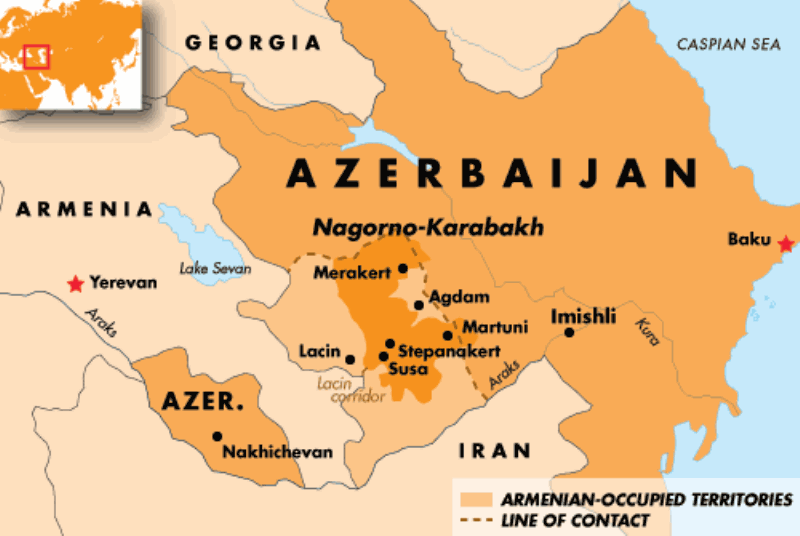
Every day, hundreds of cargo containers cross the borders of Georgia and Azerbaijan linking east and west, Europe and Asia. New luxury hotels are being built in Azerbaijan; new jobs are being created and per capita GDP is growing steadily despite the crisis.
Georgia, too, benefits from being a transit country and is building its own strategy in this changing world. Europe, which is interested in the South Caucasus, can clearly see who in the region is a balanced player. Similarly, the United States perceives Georgia and Azerbaijan as reliable partners. As for Russia, this nation is also interested in a country, seeking to be an equal partner building strategic and mutually beneficial political and economic ties.
The global financial centers see good prospects in the countries with solid basis for growth and guarantees for stable investments. So, where does Armenia fit in? What precludes this country from becoming a part of regional cooperation and being involved more actively in the formation of the architecture of a new South Caucasus? To me, the answer is self-evident.
Self-Determination, Or Expansionism?
For every nation, the history of its people is sacred. However, by building its entire existence on two artificially created problems -- the self-determination of Armenians in the Nagorno-Karabakh region of Azerbaijan and describing the events of 1915 as the "Armenian genocide"-- Armenia is missing a historic opportunity to make a real postindustrial breakthrough.
The citizens of Armenia are being deprived of their right to participate in effective transformations similar to those that are taking place in Georgia and Azerbaijan. In a rapidly changing world, we need to understand that sticking to one's narrative of mythology can impede moving forward.
As far as the self-determination of Armenians in the Nagorno-Karabakh region is concerned, we need to clarify certain misconceptions. The Armenian people have already exercised the right of national self-determination by establishing the Republic of Armenia. Therefore, in Nagorno-Karabakh, the issue is not self-determination, but rather blatant ethnic-based expansionism. Suffice it to look at a number of international documents, including UN documents and the Convention on Security and Cooperation in Europe's Helsinki Final Act to understand the priority of the principle of territorial integrity.
The Armenian side simply misrepresents the principle of self-determination by insisting that separation or independence can be the only manifestation of such. The Armenians in Nagorno-Karabakh, just as any other citizens of the Republic of Azerbaijan, can fully exercise their rights within the framework of Azerbaijan's territorial integrity. At the same time, it should be noted that the internationally recognized territory of the Republic of Azerbaijan will never become the basis for the creation of a second Armenian state.
In the new millennium, we must find new points of agreement and new ways of interacting with one another. Of course, this will be a tough challenge, as almost every family on both sides was touched by the war. However, this must be done to establish peace and prosperity in the South Caucasus for the sake of future generations. The leadership of Armenia must understand that it is necessary to protect its citizens from a new war.
Time For Responsibility
The Armenian political elite should consider the following:
First, key decisions are being made that impact upon the security and stability of the region. Armenia's development will depend on these decisions.
Second, it is a sovereign right of a people to decide their own destiny and development. The leadership of Armenia should think about the future of that country's citizens and about providing them with an opportunity to live in a secure and improving environment. By building an independent foreign policy, Armenia can contribute to peace and stability in the South Caucasus.
Third, the prospects for opening the border between Armenia and Turkey are no longer viewed optimistically within the ruling circles of Armenia. In such a case, what is the benefit to ordinary Armenians of the occupation of Nagorno-Karabakh? What are the political and economic benefits of this occupation? Therefore, does an Armenian mother really want to see her son as a soldier on the occupied soil of another state? Are there guarantees that he'll come home safe and sound?
Fourth, the Nagorno-Karabakh region of Azerbaijan will not become independent. Moreover, Baku is not going to tolerate the current status quo indefinitely. Unfortunately, contrary to UN Security Council resolutions calling for the aggressor to withdraw from the occupied territories and documents adopted by the Council of Europe and the Organization of the Islamic Conference, the situation remains unchanged. However, our sovereign right of self-defense is guaranteed by international law and universally accepted documents and provides for the restoration of our internationally recognized sovereignty by all means, including the use of force.
Fifth, while calling upon the international community to recognize the controversial "Armenian genocide," some Armenian politicians forget about the atrocities committed in the Azerbaijani town of Khojaly in February of 1992. This is one of the most barbaric acts in contemporary history, when the atrocities were committed jointly with the 366th Motor Rifle Regiment of the former Soviet Army.
History should be a statement of truth and not a one-sided depiction of a given event. Sincerity is important not only with those around you, but also with oneself. I think it is necessary to remember the horrors and tragedies of the recent past, which, by the way, are documented by video evidence. This will enable all of us to be more responsible in the future.
Now is the time for responsibility. The right decisions should be made today because it may be too late tomorrow. Peace in the South Caucasus is the best guarantee for sustainable development and prosperity for young Azerbaijanis, Georgians, and Armenians.
It is absolutely clear that only three states -- Azerbaijan, Georgia, and Armenia -- are players within the framework of international law to define the borders of the South Caucasus. The peoples who live in these territories will always be here, but today we must determine how our future generations will co-exist.
Therefore, I suggest that the leadership of Armenia move beyond their narrow special interests and think about ordinary Armenians, who, after all, cannot be fed on theatrics and propaganda shows forever.
Elnur Aslanov is the head of the Political Analyses and Information Department of the presidential administration of the Republic of Azerbaijan. The views expressed in this commentary are the author's own and do not necessarily reflect those of RFE/RL