





Iran's presidential election campaign was widely expected to result in a close race between incumbent President Mahmud Ahmadinejad and reformist candidate Mir Hossein Musavi.
But many have been shocked by official results that seem to be so at odds with the high voter turnout and large rallies in support of Musavi.
Ahmadinejad's victory was tallied by Iran's Interior Ministry and announced within 90 minutes of the close of polls. There were no independent foreign election monitors. And there was no monitoring of the vote count.
The results not only put Ahmadinejad ahead of all other candidates, they gave the incumbent president more than 62 percent of the ballot. That was enough to be declared the outright winner in the first round and avoid a runoff against Musavi, who was said to have won about 34 percent of the vote.
'Psychological War'
Amid his surprise first-round victory, Ahmadinejad has dismissed allegations of electoral fraud as part of a "psychological war" invented by foreign media.
On June 14, at a press conference in Tehran, Ahmedinejad resorted to rhetorical questions of his own when asked to comment on allegations that Iran's Interior Ministry had rigged the vote to ensure his reelection.
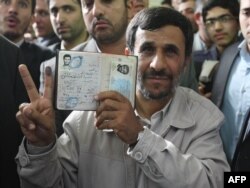 Mahmud Ahmadinejad flashes the victory sign with an ink-stained finger as he holds up his identity cards at a polling station in Tehran."How do you know that people don't accept the results of the votes? Were you in touch with 40 million people?" he challenged one journalist. "You just see the few people you like."
Ahmadinejad says anyone challenging the official results should answer the question, "Where are the irregularities in the election?"
But at the same time, Ahmadinejad's regime has cracked down on media outlets and methods that might be used to answer that very question.
Local and international phone calls have been blocked in Iran. So have mobile telephones, SMS text messaging, YouTube video blogs, Facebook, and other social networks used by opposition activists.
Iranian newspapers also have been ordered by the Intelligence Ministry not to report on large street demonstrations challenging the election results. That has prompted newspapers that support reformist candidates to publish blank front pages.
Clearly, Ahmadinejad's regime does not want Iranians to hear the answers about where possible fraud could have occurred.
'Election Coup d'Etat'
Reformist cleric Hassan Yusefi Eshkevari told RFE/RL's Radio Farda in a telephone interview from his home in Tehran that the official results show that Tehran's establishment fears democracy. Eshkevari described the disputed results as "an election coup d'etat."
"The election result is not understandable by any logic because if Ahmadinejad was supposed to have 62 percent of the vote, there would have not been so many protests and so many efforts to replace him," Eshkevari says. "Especially during the past month, all of Iran was calling in a united voice, 'We want to change [Ahmadinejad], and we don't want him [as president].' "
Juan Cole is a professor of modern Middle East history at the University of Michigan who writes an Internet blog called "Informed Comment." According to Cole and other independent observers, the best evidence of vote fraud in Iran is in the details of the official vote count itself. Cole says a close examination of the tally would likely suggest that blanket instructions were given to the Electoral Commission to falsify the results.
But Cole concludes that the cover-up was so clumsy, it produced "unbelievable" results -- including landslide victories for Ahmadinejad in Tehran and in provincial centers like Tabriz and Isfahan, the hometowns of his chief rivals.
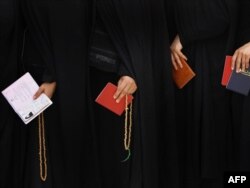 Iranian women hold prayer beads and registration cards as they line up to vote in the holy city of Qom.Indeed, the official tally shows poor results for all reformist candidates in their own hometowns.
Musavi, for example, is an ethnic Azeri from Iran's Azerbaijan Province. Opinion polls, anecdotal evidence, and strong attendance at Musavi's campaign rallies in the provincial capital of Tabriz suggested he would easily win the majority of votes there.
But the official results released by the Interior Ministry show Ahmadinejad winning 57 percent of the vote in Tabriz.
In Tehran, too, reformist candidates are popular and Ahmadinejad -- the capital's former mayor -- has lost much of his support in recent years due to dissatisfaction over his economic policies. But the official tally shows Ahmadinejad winning half of all votes cast in Tehran.
Cole says that result alone is enough to raise serious doubts about the Interior Ministry's overall vote count.
'Mathematical Mistakes'
High turnout -- about 85 percent of all eligible voters -- also has raised suspicions. Reformist candidates were widely expected to benefit from a high voter turnout. Instead, at least according to the Interior Ministry's tally, Ahmadinejad benefited.
That prompted criticism from Ebrahim Nabavi, a reformist satirist who lives in exile in Belgium and who has campaigned for Musavi.
"There are mathematical mistakes in the results. They don't even know how to rig the election properly," Nabavi says. "We didn't think that it would be so [extensive] and, I don't know what word to use -- shameless, impudent. I don't want to use bad words. But sometimes the actions of [the authorities] are describable only with [harsh] words."
The speed with which the results were announced and finalized also has raised suspicions. Voting was conducted across the country on paper ballots -- with each ballot being folded and slipped into a sealed plastic voting box.
That means each of tens of millions of ballots had to be laboriously unfolded and counted by an election official rather than being tallied electronically.
But within hours of the polls closing, Iranian news media already were announcing that 90 percent of the ballots had been counted -- nearly 30 million votes. That means Iran's election set a record not only for voter turnout, but also for the speed in which paper ballots can be physically counted.
Finally, Iran's Electoral Commission is supposed to wait three days before certifying election results. Only then is Ayatollah Ali Khamenei, Iran's supreme leader, to be informed and sign off on the process. The three-day delay is meant to allow charges of irregularities to be resolved. But in this case, Khamenei immediately approved the results.
No surprise, then, that Western leaders -- from U.S. Vice President Joe Biden to European Union diplomats and British Foreign Secretary David Miliband -- are expressing serious concerns about the allegations of election fraud.

But many have been shocked by official results that seem to be so at odds with the high voter turnout and large rallies in support of Musavi.
Ahmadinejad's victory was tallied by Iran's Interior Ministry and announced within 90 minutes of the close of polls. There were no independent foreign election monitors. And there was no monitoring of the vote count.
The results not only put Ahmadinejad ahead of all other candidates, they gave the incumbent president more than 62 percent of the ballot. That was enough to be declared the outright winner in the first round and avoid a runoff against Musavi, who was said to have won about 34 percent of the vote.
'Psychological War'
Amid his surprise first-round victory, Ahmadinejad has dismissed allegations of electoral fraud as part of a "psychological war" invented by foreign media.
On June 14, at a press conference in Tehran, Ahmedinejad resorted to rhetorical questions of his own when asked to comment on allegations that Iran's Interior Ministry had rigged the vote to ensure his reelection.
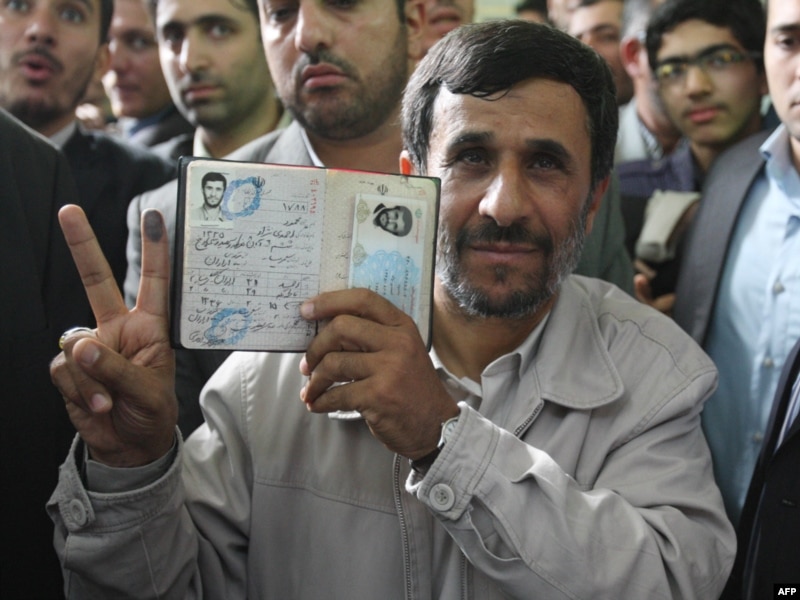
Ahmadinejad says anyone challenging the official results should answer the question, "Where are the irregularities in the election?"
But at the same time, Ahmadinejad's regime has cracked down on media outlets and methods that might be used to answer that very question.
Local and international phone calls have been blocked in Iran. So have mobile telephones, SMS text messaging, YouTube video blogs, Facebook, and other social networks used by opposition activists.
Iranian newspapers also have been ordered by the Intelligence Ministry not to report on large street demonstrations challenging the election results. That has prompted newspapers that support reformist candidates to publish blank front pages.
Clearly, Ahmadinejad's regime does not want Iranians to hear the answers about where possible fraud could have occurred.
'Election Coup d'Etat'
Reformist cleric Hassan Yusefi Eshkevari told RFE/RL's Radio Farda in a telephone interview from his home in Tehran that the official results show that Tehran's establishment fears democracy. Eshkevari described the disputed results as "an election coup d'etat."
"The election result is not understandable by any logic because if Ahmadinejad was supposed to have 62 percent of the vote, there would have not been so many protests and so many efforts to replace him," Eshkevari says. "Especially during the past month, all of Iran was calling in a united voice, 'We want to change [Ahmadinejad], and we don't want him [as president].' "
Juan Cole is a professor of modern Middle East history at the University of Michigan who writes an Internet blog called "Informed Comment." According to Cole and other independent observers, the best evidence of vote fraud in Iran is in the details of the official vote count itself. Cole says a close examination of the tally would likely suggest that blanket instructions were given to the Electoral Commission to falsify the results.
But Cole concludes that the cover-up was so clumsy, it produced "unbelievable" results -- including landslide victories for Ahmadinejad in Tehran and in provincial centers like Tabriz and Isfahan, the hometowns of his chief rivals.

Musavi, for example, is an ethnic Azeri from Iran's Azerbaijan Province. Opinion polls, anecdotal evidence, and strong attendance at Musavi's campaign rallies in the provincial capital of Tabriz suggested he would easily win the majority of votes there.
But the official results released by the Interior Ministry show Ahmadinejad winning 57 percent of the vote in Tabriz.
In Tehran, too, reformist candidates are popular and Ahmadinejad -- the capital's former mayor -- has lost much of his support in recent years due to dissatisfaction over his economic policies. But the official tally shows Ahmadinejad winning half of all votes cast in Tehran.
Cole says that result alone is enough to raise serious doubts about the Interior Ministry's overall vote count.
'Mathematical Mistakes'
High turnout -- about 85 percent of all eligible voters -- also has raised suspicions. Reformist candidates were widely expected to benefit from a high voter turnout. Instead, at least according to the Interior Ministry's tally, Ahmadinejad benefited.
That prompted criticism from Ebrahim Nabavi, a reformist satirist who lives in exile in Belgium and who has campaigned for Musavi.
"There are mathematical mistakes in the results. They don't even know how to rig the election properly," Nabavi says. "We didn't think that it would be so [extensive] and, I don't know what word to use -- shameless, impudent. I don't want to use bad words. But sometimes the actions of [the authorities] are describable only with [harsh] words."
The speed with which the results were announced and finalized also has raised suspicions. Voting was conducted across the country on paper ballots -- with each ballot being folded and slipped into a sealed plastic voting box.
That means each of tens of millions of ballots had to be laboriously unfolded and counted by an election official rather than being tallied electronically.
But within hours of the polls closing, Iranian news media already were announcing that 90 percent of the ballots had been counted -- nearly 30 million votes. That means Iran's election set a record not only for voter turnout, but also for the speed in which paper ballots can be physically counted.
Finally, Iran's Electoral Commission is supposed to wait three days before certifying election results. Only then is Ayatollah Ali Khamenei, Iran's supreme leader, to be informed and sign off on the process. The three-day delay is meant to allow charges of irregularities to be resolved. But in this case, Khamenei immediately approved the results.
No surprise, then, that Western leaders -- from U.S. Vice President Joe Biden to European Union diplomats and British Foreign Secretary David Miliband -- are expressing serious concerns about the allegations of election fraud.
Iran Election Diary
Iran Election Diary

