


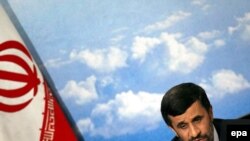
WASHINGTON -- Iranian President Mahmud Ahmadinejad left no doubt about Iran's ambitions.
"We need to spread out to numerous sites to produce nuclear fuel for us. We shall build 10 new uranium enrichment plants," he said on state television on November 29.
"The new enrichment facilities will be the same size as our main enrichment complex at Natanz and work will begin within two months. So, in total, we need to have 10 new sites for developing our enrichment activities."
 Ahmadinejad's announcement surprised even seasoned Iran watchers.
Tehran and the international community have been deadlocked over a UN-drafted proposal to send most of Iran's enriched uranium abroad in a deal that would guarantee it couldn't produce a nuclear bomb but would still allow it to operate its medical research program.
But few observers could have anticipated that at this point in negotiations, the country would announce an expansion of its enrichment program.
The head of Iran's Atomic Energy Organization, Ali Akbar Salehi, told state radio that the government's decision was a direct response to an almost unanimous November 27 vote by the UN's nuclear watchdog, the International Atomic Energy Agency (IAEA), in favor of a resolution condemning Iran's nuclear activities and demanding that the country halt all uranium-enrichment activities.
Iran says its nuclear program is peaceful and that it has a right to uranium enrichment to produce fuel for reactors that will generate electricity. The West is concerned that it is pursuing a weapons program.
'Political Reaction'
Iran is clearly angry about the IAEA vote, but is it serious about building up to 10 new uranium-enrichment plants?
"I think it's bluster. I think that there is little way forward for them, technically, to launch and maintain a program of that scale," says Jacqueline Shire, a senior analyst at the Institute for Science and International Security in Washington, D.C. Shire spent eight years in the U.S. State Department's Bureau of Political Military Affairs working on proliferation, disarmament, and WMD policy at the United Nations.
"I think we should see this," she says, "as very much a political reaction to a resolution that angered the Iranian government and came back swinging with something that it knew would upset and further aggravate tensions over their nuclear program with the wider international community."
James Acton agrees. He's an expert in nonproliferation and disarmament issues at the Carnegie Endowment For International Peace who has advised the Norwegian government and lectured in the Department of War Studies at King's College London.
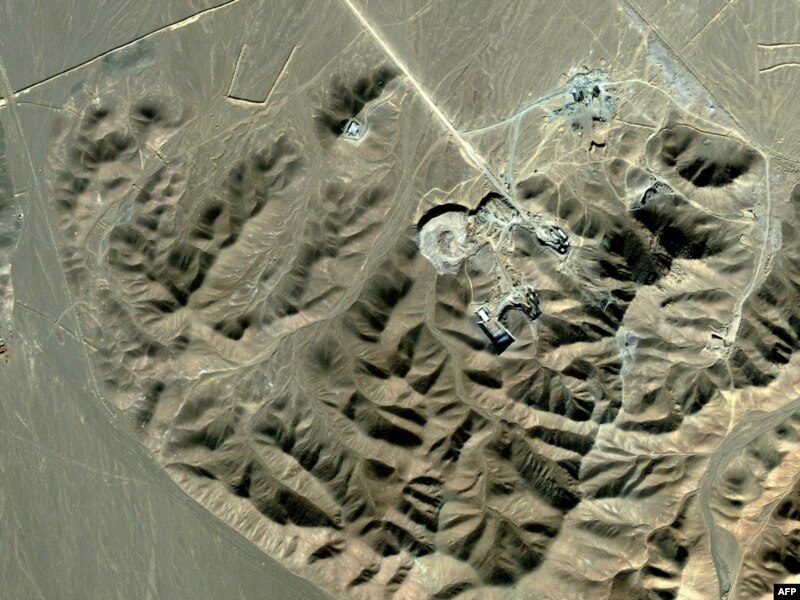
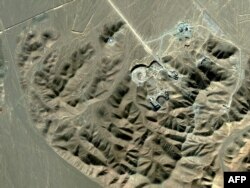 A satellite image of a suspected uranium-enrichment facility near Qom"It's bluster. The resources required to build 10 centrifuge-enrichment plants are very considerable," Acton says. "I mean, I'm not only talking about building the facilities here but even just building enough centrifuges are very, very considerable and probably beyond Iran's reach.
"So the idea that Iran will complete 10 enrichment plants in...five or six years is just nonsense."
Acton says Iran is sending a political message that it isn't going to be intimidated by pressure from the international community.
"The signal Iran is trying to send is, the tighter you clamp down on us, the more we will rebel against you, as it were," he says. "I think it's a signal which I think it's very unlikely the international community will heed, and neither do I think should they heed this signal."
'Just Ignore It'
Shire also says the international community should not react, for now.
"I think that the international community should just ignore it for right now. I think we should pay more attention to Iran's actions, the specific things Iran does, and ignore hyperbole from its leadership at this moment," Shire says.
Still, Acton points out that Iran is defying the international community on a number of issues. It is in breach of its safeguard agreements and there are serious unanswered questions about its nuclear program, he says, especially related to its weaponization activities.
As someone who has worked closely with European countries on the nonproliferation agenda, he says it's critical these questions are fully investigated. So even though Iran reacts with anger and threats, the international community should not stop seeking answers.
The White House takes the same view. Spokesman Robert Gibbs has said that its "patience and that of the international community is limited and time is running out."
"The Iranians have been rebuked for their actions by a single, strong international voice through a strong vote in the IAEA Board of Governors," Gibbs said on November 30. "If they make a decision to fulfill their responsibilities and obligations, then the international community would welcome that. If they decide not to fulfill those responsibilities and obligations, then all I could say to the Iranians is, time is running out."
Obama administration officials have indicated that a move toward targeted economic sanctions could come as early as January if Tehran doesn't demonstrate a willingness to engage constructively before the end of the year.
The Big Question
Acton says that's a scenario he also sees.
"I think unless something radically different happens between now and the end of the year, which is very unlikely, I think it is now very, very probable that the U.S. is going to seek tougher sanctions on Iran early next year," Acton says.
The big question now is whether Russia and China will go along with such sanctions. In something of a first, both countries supported the IAEA resolution last week.
In the past, each has used its veto power in the UN Security Council to oppose sanctions against Iran. But U.S. officials have been working behind the scenes with Moscow and Beijing to convince them of the threat they believe Iran poses.
White House officials said over the weekend they are optimistic about their chances of getting both nations to support action in the Security Council.
But Shire cautions against assuming that Russian and China are on board just because of their votes on November 27. She calls their support for the IAEA resolution "a significant first step" toward bringing them in line with the U.S. and EU position, but says since the resolution didn't contain any actual punishment, it can't be seen as a sign that the two will also support sanctions.
Abbas Milani is the director of Iranian studies at Stanford University and the co-director of the Iran Democracy Project at the Hoover Institution. Like Shire and Acton, he sees Iran's announcement as little more than political posturing.
"I think it's an embarrassing bluster and bluff," Milani says. "Sounds to me like the kind of fantastic dream that Mr. Ahmadinejad has become notorious for."
Milani points out that there is a resolution currently in the Iranian parliament asking the government to withdraw from the Nuclear Nonproliferation Treaty (NPT), but says that, like the threat to build 10 new enrichment facilities, it's a bluff.
By his count, the Iranian government has threatened to pull out of the NPT at least five times before.
"In each case, they were empty bluffs. They cannot count on the continued support of Russia and China if they withdraw from NPT and they need, desperately, Russia and China," Milani says. "Without them, the regime will collapse."
'Irrational Policy Changes'
Like Acton and Shire, Milani thinks the international community should note Iran's words, but nothing more for now. He believes Ahmadinejad's announcement reveals more about the health of the regime than Iran's own leaders probably realize.
He says Iran's behavior over the last few months -- from agreeing in Geneva to export low-enriched uranium to France and Russia to the latest announcement concerning the 10 new enrichment facilities -- reveals a pattern of what he calls "irrational policy changes from a regime that is in deep crisis domestically."
"To me, these rather unpredictable and radical gyrations indicate that they have lost the cohesion in the regime that they had and continue to face a serious domestic crisis of authority and crisis of leadership," Milani says.
The crisis is so bad, he says, that if the West decides to impose targeted economic sanctions -- as it has strongly hinted it will -- he believes the Iranian people would "welcome it."
Especially, he adds, if sanctions target the Revolutionary Guards, the group of powerful government and business elites that many say now represents the real power in Iran.
"We need to spread out to numerous sites to produce nuclear fuel for us. We shall build 10 new uranium enrichment plants," he said on state television on November 29.
"The new enrichment facilities will be the same size as our main enrichment complex at Natanz and work will begin within two months. So, in total, we need to have 10 new sites for developing our enrichment activities."

Tehran and the international community have been deadlocked over a UN-drafted proposal to send most of Iran's enriched uranium abroad in a deal that would guarantee it couldn't produce a nuclear bomb but would still allow it to operate its medical research program.
But few observers could have anticipated that at this point in negotiations, the country would announce an expansion of its enrichment program.
The head of Iran's Atomic Energy Organization, Ali Akbar Salehi, told state radio that the government's decision was a direct response to an almost unanimous November 27 vote by the UN's nuclear watchdog, the International Atomic Energy Agency (IAEA), in favor of a resolution condemning Iran's nuclear activities and demanding that the country halt all uranium-enrichment activities.
Iran says its nuclear program is peaceful and that it has a right to uranium enrichment to produce fuel for reactors that will generate electricity. The West is concerned that it is pursuing a weapons program.
'Political Reaction'
Iran is clearly angry about the IAEA vote, but is it serious about building up to 10 new uranium-enrichment plants?
"I think it's bluster. I think that there is little way forward for them, technically, to launch and maintain a program of that scale," says Jacqueline Shire, a senior analyst at the Institute for Science and International Security in Washington, D.C. Shire spent eight years in the U.S. State Department's Bureau of Political Military Affairs working on proliferation, disarmament, and WMD policy at the United Nations.
"I think we should see this," she says, "as very much a political reaction to a resolution that angered the Iranian government and came back swinging with something that it knew would upset and further aggravate tensions over their nuclear program with the wider international community."
James Acton agrees. He's an expert in nonproliferation and disarmament issues at the Carnegie Endowment For International Peace who has advised the Norwegian government and lectured in the Department of War Studies at King's College London.
"So the idea that Iran will complete 10 enrichment plants in...five or six years is just nonsense."
Acton says Iran is sending a political message that it isn't going to be intimidated by pressure from the international community.
"The signal Iran is trying to send is, the tighter you clamp down on us, the more we will rebel against you, as it were," he says. "I think it's a signal which I think it's very unlikely the international community will heed, and neither do I think should they heed this signal."
'Just Ignore It'
Shire also says the international community should not react, for now.
"I think that the international community should just ignore it for right now. I think we should pay more attention to Iran's actions, the specific things Iran does, and ignore hyperbole from its leadership at this moment," Shire says.
Still, Acton points out that Iran is defying the international community on a number of issues. It is in breach of its safeguard agreements and there are serious unanswered questions about its nuclear program, he says, especially related to its weaponization activities.
As someone who has worked closely with European countries on the nonproliferation agenda, he says it's critical these questions are fully investigated. So even though Iran reacts with anger and threats, the international community should not stop seeking answers.
The White House takes the same view. Spokesman Robert Gibbs has said that its "patience and that of the international community is limited and time is running out."
"The Iranians have been rebuked for their actions by a single, strong international voice through a strong vote in the IAEA Board of Governors," Gibbs said on November 30. "If they make a decision to fulfill their responsibilities and obligations, then the international community would welcome that. If they decide not to fulfill those responsibilities and obligations, then all I could say to the Iranians is, time is running out."
Obama administration officials have indicated that a move toward targeted economic sanctions could come as early as January if Tehran doesn't demonstrate a willingness to engage constructively before the end of the year.
The Big Question
Acton says that's a scenario he also sees.
"I think unless something radically different happens between now and the end of the year, which is very unlikely, I think it is now very, very probable that the U.S. is going to seek tougher sanctions on Iran early next year," Acton says.
The big question now is whether Russia and China will go along with such sanctions. In something of a first, both countries supported the IAEA resolution last week.
I think it's an embarrassing bluster and bluff. Sounds to me like the kind of fantastic dream that Mr. Ahmadinejad has become notorious for.

White House officials said over the weekend they are optimistic about their chances of getting both nations to support action in the Security Council.
But Shire cautions against assuming that Russian and China are on board just because of their votes on November 27. She calls their support for the IAEA resolution "a significant first step" toward bringing them in line with the U.S. and EU position, but says since the resolution didn't contain any actual punishment, it can't be seen as a sign that the two will also support sanctions.
Abbas Milani is the director of Iranian studies at Stanford University and the co-director of the Iran Democracy Project at the Hoover Institution. Like Shire and Acton, he sees Iran's announcement as little more than political posturing.
"I think it's an embarrassing bluster and bluff," Milani says. "Sounds to me like the kind of fantastic dream that Mr. Ahmadinejad has become notorious for."
Milani points out that there is a resolution currently in the Iranian parliament asking the government to withdraw from the Nuclear Nonproliferation Treaty (NPT), but says that, like the threat to build 10 new enrichment facilities, it's a bluff.
By his count, the Iranian government has threatened to pull out of the NPT at least five times before.
"In each case, they were empty bluffs. They cannot count on the continued support of Russia and China if they withdraw from NPT and they need, desperately, Russia and China," Milani says. "Without them, the regime will collapse."
'Irrational Policy Changes'
Like Acton and Shire, Milani thinks the international community should note Iran's words, but nothing more for now. He believes Ahmadinejad's announcement reveals more about the health of the regime than Iran's own leaders probably realize.
He says Iran's behavior over the last few months -- from agreeing in Geneva to export low-enriched uranium to France and Russia to the latest announcement concerning the 10 new enrichment facilities -- reveals a pattern of what he calls "irrational policy changes from a regime that is in deep crisis domestically."
"To me, these rather unpredictable and radical gyrations indicate that they have lost the cohesion in the regime that they had and continue to face a serious domestic crisis of authority and crisis of leadership," Milani says.
The crisis is so bad, he says, that if the West decides to impose targeted economic sanctions -- as it has strongly hinted it will -- he believes the Iranian people would "welcome it."
Especially, he adds, if sanctions target the Revolutionary Guards, the group of powerful government and business elites that many say now represents the real power in Iran.