





YEREVAN -- Nune Hambardzumian was evicted from her home in downtown Yerevan in late December, as the authorities began clearing out residents to make room for new commercial and residential districts.
"This is anarchy! They can just come and throw you out of your house," she says. "This is my husband's ancestral home. But it turns out that one day you wake up and find out that it is already somebody else's property."
This is the dark side of urban renewal. As the Armenian capital undergoes a face-lift, with private investors moving in to gentrify what was once a dreary post-Soviet cityscape, residents like Hambardzumian are finding themselves kicked out of their homes with little or no compensation.
The Yerevan authorities are using eminent-domain legislation -- or as it is called in Armenia "prevailing public interest" -- to turn over entire neighborhoods to private developers, who then build lucrative high-end shops, hotels, restaurants, and upscale housing.
Thousands of families have been displaced in the past decade and some 30 neighborhoods in Yerevan are currently slated to be renovated under eminent domain. While such legislation has traditionally been reserved for public-works projects like schools and roads, it is increasingly being invoked to make way for commercial projects run by private investors.
Watch: Residents complain of being evicted from their homes in downtown Yerevan (in Armenian).
The State's Needs
"A redistribution of property is being carried out under the guise of state needs," says Sedrak Baghdasarian, head of the NGO Victims of the State's Needs, which helps evictees win adequate compensation in court.
"When I hear 'state needs,' I understand that to mean the construction of a reservoir or an airport. But look what the government has done -- it has taken property from one owner and handed it over to another to construct a building and make super profits."
When residents are evicted from their homes, Baghdasarian explains, they also lose their registration as residents of their district, meaning they are unable to vote in elections, get passports for their children, or use municipal services.
Baghdasarian himself was evicted from his home back in 2004 and offered just $300 per square meter in compensation, a fraction of the price new residences constructed in its place are now being sold for. After failing to win legal redress in Armenia, he and 15 other evictees have taken their case to the European Court of Human Rights.
Vahe Grigorian, an attorney who is representing some of the evicted tenants in the European Court, says Armenia's justice system is deeply corrupt and subservient to the authorities and real estate developers.
"The courts have been used as tools by the developers and the authorities in order to deprive people of their property and give them as little compensation as possible. It's very difficult to believe that courts have changed their ways now," Grigorian says.
"The real and primary reason for the wholesale violations of the rights of Yerevan residents is that there wasn't and isn't now a system of justice in the Republic of Armenia. The presence of any law by itself does not imply the protection of human rights."
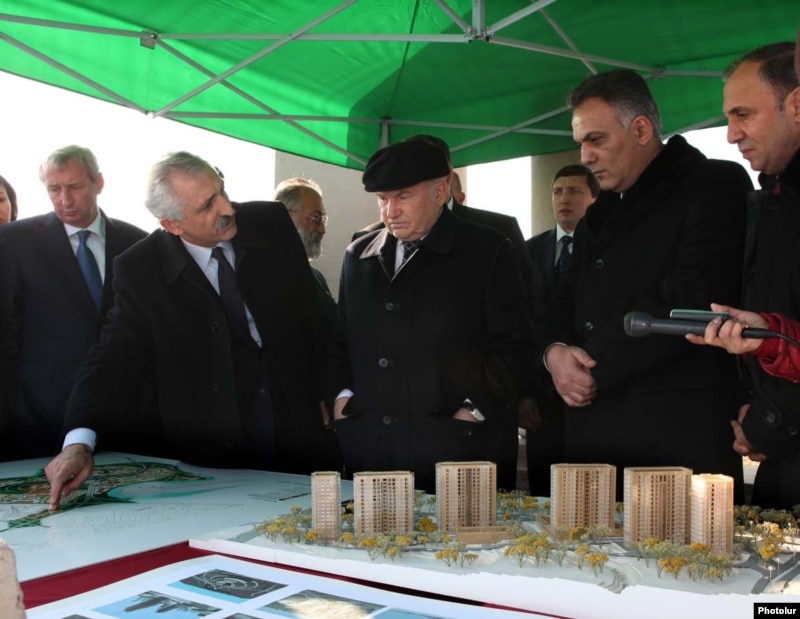
 Moscow Mayor Yury Luzhkov (center) and Armenian officials discuss a major redevelopment project.Yerevan officials say they are simply trying to improve the city, and need private investors to do so. "We are not depriving people of their property. We are simply dealing with the unsanitary condition of the city," says Levon Hakobian, the director of the department dealing with construction in Yerevan's City Hall.
"The whole purpose of this development is to implement an urban development project so that the city will be beautiful," Hakobian adds. "And they [the residents] are trying to get as much money as they can, which is natural. What else can you say?"
Luzhkov Branches Out
The wave of redevelopment in Yerevan began a decade ago, in 2000, with the Northern Avenue project, a pedestrian boulevard in downtown Yerevan that now houses chic boutiques, shops, and cafes.
According to local media reports, a key investor in that project was the Russia-based company Inteko, which is controlled by Yelena Baturina, the wife of Moscow's powerful Mayor Yury Luzhkov.
The Moscow mayor has already expressed interest in another planned urban-renewal project in Yerevan, a business center in the city's central Noragyugh district. The $6 billion project will be spread across 184 hectares and will also include residential properties and foreign embassies.
Luzhkov himself visited Yerevan in January and toured the site with Yerevan Mayor Gagik Beglarian. Luzhkov said at the time that the "location is good.... That's why we will pay serious attention to this project." Luzhkov added that his first deputy mayor would visit Yerevan in March, when construction is scheduled to commence, to further assess the project.
Luzhkov has his own problems related to real estate development back home. Critics have long accused him of staging regular "land grabs" in order to clear prime real estate of low-budget tenants in order to move ahead with lucrative development plans. Most recently, residents of the Moscow suburb of Rechnik resisted efforts to evict them.
For his part, Beglarian assured Luzhkov that he would "do everything" to assure that the residents of Noragyugh "move from here gladly." Beglarian said the residents would be relocated to new apartments elsewhere in the city.
But that is small comfort to those currently living in Noragyugh, as they anxiously await their fates.
"If you were in my place, wouldn't you be afraid?" one resident asks. "They forced people in Northern Avenue out of their homes and did not pay proper compensation to them. People turned into tramps. Will the state give me the amenities that I already enjoy? No, it won't."
RFE/RL correspondent Brian Whitmore contributed to this report from Prague
"This is anarchy! They can just come and throw you out of your house," she says. "This is my husband's ancestral home. But it turns out that one day you wake up and find out that it is already somebody else's property."
This is the dark side of urban renewal. As the Armenian capital undergoes a face-lift, with private investors moving in to gentrify what was once a dreary post-Soviet cityscape, residents like Hambardzumian are finding themselves kicked out of their homes with little or no compensation.
The Yerevan authorities are using eminent-domain legislation -- or as it is called in Armenia "prevailing public interest" -- to turn over entire neighborhoods to private developers, who then build lucrative high-end shops, hotels, restaurants, and upscale housing.
Thousands of families have been displaced in the past decade and some 30 neighborhoods in Yerevan are currently slated to be renovated under eminent domain. While such legislation has traditionally been reserved for public-works projects like schools and roads, it is increasingly being invoked to make way for commercial projects run by private investors.
Watch: Residents complain of being evicted from their homes in downtown Yerevan (in Armenian).
The State's Needs
"A redistribution of property is being carried out under the guise of state needs," says Sedrak Baghdasarian, head of the NGO Victims of the State's Needs, which helps evictees win adequate compensation in court.
"When I hear 'state needs,' I understand that to mean the construction of a reservoir or an airport. But look what the government has done -- it has taken property from one owner and handed it over to another to construct a building and make super profits."
When residents are evicted from their homes, Baghdasarian explains, they also lose their registration as residents of their district, meaning they are unable to vote in elections, get passports for their children, or use municipal services.
Baghdasarian himself was evicted from his home back in 2004 and offered just $300 per square meter in compensation, a fraction of the price new residences constructed in its place are now being sold for. After failing to win legal redress in Armenia, he and 15 other evictees have taken their case to the European Court of Human Rights.
Vahe Grigorian, an attorney who is representing some of the evicted tenants in the European Court, says Armenia's justice system is deeply corrupt and subservient to the authorities and real estate developers.
"The courts have been used as tools by the developers and the authorities in order to deprive people of their property and give them as little compensation as possible. It's very difficult to believe that courts have changed their ways now," Grigorian says.
"The real and primary reason for the wholesale violations of the rights of Yerevan residents is that there wasn't and isn't now a system of justice in the Republic of Armenia. The presence of any law by itself does not imply the protection of human rights."
"The whole purpose of this development is to implement an urban development project so that the city will be beautiful," Hakobian adds. "And they [the residents] are trying to get as much money as they can, which is natural. What else can you say?"
Luzhkov Branches Out
The wave of redevelopment in Yerevan began a decade ago, in 2000, with the Northern Avenue project, a pedestrian boulevard in downtown Yerevan that now houses chic boutiques, shops, and cafes.
According to local media reports, a key investor in that project was the Russia-based company Inteko, which is controlled by Yelena Baturina, the wife of Moscow's powerful Mayor Yury Luzhkov.
The Moscow mayor has already expressed interest in another planned urban-renewal project in Yerevan, a business center in the city's central Noragyugh district. The $6 billion project will be spread across 184 hectares and will also include residential properties and foreign embassies.
Luzhkov himself visited Yerevan in January and toured the site with Yerevan Mayor Gagik Beglarian. Luzhkov said at the time that the "location is good.... That's why we will pay serious attention to this project." Luzhkov added that his first deputy mayor would visit Yerevan in March, when construction is scheduled to commence, to further assess the project.
Luzhkov has his own problems related to real estate development back home. Critics have long accused him of staging regular "land grabs" in order to clear prime real estate of low-budget tenants in order to move ahead with lucrative development plans. Most recently, residents of the Moscow suburb of Rechnik resisted efforts to evict them.
For his part, Beglarian assured Luzhkov that he would "do everything" to assure that the residents of Noragyugh "move from here gladly." Beglarian said the residents would be relocated to new apartments elsewhere in the city.
But that is small comfort to those currently living in Noragyugh, as they anxiously await their fates.
"If you were in my place, wouldn't you be afraid?" one resident asks. "They forced people in Northern Avenue out of their homes and did not pay proper compensation to them. People turned into tramps. Will the state give me the amenities that I already enjoy? No, it won't."
RFE/RL correspondent Brian Whitmore contributed to this report from Prague