





Strategic relationship? What strategic relationship? "I don't think we can use that word anymore," one Turkish official grimly opined, describing the diplomatic aftermath of Israel's deadly commando raid on an aid flotilla bound for the Gaza Strip with Ankara's blessing.
With that terse assessment, an intimate bilateral partnership that spawned not only burgeoning trade and arms ties, but a mutual trust prompting intensive diplomatic efforts by Turkey to mediate between Israel and its Arab adversaries, finally bit the dust.
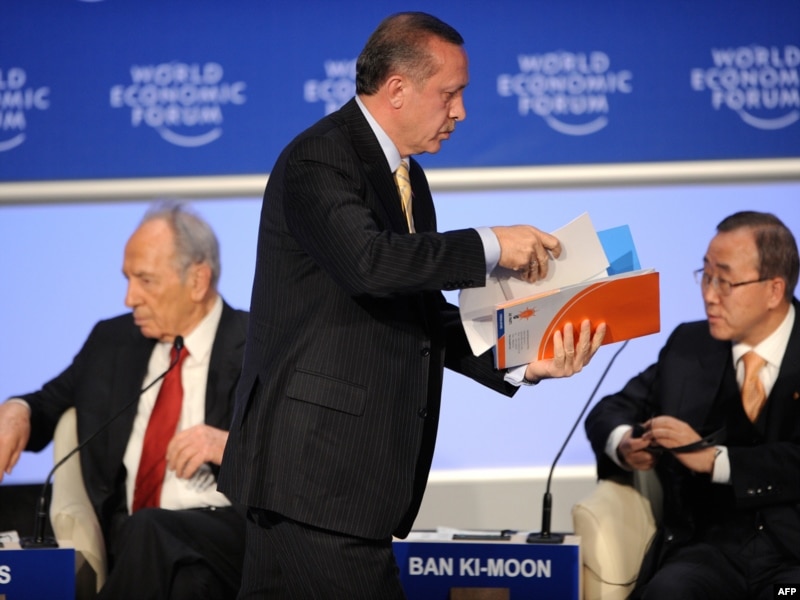
 Relations between Ankara and Tel Aviv have been on a downward spiral for 18 months -- ever since a prolonged Israeli military assault on Gaza that left around 1,300 Palestinians dead triggered a furious backlash in Turkey. That culminated in Turkey's tempestuous prime minister, Recep Tayyip Erdogan, storming out of a debate at the World Economic Forum in Davos in January last year after clashing with the Israeli president, Shimon Peres.
Things were subsequently patched up -- at least publicly -- despite the persistence of underlying tensions. The pattern repeated itself when Turkey blackballed Israel from taking part in NATO military maneuvers last October, and then again in January, when Israeli Deputy Foreign Minister Danny Ayalon deliberately humiliated Turkey's ambassador to Tel Aviv, Ahmet Oguz Celikkol, by upbraiding him before television cameras over a Turkish TV series that depicted Israeli intelligence agents as baby snatchers.
'Serious Ramifications'
The chances of a similar kiss-and-make-up this time are much slimmer. Despite talk among officials of using "silent diplomacy" to "salvage as much as we can," the outlook for a relationship once described as "perfect" by the Israeli Foreign Ministry appears bleak. That description may have been part self-delusion; in truth, things have been on the slide since Turkey hosted the exiled Hamas leader, Khalid Mishaal, in 2006, much to Israeli dismay.
 An Israeli military vessel (left) escorts one of the boats from the Gaza-bound aid flotilla."Relations were not very rosy anyway. This will make things go further back," said the Turkish official, who was speaking on condition of anonymity. "I don't know how we are going to get past this.... It's looking very bad."
His comments came before the Turkish cabinet announced it was requesting an emergency meeting of the UN Security Council -- of which Turkey is currently a member -- and withdrawing Celikkol from his ambassador's post in Israel. A decision by Turkish Foreign Minister Ahmet Davutoglu to cancel a scheduled meeting in Washington with U.S. Secretary of State Hillary Clinton and fly instead to New York, where he was expected to confer with officials at the UN, suggests tensions had assumed international crisis proportions.
Mensur Akgun, foreign-policy program director at the Turkish Economic and Social Studies Foundation, an Istanbul-based think tank, says the latest incident dwarfs previous disagreements and could have long-term effects on Turkish foreign policy.
"It's much more significant," Akgun says. "It will have long-lasting ramifications for the bilateral relations and, depending on the reactions of the EU and also the U.S. and probably within the Security Council framework, Turkey's near foreign policy will be reshaped."
'Worst Kind Of Prevention'
That the May 31 storming of the Turkish vessel, the "Mavi Marmara" -- with the death of at least 10 activists, including Turks -- happened at all is a graphic demonstration of the extent to which Turkish-Israeli relations had already become a dialogue of the deaf.
Officials in Turkey's Justice and Development Party (AKP) government had been expressing concerns for months about a worsening humanitarian situation in Gaza and had accused the world of turning a blind eye.
 Turkish TV shows Israeli commandos storming the 'Mavi Marmara' off Gaza.One of the most striking disclosures to emerge after the incident was that Davutoglu had held talks about the aid convoy with Israeli Defense Minister Ehud Barak as it sailed toward Gaza. Davutoglu, who has publicly pursued a policy of "zero problems" with Turkey's neighbors, is said to have stressed that its purpose was humanitarian and that Turkey did not want any "incidents."
Selim Yenel, deputy undersecretary at the Turkish Foreign Ministry, acknowledges that Israel had expressed its determination to prevent the ship reaching Gaza, but says Turkey's anger is directed at the lethal use of force, which he describes as "the worst kind of prevention."
"The Israelis had told us that they didn't want this, that they would take necessary measures," he says, "but, look, this is a ship of peaceful intent carrying only humanitarian aid and of course the Israelis may not want it to come through to one of the ports. But the way to prevent this, there are many ways to do it and many them, actually, do not entail force."
End Of The Affair
In their depiction of the raid as a breach of international law, Turkish diplomats are also stressing that the incident happened 70 nautical miles off Gaza's coast, well outside the 20-mile exclusion zone Israel has imposed around the territory.
They are pinning the blame for the decline in relations on the uncompromising approach of the current Israeli coalition government, led by Prime Minister Binyamin Netanyahu, and especially on its hard-line foreign minister, Avigdor Lieberman, who has dismissed reports of a humanitarian crisis in Gaza, which Israel regards as the incorrigible heartland of its bete noir, Hamas.
 Turkey's Erdogan leaves a debate with Israel's Peres (left) -- a sign of things to come?Akgun says the deaths of Turkish nationals ensures that public opinion -- a factor the Erdogan government has already stressed as its attitude to Israel has grown more critical -- will play a key role in how the crisis unfolds. "On such an issue, they cannot neglect public opinion," he says. "It's hardly possible that Turks will forget what has happened to this 'Mavi Marmara ship.'"
The strength of public sentiment was clear in the angry crowds that gathered outside the Israeli Consulate in Istanbul this morning, in scenes that reprised the anti-Israel feeling that was widespread in Turkey during last year's bombardment of Gaza.
Erdogan played to those emotions with his histrionic walkout at Davos, which led to him being given a hero's welcome by cheering crowds when he arrived back at Istanbul's Ataturk airport.
With a general election due in Turkey within the next year, the temptation to use hostility toward Israel as a potential vote winner will loom large.
Meanwhile, a once-harmonious relationship that saw Peres address the Turkish parliament and frequent mutual exchanges of senior ministers appears doomed to wither on the vine. Turkey may be seeing more of Mishaal and his allies in future.
With that terse assessment, an intimate bilateral partnership that spawned not only burgeoning trade and arms ties, but a mutual trust prompting intensive diplomatic efforts by Turkey to mediate between Israel and its Arab adversaries, finally bit the dust.
Things were subsequently patched up -- at least publicly -- despite the persistence of underlying tensions. The pattern repeated itself when Turkey blackballed Israel from taking part in NATO military maneuvers last October, and then again in January, when Israeli Deputy Foreign Minister Danny Ayalon deliberately humiliated Turkey's ambassador to Tel Aviv, Ahmet Oguz Celikkol, by upbraiding him before television cameras over a Turkish TV series that depicted Israeli intelligence agents as baby snatchers.
'Serious Ramifications'
The chances of a similar kiss-and-make-up this time are much slimmer. Despite talk among officials of using "silent diplomacy" to "salvage as much as we can," the outlook for a relationship once described as "perfect" by the Israeli Foreign Ministry appears bleak. That description may have been part self-delusion; in truth, things have been on the slide since Turkey hosted the exiled Hamas leader, Khalid Mishaal, in 2006, much to Israeli dismay.

His comments came before the Turkish cabinet announced it was requesting an emergency meeting of the UN Security Council -- of which Turkey is currently a member -- and withdrawing Celikkol from his ambassador's post in Israel. A decision by Turkish Foreign Minister Ahmet Davutoglu to cancel a scheduled meeting in Washington with U.S. Secretary of State Hillary Clinton and fly instead to New York, where he was expected to confer with officials at the UN, suggests tensions had assumed international crisis proportions.
Mensur Akgun, foreign-policy program director at the Turkish Economic and Social Studies Foundation, an Istanbul-based think tank, says the latest incident dwarfs previous disagreements and could have long-term effects on Turkish foreign policy.
"It's much more significant," Akgun says. "It will have long-lasting ramifications for the bilateral relations and, depending on the reactions of the EU and also the U.S. and probably within the Security Council framework, Turkey's near foreign policy will be reshaped."
'Worst Kind Of Prevention'
That the May 31 storming of the Turkish vessel, the "Mavi Marmara" -- with the death of at least 10 activists, including Turks -- happened at all is a graphic demonstration of the extent to which Turkish-Israeli relations had already become a dialogue of the deaf.
Officials in Turkey's Justice and Development Party (AKP) government had been expressing concerns for months about a worsening humanitarian situation in Gaza and had accused the world of turning a blind eye.

Selim Yenel, deputy undersecretary at the Turkish Foreign Ministry, acknowledges that Israel had expressed its determination to prevent the ship reaching Gaza, but says Turkey's anger is directed at the lethal use of force, which he describes as "the worst kind of prevention."
"The Israelis had told us that they didn't want this, that they would take necessary measures," he says, "but, look, this is a ship of peaceful intent carrying only humanitarian aid and of course the Israelis may not want it to come through to one of the ports. But the way to prevent this, there are many ways to do it and many them, actually, do not entail force."
End Of The Affair
In their depiction of the raid as a breach of international law, Turkish diplomats are also stressing that the incident happened 70 nautical miles off Gaza's coast, well outside the 20-mile exclusion zone Israel has imposed around the territory.
They are pinning the blame for the decline in relations on the uncompromising approach of the current Israeli coalition government, led by Prime Minister Binyamin Netanyahu, and especially on its hard-line foreign minister, Avigdor Lieberman, who has dismissed reports of a humanitarian crisis in Gaza, which Israel regards as the incorrigible heartland of its bete noir, Hamas.
The strength of public sentiment was clear in the angry crowds that gathered outside the Israeli Consulate in Istanbul this morning, in scenes that reprised the anti-Israel feeling that was widespread in Turkey during last year's bombardment of Gaza.
Erdogan played to those emotions with his histrionic walkout at Davos, which led to him being given a hero's welcome by cheering crowds when he arrived back at Istanbul's Ataturk airport.
With a general election due in Turkey within the next year, the temptation to use hostility toward Israel as a potential vote winner will loom large.
Meanwhile, a once-harmonious relationship that saw Peres address the Turkish parliament and frequent mutual exchanges of senior ministers appears doomed to wither on the vine. Turkey may be seeing more of Mishaal and his allies in future.