



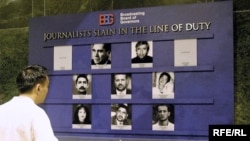
On July 15, the Broadcasting Board of Governors (BBG) dedicated a memorial in Washington to 10 journalists who have been killed since 1954 in connection with their reporting work.
The unveiling, at the headquarters of Voice of America (VOA) in Washington, was attended by representatives of all the media that fall under BBG supervision (including RFE/RL).
In opening that ceremony, BBG Governor Edward Kaufman noted that each of those men and women died for simply doing their job. He reminded the audience, which included representatives of the BBG's media organizations, of the difficulties that journalists face reporting in countries where independent news is most needed.
"You know better than I that we must overcome many obstacles, and one of the biggest is [that] the place we most want to broadcast are the places where the governments are least hospitable to what we're doing and hostile to a free press," Kaufman said. "So I want to thank all of our broadcasters -- past, present, and future -- and many of the people who are present here. We honor you in this today for your own work as we remember your fallen colleagues."
Steven Simmons, another BBG governor, said U.S. international broadcasting is most interested in these countries where newsgathering is difficult. He cited statistics from the advocacy group Reporters Without Borders and from Freedom House.
"Freedom House's annual report on world press freedom observes [that] 'for every step forward in press freedom last year, there were two steps back,'" Simmons said. "Sixty-six percent of the countries surveyed were rated either not free or only partially free as far as the press is concerned. BBG broadcasts to nine out of 10 of these countries, which cover wide areas of land mass -- from Asia to Africa to Eastern Europe to the Middle East."
Simmons reminded those in attendance that the memorial to the slain reporters is "a sad reminder" that they died fighting for freedom of information.
Another BBG governor, Joaquin Blaya, said this fight frequently requires only the most basic tools yet pays great dividends in popular enlightenment. He said repressive governments recognize this, and they fear it, and they fight back.
"By observing events, hearing others' perspectives, asking questions, and then sharing information, journalists fight against ignorance and misinformation throughout the world," Blaya said. "And while a journalist's tool box consists of pens, papers, and sometimes a laptop, camera, or microphone, the arsenal of the opponents of freedoms of the press too often includes fists, arrests, warrants, and -- as we acknowledge so vividly today -- murder."
Fellow BBG member Blanquita Walsh Cullum then shared brief obituaries of each of the 10 reporters. When she was done, she congratulated the media representatives by saying they were carrying on the tradition of their murdered colleagues, even if many don't always work in such dangerous circumstances.
After observing a moment of silence, Cullum urged those in attendance to regard the memorial as a reminder that the fight for freedom of information won't stop.
"My friends, when you go by that memorial, give [the photos of the slain journalists] a little thumbs up," Cullum said. "Remember that they doing what we are all about: trying to serve the people of the world who do not have access to the kinds of free press that our amazing entities provide. We bless them and their families, but we [also] bless you and thank you for the work that you do every day."

* Leonid Karas of RFE/RL, drowned in Germany in 1954 under suspicious circumstances.
* Abdulrachmann Fatalibey, of RFE/RL's Azerbaijani Service, was found strangled and beaten in Munich, also in 1954.
* Georgi Markov, of RFE/RL's Bulgarian Service, was poisoned with the lethal toxin ricin in London in 1978.
* Ricardo de Mello of VOA, was found shot to death in Luanda in 1995 while covering the Angolan civil war.
* Iskandar Khatloni, of RFE/RL, who covered the Soviet Union, including abuses in Chechnya, was fatally attacked in Moscow in 2000.
* Abdul-Hussein Khazal, a correspondent for the Middle East Broadcasting Network in Iraq, was shot to death -- along with his 3-year-old son -- as the two left their home in Al-Basrah.
* Ogulsapar Muradova of RFE/RL's Turkmenistan Service, was arrested and died in custody under mysterious circumstances. Family members cited marks of torture on her body.
* Khamail Muhsin Khalaf, of RFE/RL, covered Iraq. She was evidently tortured then shot to death in 2007.
* Nazar Abdulwahid al-Radhi, an RFE/RL correspondent in Iraq, was shot to death in 2007.
* Alisher Saipov, who worked for both VOA and RFE/RL, reported on the Ferghana Valley shared by Kyrgyzstan, Tajikistan, and Uzbekistan. Saipov was shot to death in 2007.
The unveiling, at the headquarters of Voice of America (VOA) in Washington, was attended by representatives of all the media that fall under BBG supervision (including RFE/RL).
In opening that ceremony, BBG Governor Edward Kaufman noted that each of those men and women died for simply doing their job. He reminded the audience, which included representatives of the BBG's media organizations, of the difficulties that journalists face reporting in countries where independent news is most needed.
"You know better than I that we must overcome many obstacles, and one of the biggest is [that] the place we most want to broadcast are the places where the governments are least hospitable to what we're doing and hostile to a free press," Kaufman said. "So I want to thank all of our broadcasters -- past, present, and future -- and many of the people who are present here. We honor you in this today for your own work as we remember your fallen colleagues."
Steven Simmons, another BBG governor, said U.S. international broadcasting is most interested in these countries where newsgathering is difficult. He cited statistics from the advocacy group Reporters Without Borders and from Freedom House.
"Freedom House's annual report on world press freedom observes [that] 'for every step forward in press freedom last year, there were two steps back,'" Simmons said. "Sixty-six percent of the countries surveyed were rated either not free or only partially free as far as the press is concerned. BBG broadcasts to nine out of 10 of these countries, which cover wide areas of land mass -- from Asia to Africa to Eastern Europe to the Middle East."
Simmons reminded those in attendance that the memorial to the slain reporters is "a sad reminder" that they died fighting for freedom of information.
Another BBG governor, Joaquin Blaya, said this fight frequently requires only the most basic tools yet pays great dividends in popular enlightenment. He said repressive governments recognize this, and they fear it, and they fight back.
"By observing events, hearing others' perspectives, asking questions, and then sharing information, journalists fight against ignorance and misinformation throughout the world," Blaya said. "And while a journalist's tool box consists of pens, papers, and sometimes a laptop, camera, or microphone, the arsenal of the opponents of freedoms of the press too often includes fists, arrests, warrants, and -- as we acknowledge so vividly today -- murder."
Fellow BBG member Blanquita Walsh Cullum then shared brief obituaries of each of the 10 reporters. When she was done, she congratulated the media representatives by saying they were carrying on the tradition of their murdered colleagues, even if many don't always work in such dangerous circumstances.
After observing a moment of silence, Cullum urged those in attendance to regard the memorial as a reminder that the fight for freedom of information won't stop.
"My friends, when you go by that memorial, give [the photos of the slain journalists] a little thumbs up," Cullum said. "Remember that they doing what we are all about: trying to serve the people of the world who do not have access to the kinds of free press that our amazing entities provide. We bless them and their families, but we [also] bless you and thank you for the work that you do every day."
Slain In The Line Of Duty
Slain In The Line Of Duty
* Leonid Karas of RFE/RL, drowned in Germany in 1954 under suspicious circumstances.
* Abdulrachmann Fatalibey, of RFE/RL's Azerbaijani Service, was found strangled and beaten in Munich, also in 1954.
* Georgi Markov, of RFE/RL's Bulgarian Service, was poisoned with the lethal toxin ricin in London in 1978.
* Ricardo de Mello of VOA, was found shot to death in Luanda in 1995 while covering the Angolan civil war.
* Iskandar Khatloni, of RFE/RL, who covered the Soviet Union, including abuses in Chechnya, was fatally attacked in Moscow in 2000.
* Abdul-Hussein Khazal, a correspondent for the Middle East Broadcasting Network in Iraq, was shot to death -- along with his 3-year-old son -- as the two left their home in Al-Basrah.
* Ogulsapar Muradova of RFE/RL's Turkmenistan Service, was arrested and died in custody under mysterious circumstances. Family members cited marks of torture on her body.
* Khamail Muhsin Khalaf, of RFE/RL, covered Iraq. She was evidently tortured then shot to death in 2007.
* Nazar Abdulwahid al-Radhi, an RFE/RL correspondent in Iraq, was shot to death in 2007.
* Alisher Saipov, who worked for both VOA and RFE/RL, reported on the Ferghana Valley shared by Kyrgyzstan, Tajikistan, and Uzbekistan. Saipov was shot to death in 2007.