




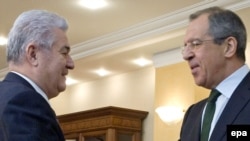
Russian President Dmitry Medvedev met in Moscow this week with Moldovan President Vladimir Voronin and the head of the unrecognized breakaway region of Transdniester, Igor Smirnov. The final statement of the tripartite talks contains no legal commitments, but the meeting itself could have negative political implications for Moldova.
The joint statement praised the Russian-commanded peacekeeping troops -- the same forces that Moldovan Foreign Minister Andrei Stratan told an OSCE Ministerial Council meeting in December 2004 were stationed on Moldovan territory "against the political will of the Moldovan constitutional authorities in defiance of unanimously recognized international norms and principles."
The statement, however, does express a joint desire by the three leaders that the peacekeeping force be placed under a mandate from the Organization for Security and Cooperation in Europe (OSCE).
Three Agendas
Each of the three men went into the March 18 meeting with his own agenda. Voronin, who wanted the meeting most, was eager for a photo-op with Medvedev, who is the second-most-popular politician in Moldova after Russian Prime Minister Vladimir Putin, ahead of Moldova's April 5 parliamentary elections. Voronin's Communist Party counts heavily on the votes of ethnic Russians and on those of ethnic Moldovans whose jobs depend on Russia.
Medvedev, for his part, was seeking to rehabilitate Russia's reputation in the wake of August's war with Georgia, to show the world that Moscow can play a mediating role as a good neighbor. But in doing so, Russia has downplayed the 5+2 negotiating format (which includes the European Union, the United States, the OSCE, Russia, and Ukraine, in addition to Moldova and Transdniester) and pushed Moldova toward direct talks with Tiraspol under the Kremlin's auspices.
As for Smirnov, he is always ready to participate in whatever meetings in whatever format Moscow dictates. He is a Russian citizen who was sent to Moldova in 1987 in order to foment and lead a separatist movement to counterbalance the nationalist movement that was emerging in Chisinau. And he accomplished this task brilliantly.
The separatist protest on the eastern side of the Nistru River culminated in an armed uprising that turned into a bloody conflict in the summer of 1992. Moldova's central leadership and armed forces were weak and soon yielded to Russian-backed troops and security forces. The Moldavian Trans-Nistrian Republic (MTR), also called Transnistria or Transdniester, was born.
Participant Or 'Guarantor'?
When a cease-fire agreement was signed on July 7, 1992, by Russian President Boris Yeltsin and Moldovan President Mircea Snegur, it seemed clear that Russia and Moldova were the two parties to this conflict. This interpretation was reinforced by a 2004 ruling of the European Court of Human Rights and by a 2006 study of the conflict by the New York City Bar Association titled "Thawing a Frozen Conflict: Legal Aspects of the Separatist Crisis in Moldova."
Nevertheless, Moscow has insisted that its pawn, the Tiraspol government, not Russia, was a party to the conflict. As in the cases of Georgia's breakaway regions of Abkhazia and South Ossetia, Russia declared itself a "mediator" in Moldova, later elevating itself to the status of "guarantor of the peace." Russia has used all its available political and economic levers to compel Moldova to accept these terms.
Every time Moldova made concessions in the dispute, Russia consolidated its position. In 1994, Moldova accepted a Russian proposal on "synchronization" that would have made a Russian troop withdrawal contingent on a status agreement for the secessionist region. In 1997, the so-called Primakov memorandum (named after its promoter, Russian Foreign Minister Yevgeny Primakov) introduced the concept of a "common state," which was ultimately interpreted differently by all parties and led to no solutions.
The so-called Kyiv document of 2002, proposed by Moscow, stipulated the federalization of Moldova, a concept that was renewed in 2003 with the infamous Kozak memorandum (named for Dmitry Kozak, an aide to then Russian President Putin). That proposal was rejected by Voronin at the last minute under the pressure of street protests in Chisinau and on advice from the EU and the United States.
Moldova In 3-D
In 2004, nongovernmental Moldovan experts, working with Western analysts, offered an alternative plan for a federated Moldova. Called the "3-D strategy" (decriminalization, demilitarization, and democratization), this document has gained broad support in Moldova.
The plan called for strengthening the then-existing five-party negotiating format (Russia, Ukraine, and the OSCE, plus Moldova and Transdniester) with a 3+1+3 format (Russia, Ukraine, and Romania plus Molodova plus the EU, the United States, and the OSCE), thereby including the West and excluding Transdniester.
It also called for a border-monitoring mission along the Ukrainian-Moldovan border, a supervising authority, and an international civil provisional administration that would implement postconflict recovery plans.
The 3-D strategy was used by the Moldovan parliament to formulate three resolutions on the conflict that were adopted in June 2005 and the law on the basic principles of the special status of the localities on the eastern bank of the Nistru, which was adopted in July 2005. That year, Ukraine became actively involved in the negotiating process, putting forward its own plans and initiatives.
These, however, largely focused on democratization (through elections in Transdniester), which was counterproductive since the processes of decriminalization and demilitarization were stalled. As a result, any elections held could hardly be considered democratic.
Since 2005, both the United States and the EU have also stepped up their involvement, notably with the opening of the EU Border Assistance Mission (EUBAM) in December 2005.
Western Interest
Russia reluctantly accepted the West at the negotiating table, a reluctance driven by Moscow's view that the former Soviet republics form a special sphere of interest for Russia. Moscow also was unwilling to concede that after Romania joined NATO and the EU, Moldova had more in common with the West than with Russia, with which it does not have a common border.
When Moldova and Ukraine began implementing customs regulations in accordance with international norms in 2006, Russia responded by applying economic sanctions against Moldova. Moscow imposed an embargo on the importation of Moldovan wines and agricultural goods, an action that not only harmed Moldova, but also was a setback for Russia's bid to join the World Trade Organization (WTO).
No matter what government takes power after the April 5 elections in Moldova or who the new parliament selects as president, Moldova clearly needs to, as they say these days, push the reset button in relations with Russia.
Chisinau will have to stick solidly to the principles of international norms and agreements and push for Moscow to fulfill the commitments it has made within the framework of international organizations. It must reject a negotiating format that has no transparency for Moldova's Western partners.
The meeting in Moscow yesterday was a mistake -- it was wrong for Moldova to leave the room where its friends and neighbors were seated in order to deal with Russia behind the scenes. And most importantly, the 3-D strategy must remain Moldova's overarching framework for resolving the Transdniester dispute.
Vlad Spanu is the president of the Moldova Foundation in Washington. He served as a senior Moldovan diplomat between 1992 and 2001 and co-authored, with Andrei Brezianu, "The Historical Dictionary of Moldova." The views expressed in this commentary are the author's own and do not necessarily reflect those of RFE/RL
The joint statement praised the Russian-commanded peacekeeping troops -- the same forces that Moldovan Foreign Minister Andrei Stratan told an OSCE Ministerial Council meeting in December 2004 were stationed on Moldovan territory "against the political will of the Moldovan constitutional authorities in defiance of unanimously recognized international norms and principles."
The statement, however, does express a joint desire by the three leaders that the peacekeeping force be placed under a mandate from the Organization for Security and Cooperation in Europe (OSCE).
Three Agendas
Each of the three men went into the March 18 meeting with his own agenda. Voronin, who wanted the meeting most, was eager for a photo-op with Medvedev, who is the second-most-popular politician in Moldova after Russian Prime Minister Vladimir Putin, ahead of Moldova's April 5 parliamentary elections. Voronin's Communist Party counts heavily on the votes of ethnic Russians and on those of ethnic Moldovans whose jobs depend on Russia.
Medvedev, for his part, was seeking to rehabilitate Russia's reputation in the wake of August's war with Georgia, to show the world that Moscow can play a mediating role as a good neighbor. But in doing so, Russia has downplayed the 5+2 negotiating format (which includes the European Union, the United States, the OSCE, Russia, and Ukraine, in addition to Moldova and Transdniester) and pushed Moldova toward direct talks with Tiraspol under the Kremlin's auspices.
As for Smirnov, he is always ready to participate in whatever meetings in whatever format Moscow dictates. He is a Russian citizen who was sent to Moldova in 1987 in order to foment and lead a separatist movement to counterbalance the nationalist movement that was emerging in Chisinau. And he accomplished this task brilliantly.
The separatist protest on the eastern side of the Nistru River culminated in an armed uprising that turned into a bloody conflict in the summer of 1992. Moldova's central leadership and armed forces were weak and soon yielded to Russian-backed troops and security forces. The Moldavian Trans-Nistrian Republic (MTR), also called Transnistria or Transdniester, was born.
Participant Or 'Guarantor'?
When a cease-fire agreement was signed on July 7, 1992, by Russian President Boris Yeltsin and Moldovan President Mircea Snegur, it seemed clear that Russia and Moldova were the two parties to this conflict. This interpretation was reinforced by a 2004 ruling of the European Court of Human Rights and by a 2006 study of the conflict by the New York City Bar Association titled "Thawing a Frozen Conflict: Legal Aspects of the Separatist Crisis in Moldova."
Nevertheless, Moscow has insisted that its pawn, the Tiraspol government, not Russia, was a party to the conflict. As in the cases of Georgia's breakaway regions of Abkhazia and South Ossetia, Russia declared itself a "mediator" in Moldova, later elevating itself to the status of "guarantor of the peace." Russia has used all its available political and economic levers to compel Moldova to accept these terms.
Every time Moldova made concessions in the dispute, Russia consolidated its position. In 1994, Moldova accepted a Russian proposal on "synchronization" that would have made a Russian troop withdrawal contingent on a status agreement for the secessionist region. In 1997, the so-called Primakov memorandum (named after its promoter, Russian Foreign Minister Yevgeny Primakov) introduced the concept of a "common state," which was ultimately interpreted differently by all parties and led to no solutions.
The so-called Kyiv document of 2002, proposed by Moscow, stipulated the federalization of Moldova, a concept that was renewed in 2003 with the infamous Kozak memorandum (named for Dmitry Kozak, an aide to then Russian President Putin). That proposal was rejected by Voronin at the last minute under the pressure of street protests in Chisinau and on advice from the EU and the United States.
Moldova In 3-D
In 2004, nongovernmental Moldovan experts, working with Western analysts, offered an alternative plan for a federated Moldova. Called the "3-D strategy" (decriminalization, demilitarization, and democratization), this document has gained broad support in Moldova.
The plan called for strengthening the then-existing five-party negotiating format (Russia, Ukraine, and the OSCE, plus Moldova and Transdniester) with a 3+1+3 format (Russia, Ukraine, and Romania plus Molodova plus the EU, the United States, and the OSCE), thereby including the West and excluding Transdniester.
It also called for a border-monitoring mission along the Ukrainian-Moldovan border, a supervising authority, and an international civil provisional administration that would implement postconflict recovery plans.
The 3-D strategy was used by the Moldovan parliament to formulate three resolutions on the conflict that were adopted in June 2005 and the law on the basic principles of the special status of the localities on the eastern bank of the Nistru, which was adopted in July 2005. That year, Ukraine became actively involved in the negotiating process, putting forward its own plans and initiatives.
These, however, largely focused on democratization (through elections in Transdniester), which was counterproductive since the processes of decriminalization and demilitarization were stalled. As a result, any elections held could hardly be considered democratic.
Since 2005, both the United States and the EU have also stepped up their involvement, notably with the opening of the EU Border Assistance Mission (EUBAM) in December 2005.
Western Interest
Russia reluctantly accepted the West at the negotiating table, a reluctance driven by Moscow's view that the former Soviet republics form a special sphere of interest for Russia. Moscow also was unwilling to concede that after Romania joined NATO and the EU, Moldova had more in common with the West than with Russia, with which it does not have a common border.
When Moldova and Ukraine began implementing customs regulations in accordance with international norms in 2006, Russia responded by applying economic sanctions against Moldova. Moscow imposed an embargo on the importation of Moldovan wines and agricultural goods, an action that not only harmed Moldova, but also was a setback for Russia's bid to join the World Trade Organization (WTO).
No matter what government takes power after the April 5 elections in Moldova or who the new parliament selects as president, Moldova clearly needs to, as they say these days, push the reset button in relations with Russia.
Chisinau will have to stick solidly to the principles of international norms and agreements and push for Moscow to fulfill the commitments it has made within the framework of international organizations. It must reject a negotiating format that has no transparency for Moldova's Western partners.
The meeting in Moscow yesterday was a mistake -- it was wrong for Moldova to leave the room where its friends and neighbors were seated in order to deal with Russia behind the scenes. And most importantly, the 3-D strategy must remain Moldova's overarching framework for resolving the Transdniester dispute.
Vlad Spanu is the president of the Moldova Foundation in Washington. He served as a senior Moldovan diplomat between 1992 and 2001 and co-authored, with Andrei Brezianu, "The Historical Dictionary of Moldova." The views expressed in this commentary are the author's own and do not necessarily reflect those of RFE/RL