



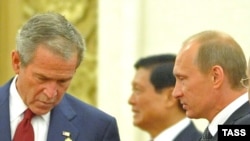
NEW YORK -- The administration of George W. Bush was often criticized in the West for adopting a short-sighted, acquiescent attitude toward Russia.
But at the same time, participants in a January 22 panel of experts at the New York-based Council on Foreign Relations noted, Russians themselves thought of Bush as one of the least friendly U.S. presidents.
Stephen Biegun, the vice president for international governmental affairs at the Ford Motor Company, said the apparent contradiction was a result of the different perceptions held by Russians and Americans on issues ranging from energy, Iran, and Russia's relations with its neighbors.
Now, the countries' two new leaders -- particularly U.S. President Barack Obama -- have a chance to make a fresh start on those issues and others.
"President Obama clearly enjoys far more ability to shed whatever burden the previous administration might have left on the table of the U.S.-Russia relationship," Biegun said. "President [Dmitry] Medvedev has that chance, generationally and also by his temperament. So I would encourage President Obama to form that personal relationship as well."
Some of the panelists said that personal bonds aside, the political realities in which presidents Medvedev and Obama operate remain strikingly different.
Despite early indications that Medvedev might be willing to push ahead with independent, liberal-leaning policies of his own, the Russian president is still seen as a protege in the shadow of his far more powerful predecessor, Vladimir Putin.
Timothy Colton, the director of the Davis Center for Russian and Eurasian Studies at Harvard University, said it is highly unlikely to think of Medvedev gaining sufficient strength to oust Putin from his current post as prime minister.
"Medvedev can't do that. In fact, he can't even criticize Putin by name -- that's definitely out. That is not natural in terms of how Russian politics works," Colton said.
"One of the few virtues that they could have as dual executives is that you can get a certain amount of dynamism and change through a change of prime minister, while the president stays because he's popularly elected. But this president [Medvedev] can't do that unless he thinks the unthinkable, which is to depose his patron."
But many Russians' perception of Putin as the country's sole power broker may be changing. "I think this is something we should be thinking about, because many Russians are starting to think that it is conceivable," Colton said. "Not tomorrow, but before the 2012 [presidential] election."
Increasing Tensions, But No Revolution
None of the panelists envision scenarios in Russia similar to the "colored" revolutions seen in Georgia, Ukraine, and Kyrgyzstan. But some said political changes may come as a result of mounting instability and social tensions brought on by Russia's mounting economic woes.
Masha Lipman of the Carnegie Moscow Center said growing domestic unrest may ultimately weaken the tightly controlled political structure developed under Putin in an era of massive revenues from metals, gas, and oil.
"This is not an autocracy based on hard repression or mass-scale repression; it is mostly based on deals and contracts and buying out loyalties," Lipman said. "And of course it is one thing to buy loyalties when the price of oil is $140, and it's quite another matter when the price of oil has gone down and the price of metals has gone down."
Stephen Sestanovich, the senior fellow for Russian and Eurasian studies at the Council on Foreign Relations, said that Russia's relations with some of its ex-Soviet neighbors -- the so-called "special interest countries" -- have become one of the most contentions foreign-policy issues between Moscow and Washington:
"The issue of Russia's relations with its neighbors has come to the center of Russia's relations not just with the United States, but even more strikingly with Europe," Sestanovich noted.
"If you think about what the interaction between Europe and Russia has been in the past six months, it's first of all been negotiating an end to the Georgia war. [French President Nicolas] Sarkozy has found himself a shuttle diplomat. [The war] became kind of the defining foreign policy issue of his presidency of the EU. Now, for the Czechs and the EU, the issue is Russia's relations with Ukraine," he added.
As for Moscow's relations with Washington, Sestanovich said there are areas for improved cooperation. "Some issues that have been seen as cooperative [in the past] have turned out to be more conflictual, and we need to move them back to cooperation," he said.
"For example, energy. Energy ought to be an area of cooperation, but it hasn't been," he continued. "Some security issues have become more prominent on the agenda, strategic nuclear issues where there's a need to renew agreements and reach new ones. Even conventional arms questions, nuclear proliferation."
Richard Burt, a former U.S. ambassador to Germany and managing director at the global strategic advisory firm McLarty Associates, said the best overture the Obama administration could make would be to demonstrate to Moscow respect and a sense that its interests are being considered in U.S. foreign policy.
"What the Russians are asking now -- which is critical in putting it in the context of the Bush administration policy -- is that they want to be taken seriously," Burt said. "They want to be a factor in American decision making, they want to be a factor in global decision making. To some extent, I think, the opportunity for the U.S. is to find ways to make them believe that they are being taken seriously."
But at the same time, participants in a January 22 panel of experts at the New York-based Council on Foreign Relations noted, Russians themselves thought of Bush as one of the least friendly U.S. presidents.
Stephen Biegun, the vice president for international governmental affairs at the Ford Motor Company, said the apparent contradiction was a result of the different perceptions held by Russians and Americans on issues ranging from energy, Iran, and Russia's relations with its neighbors.
Now, the countries' two new leaders -- particularly U.S. President Barack Obama -- have a chance to make a fresh start on those issues and others.
"President Obama clearly enjoys far more ability to shed whatever burden the previous administration might have left on the table of the U.S.-Russia relationship," Biegun said. "President [Dmitry] Medvedev has that chance, generationally and also by his temperament. So I would encourage President Obama to form that personal relationship as well."
Some of the panelists said that personal bonds aside, the political realities in which presidents Medvedev and Obama operate remain strikingly different.
Despite early indications that Medvedev might be willing to push ahead with independent, liberal-leaning policies of his own, the Russian president is still seen as a protege in the shadow of his far more powerful predecessor, Vladimir Putin.
Timothy Colton, the director of the Davis Center for Russian and Eurasian Studies at Harvard University, said it is highly unlikely to think of Medvedev gaining sufficient strength to oust Putin from his current post as prime minister.
"Medvedev can't do that. In fact, he can't even criticize Putin by name -- that's definitely out. That is not natural in terms of how Russian politics works," Colton said.
"One of the few virtues that they could have as dual executives is that you can get a certain amount of dynamism and change through a change of prime minister, while the president stays because he's popularly elected. But this president [Medvedev] can't do that unless he thinks the unthinkable, which is to depose his patron."
But many Russians' perception of Putin as the country's sole power broker may be changing. "I think this is something we should be thinking about, because many Russians are starting to think that it is conceivable," Colton said. "Not tomorrow, but before the 2012 [presidential] election."
Increasing Tensions, But No Revolution
None of the panelists envision scenarios in Russia similar to the "colored" revolutions seen in Georgia, Ukraine, and Kyrgyzstan. But some said political changes may come as a result of mounting instability and social tensions brought on by Russia's mounting economic woes.
Masha Lipman of the Carnegie Moscow Center said growing domestic unrest may ultimately weaken the tightly controlled political structure developed under Putin in an era of massive revenues from metals, gas, and oil.
"This is not an autocracy based on hard repression or mass-scale repression; it is mostly based on deals and contracts and buying out loyalties," Lipman said. "And of course it is one thing to buy loyalties when the price of oil is $140, and it's quite another matter when the price of oil has gone down and the price of metals has gone down."
Stephen Sestanovich, the senior fellow for Russian and Eurasian studies at the Council on Foreign Relations, said that Russia's relations with some of its ex-Soviet neighbors -- the so-called "special interest countries" -- have become one of the most contentions foreign-policy issues between Moscow and Washington:
"The issue of Russia's relations with its neighbors has come to the center of Russia's relations not just with the United States, but even more strikingly with Europe," Sestanovich noted.
"If you think about what the interaction between Europe and Russia has been in the past six months, it's first of all been negotiating an end to the Georgia war. [French President Nicolas] Sarkozy has found himself a shuttle diplomat. [The war] became kind of the defining foreign policy issue of his presidency of the EU. Now, for the Czechs and the EU, the issue is Russia's relations with Ukraine," he added.
As for Moscow's relations with Washington, Sestanovich said there are areas for improved cooperation. "Some issues that have been seen as cooperative [in the past] have turned out to be more conflictual, and we need to move them back to cooperation," he said.
"For example, energy. Energy ought to be an area of cooperation, but it hasn't been," he continued. "Some security issues have become more prominent on the agenda, strategic nuclear issues where there's a need to renew agreements and reach new ones. Even conventional arms questions, nuclear proliferation."
Richard Burt, a former U.S. ambassador to Germany and managing director at the global strategic advisory firm McLarty Associates, said the best overture the Obama administration could make would be to demonstrate to Moscow respect and a sense that its interests are being considered in U.S. foreign policy.
"What the Russians are asking now -- which is critical in putting it in the context of the Bush administration policy -- is that they want to be taken seriously," Burt said. "They want to be a factor in American decision making, they want to be a factor in global decision making. To some extent, I think, the opportunity for the U.S. is to find ways to make them believe that they are being taken seriously."