




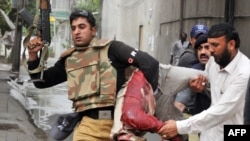
Few Pakistanis rejoiced when the country's military high command announced victory against armed militants in the Orakzai tribal agency last week -- mainly because Punjab, the heartland of Pakistan, is still threatened by galloping Talibanization.
Alarm bells have been ringing for years over the recruiting activities and training facilities of various sectarian, jihadi, and other banned militant groups in the southern parts of Punjab. Punjab is the most developed, most populous, and most prosperous province of Pakistan.
The ongoing wave of violence is the work of what were initially two distinct sets of militant groups. The first includes the sectarian groups Sipah-e-Sahaba and Lashkar-e-Jhangvi, both of which target primarily Shi’ite Muslims. The second set comprises jihadi groups such as Lashkar-e-Tayeba and Jaish-e-Muhammad, which earlier fought in Indian-held Kashmir. All these extremists claim to follow the Deobandi school of Sunni Islam.
Initially, the sectarian groups held all the aces in southern Punjab. But then jihadi groups began establishing bases there in retaliation for the 2006-07 withdrawal of support by former President Pervez Musharraf for the armed struggle they launched in India-controlled Kashmir. This quickly led to close contact between the two sets of extremists -- and the blurring of the distinctions between them.
Kill Or Be Killed
In the span of just a couple of years, the original group of just a few hundred young jihadis mushroomed into a force numbering in the thousands -- all trained to kill or be killed. And after 2007 they started pouring into the lawless tribal region of Pakistan that borders on the eastern and southeastern zone of Afghanistan.
Meanwhile, the predominantly Pashtun Tehrik-e-Taliban Pakistan (TTP), which is loosely associated with Al-Qaeda, was also expanding its influence. By circulating heroic proclamations and videos about the fighting against Afghan and "infidel" forces in neighboring Afghanistan, the group succeeded in attracting recruits from the tribal region, which comprises North and South Waziristan, Kurram, Orakzai, Khyber, Mohmand and Bajau (Bajaur).
The Musharraf government’s mishandling of the July 2007 Lal Masjid (Red Mosque) episode, in which several militants and seminarians in Islamabad were killed in an operation by government troops that lasted several days, led to a surge of support for the militants. The Punjabi Taliban, recruited mainly from the banned sectarian and jihadi outfits, reportedly acquired so much leverage within the TTP that they were given seats in the 40-member shura (assembly) of that Pashtun-dominated Taliban umbrella group.
Under the aegis of the TTP, the so-called Punjabi Taliban discovered new recruitment vistas and received financial, technical, and planning support -- mainly from Al-Qaeda.
Diverse Elements Have Merged
In 2008, following the increasing attacks by CIA-operated drones and the launching of an operation by the Pakistani security forces in the tribal areas, members of the jihadi and sectarian groups started returning to their old bases in southern Punjab, along with some of their TTP leaders and colleagues, including Mohammad Aqeel (alias, Dr. Osman), a former member of the sectarian Lashkar-e-Jhangvi (LJ) who was accused of having a hand in the October 2009 attack on the Pakistan military’s general headquarters in Rawalpindi, Punjab.
Recent statements by top government functionaries imply that the LJ was also involved in the 2008 bombing of the Marriott Hotel in Islamabad.
The spectrum of militant groups can no longer be neatly divided into the TTP, LJ, Jaish, and others. On the contrary, many diverse elements from different areas and backgrounds seem to have merged together – under the apparent patronage of the Wahhabi-dominated Al-Qaeda -- to implement a shared religious-political agenda.
In the words of Rohan Gunaratne, author of "Inside Al-Qaeda," "Jhangvi (LJ) is now the eyes, ears, and operational arm of Al-Qaeda and the Tehrik-e-Taliban Pakistan [based in Waziristan]. It is hard to distinguish between the three."
Emboldened Extremists
Both the previous and the present Pakistani governments have consistently turned a blind eye to the extremist threat. That passive stance emboldened the extremists to launch a new series of attacks, beginning in early 2009, in the provincial capital of Lahore, once the most secure and peaceful of Pakistani cities; in other Punjab cities; and even in Pakistani-controlled Kashmir.
The first of the series was the March 3, 2009, attack on the visiting Sri Lankan cricket team in Lahore that killed eight people and profoundly tarnished the image of Pakistan around the world. Later that same month and also in Lahore, armed men attacked the Manawan police station, killing eight people.
On October 15, 2009, three simultaneous terrorist attacks were carried out in the city, killing 30 people. And twin suicide attacks in Lahore on March 12, 2010, killed 45 people.
In addition, two major, daring attacks were carried out in Rawalpindi in October and December 2009. The first attack targeted the military’s general headquarters, and the second, a high-profile mosque.
The most recent in this string of attacks were those on May 28 on two mosques in Lahore belonging to the Ahmadi religious minority. Ahmadis were declared non-Muslims in the 1973 Pakistan Constitution, which was drafted by the government of Zulfiqar Ali Bhutto, father of late Benazir Bhutto.
It is, to say the least, depressing for the peaceful citizens of Pakistan to watch as a militant group that once used only pistols and AK-47s and threw hand grenades at places of worship or gatherings of rival sects has now acquired so much influence, manpower, resources, and technical expertise that it can launch large-scale attacks despite the efforts of the nearly half a dozen intelligence agencies, the police force, and the all-powerful Pakistan Army.
But to the dismay of many, the Punjab government has remained passive in the face of all this aggression. The Punjab administration is headed by Nawaz Sharif of the Pakistan Muslim League, and he and his party are widely believed to have a soft spot for the Taliban. Unlike the ruling Pakistan People's Party or the Awami National Party, the Pakistan Muslim League and its leaders are usually slow even to condemn Taliban violence across the country. It is too much to expect that they’d launch an all-out operation against the armed groups that are terrorizing southern Punjab.
Daud Khattak is a broadcaster with RFE/RL's Radio Mashaal. The views expressed in this commentary are the author's own and do not necessarily reflect those of RFE/RL.
Alarm bells have been ringing for years over the recruiting activities and training facilities of various sectarian, jihadi, and other banned militant groups in the southern parts of Punjab. Punjab is the most developed, most populous, and most prosperous province of Pakistan.
The ongoing wave of violence is the work of what were initially two distinct sets of militant groups. The first includes the sectarian groups Sipah-e-Sahaba and Lashkar-e-Jhangvi, both of which target primarily Shi’ite Muslims. The second set comprises jihadi groups such as Lashkar-e-Tayeba and Jaish-e-Muhammad, which earlier fought in Indian-held Kashmir. All these extremists claim to follow the Deobandi school of Sunni Islam.
Initially, the sectarian groups held all the aces in southern Punjab. But then jihadi groups began establishing bases there in retaliation for the 2006-07 withdrawal of support by former President Pervez Musharraf for the armed struggle they launched in India-controlled Kashmir. This quickly led to close contact between the two sets of extremists -- and the blurring of the distinctions between them.
Kill Or Be Killed
In the span of just a couple of years, the original group of just a few hundred young jihadis mushroomed into a force numbering in the thousands -- all trained to kill or be killed. And after 2007 they started pouring into the lawless tribal region of Pakistan that borders on the eastern and southeastern zone of Afghanistan.
Both the previous and the present Pakistani governments have consistently turned a blind eye to the extremist threat.
The Musharraf government’s mishandling of the July 2007 Lal Masjid (Red Mosque) episode, in which several militants and seminarians in Islamabad were killed in an operation by government troops that lasted several days, led to a surge of support for the militants. The Punjabi Taliban, recruited mainly from the banned sectarian and jihadi outfits, reportedly acquired so much leverage within the TTP that they were given seats in the 40-member shura (assembly) of that Pashtun-dominated Taliban umbrella group.
Under the aegis of the TTP, the so-called Punjabi Taliban discovered new recruitment vistas and received financial, technical, and planning support -- mainly from Al-Qaeda.
Diverse Elements Have Merged
In 2008, following the increasing attacks by CIA-operated drones and the launching of an operation by the Pakistani security forces in the tribal areas, members of the jihadi and sectarian groups started returning to their old bases in southern Punjab, along with some of their TTP leaders and colleagues, including Mohammad Aqeel (alias, Dr. Osman), a former member of the sectarian Lashkar-e-Jhangvi (LJ) who was accused of having a hand in the October 2009 attack on the Pakistan military’s general headquarters in Rawalpindi, Punjab.
Recent statements by top government functionaries imply that the LJ was also involved in the 2008 bombing of the Marriott Hotel in Islamabad.
The spectrum of militant groups can no longer be neatly divided into the TTP, LJ, Jaish, and others. On the contrary, many diverse elements from different areas and backgrounds seem to have merged together – under the apparent patronage of the Wahhabi-dominated Al-Qaeda -- to implement a shared religious-political agenda.
In the words of Rohan Gunaratne, author of "Inside Al-Qaeda," "Jhangvi (LJ) is now the eyes, ears, and operational arm of Al-Qaeda and the Tehrik-e-Taliban Pakistan [based in Waziristan]. It is hard to distinguish between the three."
Emboldened Extremists
Both the previous and the present Pakistani governments have consistently turned a blind eye to the extremist threat. That passive stance emboldened the extremists to launch a new series of attacks, beginning in early 2009, in the provincial capital of Lahore, once the most secure and peaceful of Pakistani cities; in other Punjab cities; and even in Pakistani-controlled Kashmir.
The first of the series was the March 3, 2009, attack on the visiting Sri Lankan cricket team in Lahore that killed eight people and profoundly tarnished the image of Pakistan around the world. Later that same month and also in Lahore, armed men attacked the Manawan police station, killing eight people.
On October 15, 2009, three simultaneous terrorist attacks were carried out in the city, killing 30 people. And twin suicide attacks in Lahore on March 12, 2010, killed 45 people.
In addition, two major, daring attacks were carried out in Rawalpindi in October and December 2009. The first attack targeted the military’s general headquarters, and the second, a high-profile mosque.
The most recent in this string of attacks were those on May 28 on two mosques in Lahore belonging to the Ahmadi religious minority. Ahmadis were declared non-Muslims in the 1973 Pakistan Constitution, which was drafted by the government of Zulfiqar Ali Bhutto, father of late Benazir Bhutto.
It is, to say the least, depressing for the peaceful citizens of Pakistan to watch as a militant group that once used only pistols and AK-47s and threw hand grenades at places of worship or gatherings of rival sects has now acquired so much influence, manpower, resources, and technical expertise that it can launch large-scale attacks despite the efforts of the nearly half a dozen intelligence agencies, the police force, and the all-powerful Pakistan Army.
But to the dismay of many, the Punjab government has remained passive in the face of all this aggression. The Punjab administration is headed by Nawaz Sharif of the Pakistan Muslim League, and he and his party are widely believed to have a soft spot for the Taliban. Unlike the ruling Pakistan People's Party or the Awami National Party, the Pakistan Muslim League and its leaders are usually slow even to condemn Taliban violence across the country. It is too much to expect that they’d launch an all-out operation against the armed groups that are terrorizing southern Punjab.
Daud Khattak is a broadcaster with RFE/RL's Radio Mashaal. The views expressed in this commentary are the author's own and do not necessarily reflect those of RFE/RL.

