



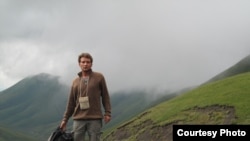
Click here for a slideshow of Polacek's photographs
It all began last year, when Tomas Polacek, a reporter for the Czech newspaper “Mlada fronta Dnes,” suggested to his editors that he could hitchhike from Prague to China and write a daily blog -- something to liven up the summer ahead of the Olympics. To his surprise, they agreed. Three weeks later, Polacek had reached Beijing and the blog was a hit.
This year, Polacek, who speaks Russian, suggested a follow-up: How about hitchhiking through the Caucasus, a year after the Russia-Georgia conflict and amid growing local insurgencies, to see what life was like on the ground? Polacek’s editors did a double take, but they didn’t hesitate.
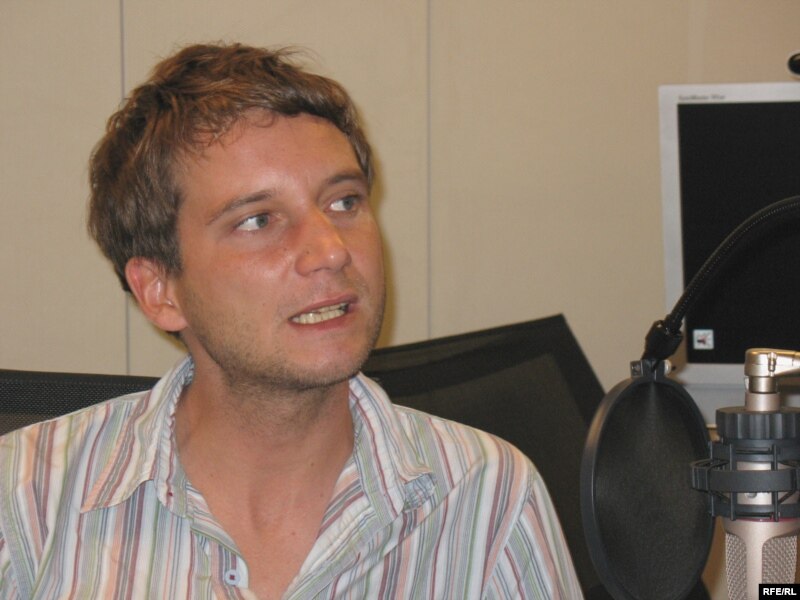
Three weeks, 105 cars, and 5,000 kilometers later, Polacek found himself in the ruined capital of South Ossetia, after a journey full of surprises. He shared his impressions with RFE/RL correspondent Jeremy Bransten after his return home to Prague.
RFE/RL: Was it easy to hitchhike through the Caucasus? What was the overall experience like?
Tomas Polacek: It's really easy to hitchhike in the Caucasus. But in general, I think it's the rule that the more you move into a slightly poorer region or a problem region, the easier it is to hitchhike. People are used to giving each other rides and in the Caucasus for Western or Czech tourists, it's heaven.
I had no problems with lodging, for example. I almost always slept for free in someone's house, even though I asked to pay. People wouldn't take the money. So I would buy them a small gift, say a jar of coffee and I would say: "Thank you so much for hosting me and letting me sleep here." But the people would run back to the store with the coffee, get the money back and return it to me. So they wouldn't let me give them a present, much less money.
RFE/RL: Can you describe your route?
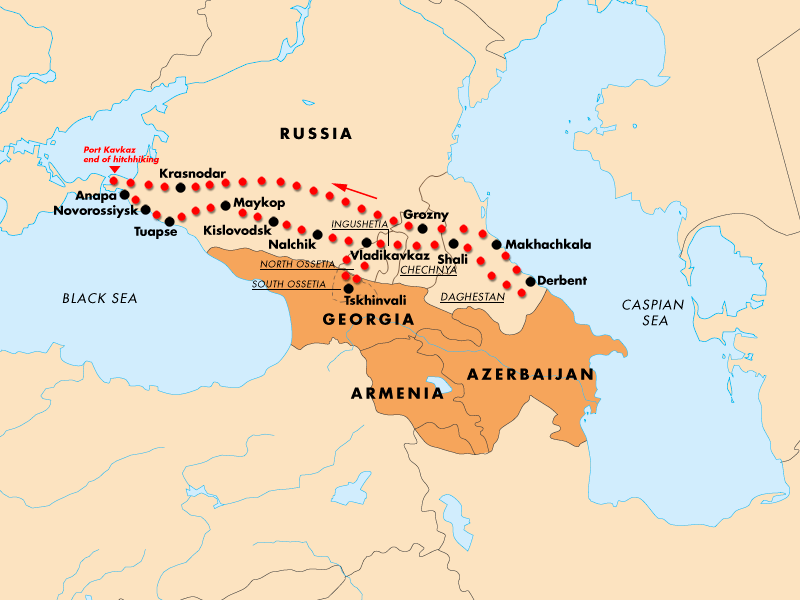
Polacek: I had planned it differently than it turned out. In the end, I only saw the North Caucasus and I had intended to see the South as well. But I became a bit of a guinea pig. I set out to test if, in the current situation, I could cross over from the North Caucasus to the South and I found out that I couldn't. My only hope was to try to get from southern Daghestan to Azerbaijan. But the [Azerbaijani] customs officers stopped me and after three hours they turned me around and told me to return to Daghestan. But that gave me a chance to really get around the North Caucasus.
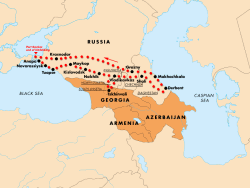 A map showing Polacek's route (click to enlarge)RFE/RL: What was the best part of your trip?
Polacek: The mountains of Daghestan made the biggest impression on me, because they were fantastic. And I don't understand why the place isn't full of tourists. I have never seen anything as beautiful. I've traveled a good chunk of the world. I know the Georgian Caucasus, I know the desert, I know China well. But this made an unbelievable impression because the Caspian Sea is beautiful and you ride half an hour away and you are in these wild mountains, where each valley is completely different. Some valleys are green, some are black. Some are gorges. Just beautiful.
People have retained their ancient traditions. I immediately ran into a beautiful traditional wedding. In the morning, when I woke up, three rams had been slaughtered and were being prepared in the courtyard for the feast. For a Czech, it's unusual. It's a Muslim region so there are small mosques everywhere, shrines. Some 150 years ago, Imam Shamil fought there, so there are monuments to him and everyone remembers the brave Shamil, who battled the tsar's forces. It made a big impression on me and I’d love to return someday because I felt safe, the landscape and the people were amazing.
In four days in Daghestan, I didn’t have to spend a single ruble, because people wouldn’t allow it. They passed me around like a relay baton and took care of me for four days. I said: "Let me at least buy my own cigarettes, because you don’t smoke." But they said: "No, no. We'll buy you some." Nonsmokers bought me cigarettes and teetotalers bought me beer.
RFE/RL: And the worst experience?
Polacek: Ingushetia made the most tragic impression because you can see that the war continues there. It's a tiny place and everywhere there are traces of violence, of explosions. You can cross Ingushetia in half an hour by car but it gives you the biggest shock, if you're not used to war. Because you can see that the war continues. It's where the most radical resistance to the Russians and the military and police is being felt. There are constant bombings.
RFE/RL: What surprised you most?
Polacek: I was stunned by today's Chechnya. Before I got there, I was on the road for some 4,000 kilometers and for most of that time people would tell me: "We know what it'll be like there. You'll be kidnapped and held for ransom or murdered or you won't be able to get in." Then I arrived in Chechnya and it was...nice. In Grozny, everyone told me it was unbelievable. Six years ago Chechnya was a bombed-out city. And now I think it's the prettiest, most modern city in the whole region.
Paradoxically, the war seems to have restarted the economy because luxury buildings are going up, the main street -- paradoxically called Putin Street -- is full of fully stocked boutiques and Internet cafes and banks. I was completely surprised. I had expected ruins, almost scorched earth. But walking through downtown Grozny is almost like walking through downtown Prague. There's a fantastic new mosque built by the Turks that looks similar to the most famous mosques in Istanbul. I was truly pleasantly surprised.
RFE/RL: I think you wrote that the worst thing that happened to you in Grozny was drinking some bad beer that sent you to bed for a couple of days?
Polacek: I have been hitchhiking like this for 16 years and, knock on wood, I've never had stomach problems, I've never felt sick. But I was in Grozny and they said: "Try our local beer!" And they brought out this red liquid without any head. I didn't want to offend them, so I drank half a glass and then said I wouldn't. And they asked: "You didn't like it?" And I said, "Of course I did, but I just can't drink anymore."
But I really didn't like it at all, this Grozny beer, which I think was called Arsenalskoye. But otherwise, I bought Russian beer -- Baltika-7, it was fine. Be careful with the Baltika-9, that's strong stuff. But otherwise the Baltika-7 is OK. It's like Czech beer.
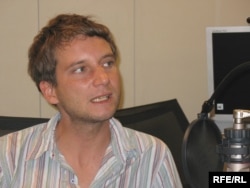 "Nonsmokers bought me cigarettes and teetotalers bought me beer," says Polacek.RFE/RL: The shops are new in Grozny. So everyone’s happy?
Polacek: That's difficult. I ran into one person, for example, who was a nervous wreck. He was a Chechen and he was shaking. He'd gone prematurely gray. He was 37 years old but his hair was completely gray. You could tell he wasn't eating much and only smoking. He told me that the week before, Russian soldiers had given him electroshocks for two days running. He said he'd been detained three times and he was constantly talking about emigrating. He told me he needed to emigrate right away and he said he was trying to get all the necessary papers, which was very hard.
But he was an exception -- this man who was clearly on edge and being pursued. He told me his story and I don't know if it's true. But he said they suspected him of helping Muslim fighters in the mountains. If he was or not, I don't know. I liked him because he was my driver. But I would like murderers if they gave me a ride. So I can't judge.
RFE/RL: What did you talk about with locals in general? Were people afraid to speak to a foreign reporter in Grozny, especially about politics?
Polacek: I didn't sense that people were afraid. But I didn't seek out those kinds of conversations, so I didn't ask about politics. Often, they broached the topic themselves. And most of the time people would make fun of President [Ramzan] Kadyrov, of his deceased father. They made fun of [Russian Prime Minister Vladimir] Putin and [Russian President Dmitry] Medvedev, whose pictures are on billboards every other kilometer along the roads, wishing travelers a happy journey. People made fun of them. They weren't afraid to talk.
As I mentioned, my driver Ibragim knew I was a journalist and he told me his whole story about how the Russian military were harassing him and how they'd given him electroshocks. I didn't get the sense they were afraid to talk. But on the other hand, it wasn't a major topic. The war is long over -- the war that affected everyone. The war continues but it concerns the radicals and the police. They are fighting. But ordinary people have a good chance of staying out of it. They live their lives, eat their melons at home, visit the mosque or go drink beers and I don’t think the war affects everyone any longer.
RFE/RL: Outside of Grozny, did you encounter any signs of war or violence? What about poverty?
Polacek: I didn't come across any clear signs of war. The only change, after coming from Daghestan, was that people were running around with machine guns. And another thing which fascinates Czechs who see it for the first time, and makes us feel like we're in some kind of western, is that every guy who walks into a cafe has a holster with a pistol. I'm not really used to that. But I think that for people who've been to the developing world, to Africa or China, there are no shocks. To me, the people there aren't poor.
I ran into few truly poor people in the Caucasus. They often complained about how poor they were, that they would earn only $150 a month. But then I saw they had big houses and every family had two cars. So, it's a little different than here at home. I think people get money in other ways, since they’re not earning it at their jobs. So in the worst place, in Ingushetia, where things are toughest and the least safe, everyone has three-story houses with 20 rooms. For a Czech, it’s a bit hard to understand.
RFE/RL: Reading your reports in “Mlada fronta Dnes,” it’s clear that what you saw in South Ossetia affected you deeply. Can you describe how you made it into the republic?
Polacek: I came back along the same road I’d originally traveled to Daghestan and I said to myself: let's give it a try. I probably won't get in, but it's worth giving it a shot.
Just outside of Vladikavkaz, I was hitchhiking and this van stopped. I thought it was a "marshrutka" [a minibus taxi]. So I said: "Hello, will you give me a ride? I'm a hitchhiker." And the driver said: "How much can you pay?" And I said: "Nothing, because I'm a hitchhiker and I don't pay drivers." So he said: "3,000 rubles at least [$95]!" And I said: "Forget it. I'd give you 200 rubles [$6] tops." So they all laughed and said: "Hop in, we're not a taxi." And they told me they were from Russia's Channel One -- a reporter and a cameraman and a driver. And they were on their way to film in Tskhinvali, the capital of South Ossetia, a year after the war. And so I got lucky.
And thanks to them I went through the border of South Ossetia. No one checked me, they just stamped my passport and after 15 minutes -- which is nothing at all for border posts in the former Soviet Union -- I was riding across the mountains through this beautiful land, down to Tskhinvali, which remains bombed out a year after the war.
RFE/RL: And what did you see when you got there?
Polacek: I have to preface my remarks by saying that I'm not a political scientist. I'm just a regular guy, a hitchhiker, who had never been in a war or in an area right after a war. So it's my layman's view.
I arrived in South Ossetia and sat down in the first cafe I saw. And three Ossetians invited me over for some food and drink and they asked who I was. And I replied that I was a Czech journalist. And they said: "Look, we don't want to tell you how to do your job. We don't want to influence you. But we want to tell you one thing. In this place, you won't run into anyone who'll say a bad word against the Russians and who would say a good word about the Georgians." I didn't believe it. But then I spent three days in Tskhinvali. And it was true.
The people there honestly love the Russians and bless them for their help last year, when they were attacked by [Georgian] President [Mikheil] Saakashvili's forces. It's more like they dread the Georgians rather than just fear them. When you say the word Saakashvili or the word Georgian, people start shaking. They are terrified of the Georgians. So I was in a sort of state of shock. I saw hundreds of demolished houses. And every family I spoke to recounted horrifying stories about how the Georgians showed up, drugged -- syringes littering the place. The operation was called Clean Field.
No one expected Saakashvili to jump in there on August 8, at midnight. And people told me horrible stories, which might or might not be true. But when they told me these things, I also began to shake. They told me how a Georgian soldier who knew how to speak Ossetian shouted: "Come out of your shelters! The Georgians are gone!" Everyone crawled out. And they gunned them all down. They showed me the car cemeteries, as they called them. Along the roads are tens, or perhaps hundreds of burned out cars. People were trying to flee north to Vladikavkaz and the Georgians shot them up.
So, I’m a layman. But at that point I got very angry at Georgia, which I’d always loved and where I’d spent several vacations. Even if Georgia had political reasons for its actions, this was too much. It was just too much.
RFE/RL: Do people in South Ossetia remain depressed, a year after the war?
Polacek: They are happy that the Georgians are gone. You can see it at every step. And they are rebuilding with verve. You can see construction everywhere. New suburbs are sprouting up around Tskhinvali. And the Russians are helping a lot. Again, speaking about politics and why this is happening, the Russians most certainly aren't doing it because they're saints. They are strengthening their influence, of course. But right now, the Russians are loved there. There are signs and graffiti on buildings everywhere thanking Russian forces and Russia.
So life is not bad there in the summer. There are no restaurants yet. When night falls, only the center of Tskhinvali has lighting. Otherwise, people walk around with flashlights. But it's not so bad anymore. It doesn’t seem that people don't have enough to eat. If anyone wanted to visit, I think it's worth it because those mountains are amazing. I praised Daghestan for its beauty. Well, the second most beautiful place I visited was Ossetia. It's like Switzerland.
RFE/RL: Quite a compliment.
Polacek: The people are incredibly hospitable. They have come through a war but will share everything they have. I was talking to a lady, about 80. She was by coincidence Georgian, who married an Ossetian a long time ago, in a village near Tskhinvali. And a year ago, the Georgians destroyed her house and blew up her only cow, and her pigs. But they let grandma live. So this Georgian grandmother lives in a tent. I asked her why she didn't get another cow and she said she didn't have the money. She still lives in a tent, a year after the war.
But that's not the point. The point is that when I was about to leave, she said: "Wait! Wait!" And she brought out wine and some fruit -- apricots or something. She had nothing and I'd come to bother her with my questions. And she brought out her bag with 3 liters of wine and 2 kilos of fruit. What incredible hospitality.
RFE/RL: Where will you hitchhike to next?
Polacek: If the Czech Republic makes it to the World Cup, which is going to be played in South Africa next year, it might make me consider a trip across all of Africa, from north to south. But the Czech Republic isn't doing too well in football right now, so I doubt I'll go. But if the Czech Republic makes it, I'd consider the trip, if it's possible at all. That would tempt me.
It all began last year, when Tomas Polacek, a reporter for the Czech newspaper “Mlada fronta Dnes,” suggested to his editors that he could hitchhike from Prague to China and write a daily blog -- something to liven up the summer ahead of the Olympics. To his surprise, they agreed. Three weeks later, Polacek had reached Beijing and the blog was a hit.
This year, Polacek, who speaks Russian, suggested a follow-up: How about hitchhiking through the Caucasus, a year after the Russia-Georgia conflict and amid growing local insurgencies, to see what life was like on the ground? Polacek’s editors did a double take, but they didn’t hesitate.
Three weeks, 105 cars, and 5,000 kilometers later, Polacek found himself in the ruined capital of South Ossetia, after a journey full of surprises. He shared his impressions with RFE/RL correspondent Jeremy Bransten after his return home to Prague.
RFE/RL: Was it easy to hitchhike through the Caucasus? What was the overall experience like?
Tomas Polacek: It's really easy to hitchhike in the Caucasus. But in general, I think it's the rule that the more you move into a slightly poorer region or a problem region, the easier it is to hitchhike. People are used to giving each other rides and in the Caucasus for Western or Czech tourists, it's heaven.
I had no problems with lodging, for example. I almost always slept for free in someone's house, even though I asked to pay. People wouldn't take the money. So I would buy them a small gift, say a jar of coffee and I would say: "Thank you so much for hosting me and letting me sleep here." But the people would run back to the store with the coffee, get the money back and return it to me. So they wouldn't let me give them a present, much less money.
RFE/RL: Can you describe your route?
Polacek: I had planned it differently than it turned out. In the end, I only saw the North Caucasus and I had intended to see the South as well. But I became a bit of a guinea pig. I set out to test if, in the current situation, I could cross over from the North Caucasus to the South and I found out that I couldn't. My only hope was to try to get from southern Daghestan to Azerbaijan. But the [Azerbaijani] customs officers stopped me and after three hours they turned me around and told me to return to Daghestan. But that gave me a chance to really get around the North Caucasus.
Polacek: The mountains of Daghestan made the biggest impression on me, because they were fantastic. And I don't understand why the place isn't full of tourists. I have never seen anything as beautiful. I've traveled a good chunk of the world. I know the Georgian Caucasus, I know the desert, I know China well. But this made an unbelievable impression because the Caspian Sea is beautiful and you ride half an hour away and you are in these wild mountains, where each valley is completely different. Some valleys are green, some are black. Some are gorges. Just beautiful.
People have retained their ancient traditions. I immediately ran into a beautiful traditional wedding. In the morning, when I woke up, three rams had been slaughtered and were being prepared in the courtyard for the feast. For a Czech, it's unusual. It's a Muslim region so there are small mosques everywhere, shrines. Some 150 years ago, Imam Shamil fought there, so there are monuments to him and everyone remembers the brave Shamil, who battled the tsar's forces. It made a big impression on me and I’d love to return someday because I felt safe, the landscape and the people were amazing.
In four days in Daghestan, I didn’t have to spend a single ruble, because people wouldn’t allow it. They passed me around like a relay baton and took care of me for four days. I said: "Let me at least buy my own cigarettes, because you don’t smoke." But they said: "No, no. We'll buy you some." Nonsmokers bought me cigarettes and teetotalers bought me beer.
RFE/RL: And the worst experience?
Polacek: Ingushetia made the most tragic impression because you can see that the war continues there. It's a tiny place and everywhere there are traces of violence, of explosions. You can cross Ingushetia in half an hour by car but it gives you the biggest shock, if you're not used to war. Because you can see that the war continues. It's where the most radical resistance to the Russians and the military and police is being felt. There are constant bombings.
RFE/RL: What surprised you most?
Polacek: I was stunned by today's Chechnya. Before I got there, I was on the road for some 4,000 kilometers and for most of that time people would tell me: "We know what it'll be like there. You'll be kidnapped and held for ransom or murdered or you won't be able to get in." Then I arrived in Chechnya and it was...nice. In Grozny, everyone told me it was unbelievable. Six years ago Chechnya was a bombed-out city. And now I think it's the prettiest, most modern city in the whole region.
Paradoxically, the war seems to have restarted the economy because luxury buildings are going up, the main street -- paradoxically called Putin Street -- is full of fully stocked boutiques and Internet cafes and banks. I was completely surprised. I had expected ruins, almost scorched earth. But walking through downtown Grozny is almost like walking through downtown Prague. There's a fantastic new mosque built by the Turks that looks similar to the most famous mosques in Istanbul. I was truly pleasantly surprised.
RFE/RL: I think you wrote that the worst thing that happened to you in Grozny was drinking some bad beer that sent you to bed for a couple of days?
Polacek: I have been hitchhiking like this for 16 years and, knock on wood, I've never had stomach problems, I've never felt sick. But I was in Grozny and they said: "Try our local beer!" And they brought out this red liquid without any head. I didn't want to offend them, so I drank half a glass and then said I wouldn't. And they asked: "You didn't like it?" And I said, "Of course I did, but I just can't drink anymore."
But I really didn't like it at all, this Grozny beer, which I think was called Arsenalskoye. But otherwise, I bought Russian beer -- Baltika-7, it was fine. Be careful with the Baltika-9, that's strong stuff. But otherwise the Baltika-7 is OK. It's like Czech beer.
Polacek: That's difficult. I ran into one person, for example, who was a nervous wreck. He was a Chechen and he was shaking. He'd gone prematurely gray. He was 37 years old but his hair was completely gray. You could tell he wasn't eating much and only smoking. He told me that the week before, Russian soldiers had given him electroshocks for two days running. He said he'd been detained three times and he was constantly talking about emigrating. He told me he needed to emigrate right away and he said he was trying to get all the necessary papers, which was very hard.
But he was an exception -- this man who was clearly on edge and being pursued. He told me his story and I don't know if it's true. But he said they suspected him of helping Muslim fighters in the mountains. If he was or not, I don't know. I liked him because he was my driver. But I would like murderers if they gave me a ride. So I can't judge.
RFE/RL: What did you talk about with locals in general? Were people afraid to speak to a foreign reporter in Grozny, especially about politics?
Polacek: I didn't sense that people were afraid. But I didn't seek out those kinds of conversations, so I didn't ask about politics. Often, they broached the topic themselves. And most of the time people would make fun of President [Ramzan] Kadyrov, of his deceased father. They made fun of [Russian Prime Minister Vladimir] Putin and [Russian President Dmitry] Medvedev, whose pictures are on billboards every other kilometer along the roads, wishing travelers a happy journey. People made fun of them. They weren't afraid to talk.
As I mentioned, my driver Ibragim knew I was a journalist and he told me his whole story about how the Russian military were harassing him and how they'd given him electroshocks. I didn't get the sense they were afraid to talk. But on the other hand, it wasn't a major topic. The war is long over -- the war that affected everyone. The war continues but it concerns the radicals and the police. They are fighting. But ordinary people have a good chance of staying out of it. They live their lives, eat their melons at home, visit the mosque or go drink beers and I don’t think the war affects everyone any longer.
RFE/RL: Outside of Grozny, did you encounter any signs of war or violence? What about poverty?
Polacek: I didn't come across any clear signs of war. The only change, after coming from Daghestan, was that people were running around with machine guns. And another thing which fascinates Czechs who see it for the first time, and makes us feel like we're in some kind of western, is that every guy who walks into a cafe has a holster with a pistol. I'm not really used to that. But I think that for people who've been to the developing world, to Africa or China, there are no shocks. To me, the people there aren't poor.
I ran into few truly poor people in the Caucasus. They often complained about how poor they were, that they would earn only $150 a month. But then I saw they had big houses and every family had two cars. So, it's a little different than here at home. I think people get money in other ways, since they’re not earning it at their jobs. So in the worst place, in Ingushetia, where things are toughest and the least safe, everyone has three-story houses with 20 rooms. For a Czech, it’s a bit hard to understand.
RFE/RL: Reading your reports in “Mlada fronta Dnes,” it’s clear that what you saw in South Ossetia affected you deeply. Can you describe how you made it into the republic?
Polacek: I came back along the same road I’d originally traveled to Daghestan and I said to myself: let's give it a try. I probably won't get in, but it's worth giving it a shot.
Just outside of Vladikavkaz, I was hitchhiking and this van stopped. I thought it was a "marshrutka" [a minibus taxi]. So I said: "Hello, will you give me a ride? I'm a hitchhiker." And the driver said: "How much can you pay?" And I said: "Nothing, because I'm a hitchhiker and I don't pay drivers." So he said: "3,000 rubles at least [$95]!" And I said: "Forget it. I'd give you 200 rubles [$6] tops." So they all laughed and said: "Hop in, we're not a taxi." And they told me they were from Russia's Channel One -- a reporter and a cameraman and a driver. And they were on their way to film in Tskhinvali, the capital of South Ossetia, a year after the war. And so I got lucky.
And thanks to them I went through the border of South Ossetia. No one checked me, they just stamped my passport and after 15 minutes -- which is nothing at all for border posts in the former Soviet Union -- I was riding across the mountains through this beautiful land, down to Tskhinvali, which remains bombed out a year after the war.
RFE/RL: And what did you see when you got there?
Polacek: I have to preface my remarks by saying that I'm not a political scientist. I'm just a regular guy, a hitchhiker, who had never been in a war or in an area right after a war. So it's my layman's view.
I arrived in South Ossetia and sat down in the first cafe I saw. And three Ossetians invited me over for some food and drink and they asked who I was. And I replied that I was a Czech journalist. And they said: "Look, we don't want to tell you how to do your job. We don't want to influence you. But we want to tell you one thing. In this place, you won't run into anyone who'll say a bad word against the Russians and who would say a good word about the Georgians." I didn't believe it. But then I spent three days in Tskhinvali. And it was true.
The people there honestly love the Russians and bless them for their help last year, when they were attacked by [Georgian] President [Mikheil] Saakashvili's forces. It's more like they dread the Georgians rather than just fear them. When you say the word Saakashvili or the word Georgian, people start shaking. They are terrified of the Georgians. So I was in a sort of state of shock. I saw hundreds of demolished houses. And every family I spoke to recounted horrifying stories about how the Georgians showed up, drugged -- syringes littering the place. The operation was called Clean Field.
No one expected Saakashvili to jump in there on August 8, at midnight. And people told me horrible stories, which might or might not be true. But when they told me these things, I also began to shake. They told me how a Georgian soldier who knew how to speak Ossetian shouted: "Come out of your shelters! The Georgians are gone!" Everyone crawled out. And they gunned them all down. They showed me the car cemeteries, as they called them. Along the roads are tens, or perhaps hundreds of burned out cars. People were trying to flee north to Vladikavkaz and the Georgians shot them up.
So, I’m a layman. But at that point I got very angry at Georgia, which I’d always loved and where I’d spent several vacations. Even if Georgia had political reasons for its actions, this was too much. It was just too much.
RFE/RL: Do people in South Ossetia remain depressed, a year after the war?
Polacek: They are happy that the Georgians are gone. You can see it at every step. And they are rebuilding with verve. You can see construction everywhere. New suburbs are sprouting up around Tskhinvali. And the Russians are helping a lot. Again, speaking about politics and why this is happening, the Russians most certainly aren't doing it because they're saints. They are strengthening their influence, of course. But right now, the Russians are loved there. There are signs and graffiti on buildings everywhere thanking Russian forces and Russia.
So life is not bad there in the summer. There are no restaurants yet. When night falls, only the center of Tskhinvali has lighting. Otherwise, people walk around with flashlights. But it's not so bad anymore. It doesn’t seem that people don't have enough to eat. If anyone wanted to visit, I think it's worth it because those mountains are amazing. I praised Daghestan for its beauty. Well, the second most beautiful place I visited was Ossetia. It's like Switzerland.
RFE/RL: Quite a compliment.
Polacek: The people are incredibly hospitable. They have come through a war but will share everything they have. I was talking to a lady, about 80. She was by coincidence Georgian, who married an Ossetian a long time ago, in a village near Tskhinvali. And a year ago, the Georgians destroyed her house and blew up her only cow, and her pigs. But they let grandma live. So this Georgian grandmother lives in a tent. I asked her why she didn't get another cow and she said she didn't have the money. She still lives in a tent, a year after the war.
But that's not the point. The point is that when I was about to leave, she said: "Wait! Wait!" And she brought out wine and some fruit -- apricots or something. She had nothing and I'd come to bother her with my questions. And she brought out her bag with 3 liters of wine and 2 kilos of fruit. What incredible hospitality.
RFE/RL: Where will you hitchhike to next?
Polacek: If the Czech Republic makes it to the World Cup, which is going to be played in South Africa next year, it might make me consider a trip across all of Africa, from north to south. But the Czech Republic isn't doing too well in football right now, so I doubt I'll go. But if the Czech Republic makes it, I'd consider the trip, if it's possible at all. That would tempt me.