





Turkey's Islamist-rooted ruling party has dramatically upped the stakes in its showdown with the secularist establishment by detaining more than 50 current and former military commanders.
For decades, the military has been considered the guardian of the secular order established by the republic founder and revered army officer, Mustafa Kemal. The first president of Turkey is known throughout the country simply as Ataturk, or "Father of the Turks," and his adherents as "Kemalists."
 On February 22, the long-established order suffered a significant blow when 21 generals were detained, including former navy chief Admiral Ozden Ornek, former air force chief General Ibrahim Firtina, and former 1st Army commander General Ergin Saygun. Most of the others detained were colonels.
The detentions are by far the most sensational single event in the government's investigation of the "Ergenekon" network, an alleged gang of top military officials who sought for decades to act as a shadow government and determine the country's political course.
According to Turkish press reports, the new round of detentions may be linked to a plan by Ergenekon members to carry out a military coup against the ruling Justice and Development Party (AKP) in 2003.
The plot for the coup, code-named "Balyoz" (Sledgehammer), allegedly involved plans to spark unrest by bombing two major mosques in Istanbul and staging an assault on a military museum by attackers disguised as Islamic fundamentalists.
'Uncharted Territory'
The detentions have electrified Turkey as the most sweeping move to date by the Islamist-rooted AKP to redefine the Turkish republic by challenging the traditional dominance of the military as its protector.
That protection to date has included the military's toppling of four governments since 1960 in the name of safeguarding the republic's Kemalist secular identity. Ozgur Ogrit, a correspondent for "Hurriyet Daily News" in Istanbul, says it is impossible to predict what will happen next.
"This is uncharted territory for Turkey because, since last month, everyday you see the same phrase in the headlines: for the first time in Turkey, for the first time in republican history, for the first time this general came to give testimony, or this general was arrested, or a secret room of the military was inspected," Ogrit says. "I don't think anyone in Turkey can tell you where we are going to go from here."
Dividing Turkey
The Ergenekon investigation, launched in 2007, is causing huge divisions within Turkey as the pro-AKP and pro-Kemalist camps have squared off in political and media circles.
The division has equally reached into the once solidly Kemalist bastions of the military, judiciary, and bureaucracy -- the three legs of the traditional Turkish state -- making it still more impossible to predict how the showdown will end.
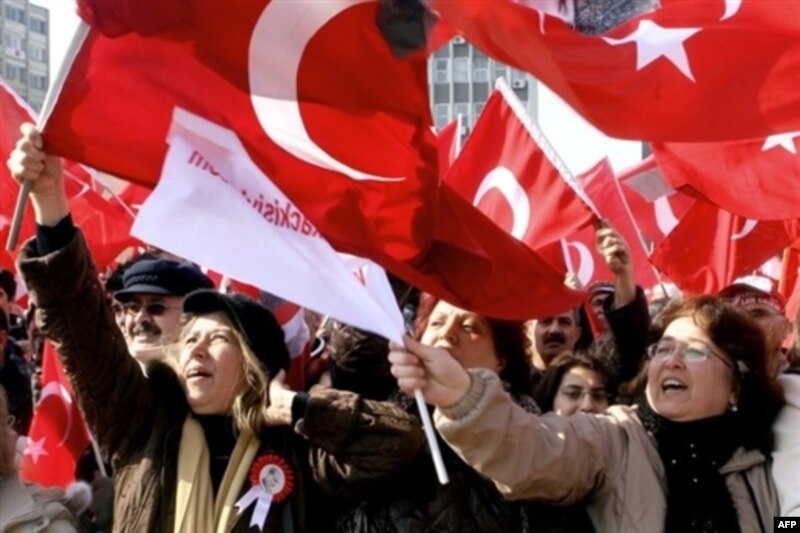
 The Ergenekon case has divided Turks on many levels of society.The detentions of the generals come close on the heels of a fierce battle within the judiciary itself between prosecutors determined to push ahead with the Ergenekon investigation and those who see the affair as a political tool for the AKP to punish secular opponents.
The battle within the judiciary came to a head last week as the Higher Board of Judges and Prosecutors condemned the arrest of a prosecutor who had been charged by colleagues with belonging to Ergenekon himself. The arrested prosecutor, Ilhan Cihaner, had launched a probe into the Islamic community.
After the board removed four other prosecutors from an investigation into Cihaner, the AKP-led government condemned the board for delivering a "heavy blow" against justice.
Turkey's Future In The Balance
But if tit-for-tat moves like those have at times risked making the public weary of the now years-long political crisis over the Ergenekon investigation, this week's detention of some 50 commanders guarantees the affair a new and long life.
"People had been asking why, if the Ergenekon gang was supposed to be planning a coup, the investigation was bringing in journalists, scholars, writers, but where were the soldiers who would carry out the coup? And that was a very fair question," Ogrit notes. "Now, they have started to go after the top generals and now, I think, the case is meaningful once more."
The credibility of the Ergenekon investigation had waned as it focused on soft targets without any immediate indication it would reach the alleged core Ergenekon group itself.
At times, the arrests or detentions of secularist journalists, writers, and academics, appeared to rely upon increasingly dubious anonymous letters and secret witnesses. Some suspects accused the police of fabricating evidence.
But now, with the stakes dramatically raised, the question of whether the investigation would reach some of the country's most powerful current and former members of the military is answered.
And instead, the question for the months ahead has become whether the AKP has the political strength to bring the detained commanders to trial and whether, if convicted, the verdicts would still be overturned by the old-guard Supreme Court of Appeals.
The answer will tell much about the future direction in which Turkey will go. That direction now is generally seen inside Turkey itself as a choice between two poles: the traditional Kemalist secular state vs. an Islamic order that critics say would usher in Shari'a law.
But the reality may ultimately be an identity at a point somewhere along this continuum that has not yet been determined. And part of the process of determining that point may be exactly the political crisis now rocking the country.
For decades, the military has been considered the guardian of the secular order established by the republic founder and revered army officer, Mustafa Kemal. The first president of Turkey is known throughout the country simply as Ataturk, or "Father of the Turks," and his adherents as "Kemalists."
The detentions are by far the most sensational single event in the government's investigation of the "Ergenekon" network, an alleged gang of top military officials who sought for decades to act as a shadow government and determine the country's political course.
According to Turkish press reports, the new round of detentions may be linked to a plan by Ergenekon members to carry out a military coup against the ruling Justice and Development Party (AKP) in 2003.
The plot for the coup, code-named "Balyoz" (Sledgehammer), allegedly involved plans to spark unrest by bombing two major mosques in Istanbul and staging an assault on a military museum by attackers disguised as Islamic fundamentalists.
'Uncharted Territory'
The detentions have electrified Turkey as the most sweeping move to date by the Islamist-rooted AKP to redefine the Turkish republic by challenging the traditional dominance of the military as its protector.
That protection to date has included the military's toppling of four governments since 1960 in the name of safeguarding the republic's Kemalist secular identity. Ozgur Ogrit, a correspondent for "Hurriyet Daily News" in Istanbul, says it is impossible to predict what will happen next.
"This is uncharted territory for Turkey because, since last month, everyday you see the same phrase in the headlines: for the first time in Turkey, for the first time in republican history, for the first time this general came to give testimony, or this general was arrested, or a secret room of the military was inspected," Ogrit says. "I don't think anyone in Turkey can tell you where we are going to go from here."
Dividing Turkey
The Ergenekon investigation, launched in 2007, is causing huge divisions within Turkey as the pro-AKP and pro-Kemalist camps have squared off in political and media circles.
The division has equally reached into the once solidly Kemalist bastions of the military, judiciary, and bureaucracy -- the three legs of the traditional Turkish state -- making it still more impossible to predict how the showdown will end.
The battle within the judiciary came to a head last week as the Higher Board of Judges and Prosecutors condemned the arrest of a prosecutor who had been charged by colleagues with belonging to Ergenekon himself. The arrested prosecutor, Ilhan Cihaner, had launched a probe into the Islamic community.
After the board removed four other prosecutors from an investigation into Cihaner, the AKP-led government condemned the board for delivering a "heavy blow" against justice.
Turkey's Future In The Balance
But if tit-for-tat moves like those have at times risked making the public weary of the now years-long political crisis over the Ergenekon investigation, this week's detention of some 50 commanders guarantees the affair a new and long life.
"People had been asking why, if the Ergenekon gang was supposed to be planning a coup, the investigation was bringing in journalists, scholars, writers, but where were the soldiers who would carry out the coup? And that was a very fair question," Ogrit notes. "Now, they have started to go after the top generals and now, I think, the case is meaningful once more."
The credibility of the Ergenekon investigation had waned as it focused on soft targets without any immediate indication it would reach the alleged core Ergenekon group itself.
At times, the arrests or detentions of secularist journalists, writers, and academics, appeared to rely upon increasingly dubious anonymous letters and secret witnesses. Some suspects accused the police of fabricating evidence.
But now, with the stakes dramatically raised, the question of whether the investigation would reach some of the country's most powerful current and former members of the military is answered.
And instead, the question for the months ahead has become whether the AKP has the political strength to bring the detained commanders to trial and whether, if convicted, the verdicts would still be overturned by the old-guard Supreme Court of Appeals.
The answer will tell much about the future direction in which Turkey will go. That direction now is generally seen inside Turkey itself as a choice between two poles: the traditional Kemalist secular state vs. an Islamic order that critics say would usher in Shari'a law.
But the reality may ultimately be an identity at a point somewhere along this continuum that has not yet been determined. And part of the process of determining that point may be exactly the political crisis now rocking the country.