




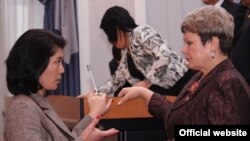
By law, one out of every three lawmakers in Kyrgyzstan's parliament is female. One of them, 42-year-old Gulnora Derbisheva, says she has always wanted to play a role in changing society.
Derbisheva began by working as a teacher, then moved on to become a social activist, joining neighborhood and women's rights committees before setting up her own NGO in her home province of Batken in southern Kyrgyzstan.
That much she was able to achieve on her own. But she says she would never have been able to enter parliament three years ago if there had not been a special quota for women. "There were so many obstacles on my path to politics. Even now, I feel there's discrimination against women," she says.
"A few years ago, there was a lot of prejudice against female lawmakers, and honestly, it was quite a hard time for me," Derbisheva continues. "Some people would say, 'Just what are these women capable of doing -- especially this one?' Some men, fellow lawmakers, would even say things to me like: 'What issues could you possibly have that would be worth bringing to our attention?'"
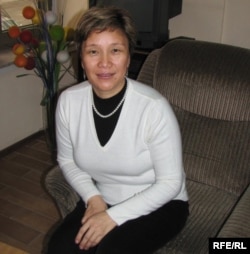 Gulnara Derbisheva has benefitted from gender quotas -- to a point.Derbisheva's dream of becoming a legislator and moving to the capital to take part in "serious politics" became possible only after Kyrgyzstan introduced a 30 percent quota for women in parliament in 2007, after complaints that the country's post-Tulip Revolution legislature did not include a single woman.
Surpassing U.S., France
Gender quotas exist throughout Central Asia. Under the Soviet system, women in the region enjoyed rights and opportunities equal to their male counterparts. But many of those opportunities dried up in the chaos of the Soviet collapse, leading governments to step forward and impose a mathematical solution to a suddenly complex gender equation.
The countries of Central Asia, many of which are still led by their communist-era elite, are routinely criticized for human rights abuses and rampant corruption. But even the region's staunchest critics acknowledge that local governments have made important strides to improve the gender balance in politics -- even though many believe it's little more than a cosmetic attempt to enhance the countries' images abroad.
Even Uzbekistan -- a country that regularly appears at the bottom of international rights and transparency rankings -- has instituted a 30 percent quota for women in parliament. On paper, that puts it well above France (19 percent), the United States (17 percent), and Russia (14 percent).
In Tajikistan, all government agencies are required to appoint at least one woman to a high-ranking post, although such titles usually reach no further than the level of deputy heads. Neither Kazakhstan nor Turkmenistan has a quota system for women, but both countries strive to take the gender balance into consideration.
Alina Hamatdinova, the executive director of an NGO called the Civic Alliance of Kazakhstan, says there is an "unofficial agreement" in her country that women must be included in all levels of decision making. "Women sometimes have better chances to advance in the workplace than men. Specifically, at state corporations there is an understanding that women are more responsible than men and less corrupt," she says. "So there is a tendency to promote women."
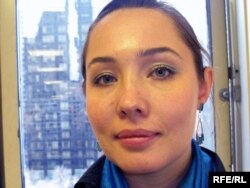 Alina Hamatdinova says that women are seen as less likely to be corrupt.Turkmenistan -- Central Asia's most conservative country regarding women's place in society -- has placed women in a number of top jobs, such as the speaker of parliament and the ambassador to the United Nations. Nearly all the deputies to provincial governors are women as well.
Impact of Poverty, Religion
In white-collar professions like medicine and education, little has changed since Soviet times, with the balance between Central Asian men and women roughly equal. Likewise, the gender balance among university students remains more or less evenly split.
However, economic hardship and mass labor migration to Russia have made millions of women the sole breadwinners for their families. The rising influence of Islam in the region has also considerably altered the perception of women's role in society, with a growing number of people favoring the notion that women should stay at home to care for their husband and children.
The majority of women currently engaged in leadership positions in Central Asia still spring from the generations raised and educated during the Soviet era. Activists believe that, under such circumstances, official quotas will help raise and protect women's social standing while the countries in the region continue the transition from their Soviet pasts.
Quota systems do have their limitations. Although women are numerically represented in many corridors of government, they are virtually nonexistent in power ministries like those of law enforcement, energy, defense, or foreign affairs. Instead, the majority are engaged in "softer" spheres like education and health. In Turkmenistan, the country's only female deputy prime minister is in charge of the culture portfolio.
Just Filling A Quota
In a region with rampant corruption, many women activists also complain that government officials use gender quotas as a convenient opportunity to offer positions to their own female relatives and friends, who are not necessarily qualified for the job.
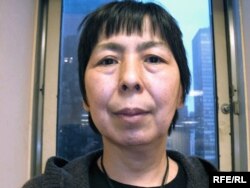 Nurul Djanaeva says that even with quotas, women have to do more than men.In Tajikistan, women's rights activists like Marhabo Davlatova argue that quotas in some instances have actually limited the opportunities open to women. "Sometimes we've had the heads of organizations bar a woman from a vacant top position, saying they've already filled the 'women's quota' by appointing a deputy," she says.
Zurafo Rahmoni, a member of Tajikistan's Islamic Renaissance Party, opposes gender quotas, saying it's an artificial way of promoting women and a system that breeds contempt, rather than respect, for many women. "Women should be treated as men's equals, so they could have an equal and healthy competition with men," she says. "If we create such conditions for women, hundreds of them will emerge as leaders on their own merits."
Still, among women, gender quotas have more supporters than critics. Kyrgyzstan's parliament this week welcomed two new female lawmakers, thereby fulfilling the 30 percent women's quota as vowed.
But there's a long way to go. Nurgul Djanaeva, a Bishkek-based NGO activist, says that even with the quota system, the expectations and demands placed on women in the workplace are far less forgiving than those facing their male counterparts.
"When we are talking about men, nobody cares about the fact that they're using whatever resources, whatever tools, corrupt or not corrupt, Djanaeva said. "When it comes to women, immediately there's a double standard: 'If she comes, she should be clean.' I agree totally -- men and women should both come [into a position] using clean, normal, legal ways."
RFE/RL correspondents Zeinep Altymysheva and Nikola Krastev contributed to this report from Bishkek and New York
Derbisheva began by working as a teacher, then moved on to become a social activist, joining neighborhood and women's rights committees before setting up her own NGO in her home province of Batken in southern Kyrgyzstan.
That much she was able to achieve on her own. But she says she would never have been able to enter parliament three years ago if there had not been a special quota for women. "There were so many obstacles on my path to politics. Even now, I feel there's discrimination against women," she says.
"A few years ago, there was a lot of prejudice against female lawmakers, and honestly, it was quite a hard time for me," Derbisheva continues. "Some people would say, 'Just what are these women capable of doing -- especially this one?' Some men, fellow lawmakers, would even say things to me like: 'What issues could you possibly have that would be worth bringing to our attention?'"

Surpassing U.S., France
Gender quotas exist throughout Central Asia. Under the Soviet system, women in the region enjoyed rights and opportunities equal to their male counterparts. But many of those opportunities dried up in the chaos of the Soviet collapse, leading governments to step forward and impose a mathematical solution to a suddenly complex gender equation.
The countries of Central Asia, many of which are still led by their communist-era elite, are routinely criticized for human rights abuses and rampant corruption. But even the region's staunchest critics acknowledge that local governments have made important strides to improve the gender balance in politics -- even though many believe it's little more than a cosmetic attempt to enhance the countries' images abroad.
Even Uzbekistan -- a country that regularly appears at the bottom of international rights and transparency rankings -- has instituted a 30 percent quota for women in parliament. On paper, that puts it well above France (19 percent), the United States (17 percent), and Russia (14 percent).
In Tajikistan, all government agencies are required to appoint at least one woman to a high-ranking post, although such titles usually reach no further than the level of deputy heads. Neither Kazakhstan nor Turkmenistan has a quota system for women, but both countries strive to take the gender balance into consideration.
Alina Hamatdinova, the executive director of an NGO called the Civic Alliance of Kazakhstan, says there is an "unofficial agreement" in her country that women must be included in all levels of decision making. "Women sometimes have better chances to advance in the workplace than men. Specifically, at state corporations there is an understanding that women are more responsible than men and less corrupt," she says. "So there is a tendency to promote women."

Impact of Poverty, Religion
In white-collar professions like medicine and education, little has changed since Soviet times, with the balance between Central Asian men and women roughly equal. Likewise, the gender balance among university students remains more or less evenly split.
However, economic hardship and mass labor migration to Russia have made millions of women the sole breadwinners for their families. The rising influence of Islam in the region has also considerably altered the perception of women's role in society, with a growing number of people favoring the notion that women should stay at home to care for their husband and children.
The majority of women currently engaged in leadership positions in Central Asia still spring from the generations raised and educated during the Soviet era. Activists believe that, under such circumstances, official quotas will help raise and protect women's social standing while the countries in the region continue the transition from their Soviet pasts.
Quota systems do have their limitations. Although women are numerically represented in many corridors of government, they are virtually nonexistent in power ministries like those of law enforcement, energy, defense, or foreign affairs. Instead, the majority are engaged in "softer" spheres like education and health. In Turkmenistan, the country's only female deputy prime minister is in charge of the culture portfolio.
Just Filling A Quota
In a region with rampant corruption, many women activists also complain that government officials use gender quotas as a convenient opportunity to offer positions to their own female relatives and friends, who are not necessarily qualified for the job.

Zurafo Rahmoni, a member of Tajikistan's Islamic Renaissance Party, opposes gender quotas, saying it's an artificial way of promoting women and a system that breeds contempt, rather than respect, for many women. "Women should be treated as men's equals, so they could have an equal and healthy competition with men," she says. "If we create such conditions for women, hundreds of them will emerge as leaders on their own merits."
Still, among women, gender quotas have more supporters than critics. Kyrgyzstan's parliament this week welcomed two new female lawmakers, thereby fulfilling the 30 percent women's quota as vowed.
But there's a long way to go. Nurgul Djanaeva, a Bishkek-based NGO activist, says that even with the quota system, the expectations and demands placed on women in the workplace are far less forgiving than those facing their male counterparts.
"When we are talking about men, nobody cares about the fact that they're using whatever resources, whatever tools, corrupt or not corrupt, Djanaeva said. "When it comes to women, immediately there's a double standard: 'If she comes, she should be clean.' I agree totally -- men and women should both come [into a position] using clean, normal, legal ways."
RFE/RL correspondents Zeinep Altymysheva and Nikola Krastev contributed to this report from Bishkek and New York