


map
Our Affiliates
Listen In 28 LanguagesRFE/RL Radio
In 28 Languages

'Berlin Wall's Lessons For Today'

In an op-ed for "USA Today," Jeffrey Gedmin discusses RFE and the role of free media in societies living under repressive regimes. More
More Articles

Commentary

Does A State Have The Right To Protect Its Citizens Abroad?

August 22, 2008
By Natalie Wild
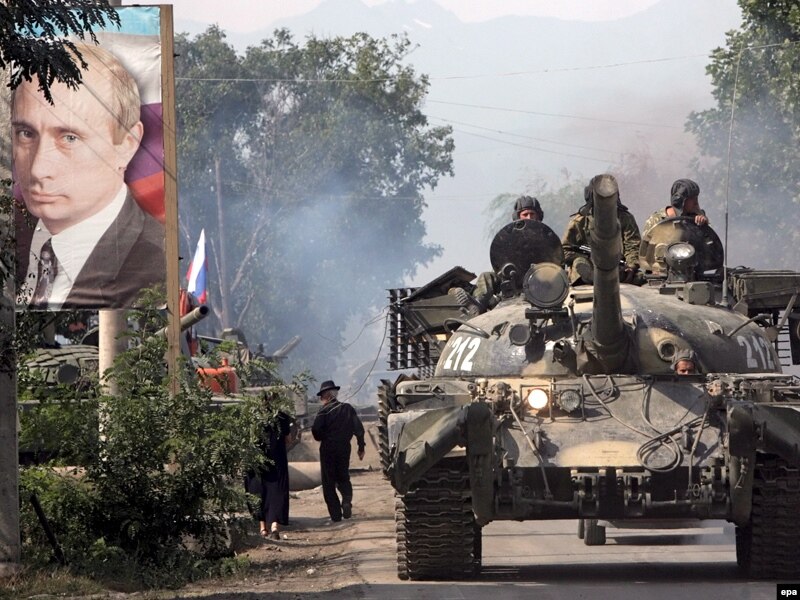
A Russian tank passes by a huge portrait of Russian Prime Minister Vladimir Putin as it passes through Tskhinvali, the South Ossetian capital.

There has been a huge amount of analysis, editorials, and speculation about the immediate and potential consequences of the Russia-Georgia conflict, not only for the two countries involved but for the world as we know it.

Much has been written about the disproportionate use of force by the Russian armed forces and the violation of Georgia's territorial integrity and sovereignty. However, the main premise of the Russian argument -- that Russia acted fully within its rights in defending its citizens in South Ossetia -- has gone unchallenged.

Russia, the argument goes, had to resort to the use of force to fulfill its constitutional responsibility to protect its citizens who faced the threat of genocide. In an attempt to claim both international legitimacy and the moral high ground, Russian leaders described the military operation against Georgia interchangeably as either a "peace-enforcement operation" or "a humanitarian intervention."

Arguments Rang Hollow

As events unfolded and the Russian military extended its area of activities far beyond the zone of conflict or "the danger zone for its citizens" and attacked both military and civilian targets in Georgia proper, Russia's "humanitarian" arguments began to ring hollow. However, nobody seemed to be in any rush to remind Russia what responsibility to protect means under international law.

Furthermore, Russia's claims to have the right to protect its citizens abroad were received with a degree of sympathy and understanding by the European Union Presidency and a number of European leaders. The Russian Foreign Ministry said in a press release on August 8 that German Foreign Minister Frank-Walter Steinmeier expressed "understanding" for Russia's motives and actions, just as did Italian Prime Minister Silvio Berlusconi. French President Nicolas Sarkozy, whose country holds the EU Presidency, was quoted as saying that "it is perfectly normal that Russia should want to defend its interests, those of Russians in Russia and Russian speakers outside Russia."

The fact that this announcement came during an open military confrontation is doubly troubling.

On the one hand, it acknowledges the right of one state to intervene under the pretext of "protection" in any other state where its citizens happen to reside, and on the other, it accepts that this intervention may take the form of a military operation, as in the case of Georgia. In other words, Russia claimed special rights in relation to its citizens and ethnic kin abroad, and the international community remained silent in response.

The first to draw conclusions from this silence was Russia itself. At a joint press conference on August 15 with German Chancellor Angela Merkel, Russian President Dmitry Medvedev said that Russia acted fully in accordance with international law to protect its citizens from grave danger, and will act in the same way in the future. He then proclaimed Russia the only guarantor of stability and security in the Caucasus, adding that "any aggression against Russians will be met with a crushing response."

Ukraine and the Baltic states, all of which host large Russian minorities, were quick to draw conclusions.

Protecting Its Citizens

The Latvian parliament issued a statement on August 14 condemning Russia's action in Georgia, which it said raises concerns for "the security, territorial inviolability, and independence of every neighbor state of Russia." The Ukrainian authorities have reportedly ordered an investigation into holders of dual citizenship in Crimea after allegations surfaced that Russia was speeding up the distribution of passports among Crimea's Russian-speaking population.

So, does a state have the right under international law to protect its citizens or ethnic kin residing abroad?

First, it should be noted that both respect for principles of sovereignty and friendly, good neighborly relations require that states refrain from granting citizenship en masse to citizens of another state without that state's explicit consent. Russia violated the above principles by conferring citizenship on residents of Georgia's breakaway regions of South Ossetia and Abkhazia, since Georgia not only did not consent to Russia's handing out passports to its citizens, but also repeatedly objected to it.

Second, states have only limited jurisdiction over their citizens residing abroad, such as consular protection, and this should be exercised with respect for the principles of sovereignty and friendly relations. The primary responsibility for the protection of its residents, including persons belonging to national minorities and those who hold multiple citizenship, lies with the state of residence.

At the same time, protection of human rights is a matter of international concern and other states, including the so-called "kin states," may have an interest in the well-being of certain groups of people, particularly those with whom they share ties of kinship and/or citizenship. This interest, however, does not translate into a right under international law.

Russia, therefore, may have a constitutionally declared responsibility to protect and support Russians abroad, but this does not in any way imply a right under international law to exercise jurisdiction over those persons on the territory of another state, and without that state's consent.

If a state is unable or unwilling to protect persons residing on its territory from mass murder and large-scale ethnic cleansing, then the protection of human life and dignity becomes the responsibility of the broader community of states. This is when the so-called humanitarian intervention, also known as the international responsibility to protect (R2P), may be considered.

Conditions Need To Be Met

For such intervention to be legitimate, however, certain conditions need to be met. These include the existence of undisputed evidence of crimes committed against the civilian population; international authorization for the use of multilateral force; the objective must be limited to preventing human suffering and protecting the population; and the use of force should not exceed that required to achieve the humanitarian objective. Even at the risk of delaying an adequate response to a humanitarian catastrophe, these conditions need to be met in order to avoid the possible abuse of the precedent with damaging consequences for both the principle of intervention and its practical application.

In sum, a state's rights in relation to its citizens or ethnic kin abroad are limited and, as a rule, require the consent of the state of residence. In the event of a major humanitarian catastrophe, the international community has the right to act, provided the conditions listed above are met. Unilateral intervention, particularly on the part of a neighboring state, cannot be justified because the motivation for such intervention will invariably be open to question.

Russia's action in Georgia not only violated international norms and principles, but also demonstrated how and to what extent the notion of humanitarian intervention can be abused. It showed clearly that the misapplication of the R2P can result in a punitive, rather than a humanitarian intervention, and that the unilateral and disproportionate use of force by a single power pursuing its own questionable objectives can lead to a counterwave of ethnic cleansing and human suffering on a massive scale.  

Natalie Wild is a political scientist at Oxford University. The views expressed in this commentary are the author's own and do not necessarily reflect those of RFE/RL
     
Comments
by: Michael Abele from: USA
August 29, 2008 03:33
Interesting debate. As a physician who worked for a year (2000-2001) in Abkhazia providing medical care to the population there, deprived as it was of the ability to rebuild the country's medical infrastructure system following the 1992-94 war as a result of the economic embargo imposed largely at Georgia's behest, I guess my point of view is that the Georgian government behaved during essentially all of the post-war period in a manner that failed to protect the "human life and dignity" of people which it, ostensibly at least, claimed were its own citizens. To me, the imposition of an embargo which quite literally took the lives of many, many innocent people in Abkhazia over a period of 14-15 years, ought to have at least raised the question of whether there was some "responsibility to protect" among the "broader community of states" to which the author refers. And yet, there seems to have been no serious attempt on the part of the international community during that time to intervene with Georgia to lift this embargo, in order to reduce the suffering of the Abkhazian people.

Could a case perhaps be made that maintaining an economic embargo against a civilian population for 14-15 years - an embargo which deprives people of the opportunity to obtain food, fuel for their homes, or medical care for their ailments - might justifiably be viewed, if not necessarily as an attempt at overt ethnic cleansing, at the very least as a form excessive and unjustified abuse of fundamental human rights?

Is it really appropriate to pursue one's political aims by imposing economic sanctions which lead to the deaths, on a large scale, of innocent civilians, including children? To pursue this point further, should international law be allowed to act as a shield for such actions? Or are such actions to be considered as "crimes against the civilian population", i.e., potentially worthy of "intervention" in an effort to protect the lives and welfare of innocent people?

To me at least, serious problems arise when the "requirements" of international law visibly collide with the most fundamental "requirements" of basic ethical behavior. Georgia's actions, both in terms of repeatedly invading the two territories as well as deliberately isolating them economically, with the goal of "punishing" the separatist populations into submission, have long struck me as morally indefensible, whether or not they somehow "comply" with the requirements of international law. In any event, there seems to be little doubt that this divergence between what Georgia and the West viewed as "legally" defensible versus what the territorial populations themselves viewed as "morally" defensible goes a long way toward explaining why the latter are now irreconciliably opposed to Georgian rule, and fully accepting of Russia's moral justifications for "protecting" the citizens of the territories.

by: Rob from: Paris
August 28, 2008 10:54
Andy is right that the Georgian use of grads on Tskhinvali was wrong, just as it was wrong for the Ossetian militia to use artillery and mortars against Georgian villages in South Ossetia in the days before the Georgian attack. He is wrong to say, though, that grads provide a fast killing option and to imply that that was what the Georgians wanted. Grads are inaccurate and sow terror more than they take human life. I speak on some authority as I had the misfortune to come under Russian grad attack in Chechnya on a few occasions. Do you remember Chechnya, Andy? Were you moved to come to the defence of the Chechens or did you support Russia's right to assert its sovereignty over Chechen territory? If you do remember Chechnya, you will recall that the Russians used vacuum bombs, cluster bombs, Uragan rocket systems and Tochka-U rockets indiscriminately and on a massive scale against the civilian population of Grozny, a city some fifteen times more populous than tiny Tskhinvali. I suspect I am not alone in disbelieving Russia's crocodile tears for the Ossetians.
Of course it matters that Russians planned their operation. If, over a period of several years, I repeatedly kick you in the shins, the chances are that you are going to respond, even if to do so is unwise. The Georgians were unwise to respond but let's not pretend that this was not the outcome that Moscow had been seeking.
You are right of course that the Georgian government closed down Russian media outlets in Georgia. Georgia was at war with Russia, which is a vastly bigger and more powerful state. It had to defend itself against Russian propaganda. This is what states do when they are at war. In this respect, Georgia is no exception to the rule.

by: eddy from: kigali, rwanda
August 27, 2008 16:09
when i consider this situation and reactions from the west i conclude that nobody can do any thing about this. this has shown those wekeness of the UN. can some one make a comparaison betwenn russian actions and the war between Rwanda and Congo??

by: Andy from: Switzerland
August 27, 2008 15:49
Thank you for legal explanation of the matter. I was looking for clear answers for some time now. This shows that this law would be appropriate for a ¨slow¨ killing of population with bullets and isolation means, when lawyers could try to decide what would be a proportional response to such actions. The S. Osetia case had shown that use of ¨Grad¨ system on the city would qualify as a carpet bombing (undisputed crime) or fast killing technique which would end up of a wipe of all inhabitance in that city in hours rather than months (because of pro American and NATO support) witch would be necessary to get a green light from UN and that would mean that there is no one left to protect. Given that Georgian forces would be than on location they would have time to cover up most of the evidence of their criminal activities in the area. It doesn’t matter how many civilians were in the city at the time of bombardment, but it is clear that carpet bombing is not the method some one use with just one objective to take over the control of civilian populated areas. This along puts the law in the trash can (don’t forget that peace keeping forces in S.Osetia have all legal rights to be there, and part of them were undisputed Russian citizens which were killed). The term of ¨disproportional force¨ makes no sense at all in military encounters and invented by politicians which care less for population which is being slathered.
It doesn’t matter if Russians were planning this or not. The fact is that Georgians shouldn’t have done what they did. There wouldn’t be a disputable situation.
This is pure nonsense that Russia will now try to invade other countries under a pretext of defending its citizens (unless those countries will start mass murders as Georgians did). It is a pure act of deceiving and lying by its own politicians to its own population of those countries which makes those politicians criminals, you can’t justify deception and leis as a benefit to their population and that’s what west media has done these weeks. All they do is making Russia look bad so they can win votes and they don’t show both sides of the story. Georgia closed all pro Russian media sources. All this is called ¨protection of western and democratic values¨. IT IS NOT. West blames Russia (USSR) for making propaganda (one sided coverage of events as minimum), but in Russia any sort of media access is available. The worst thing what was achieved by the west with such actions is that Russian people will keep to support in the future people with authoritarian and dictator like stile of governing (or was is an intention of the west to have a created enemy?).
     
TEXT SIZE - +
Crisis In Georgia
For RFE/RL's full coverage of the conflict that began in Georgia's breakway region of South Ossetia, click here.


Follow Us On Twitter

Keep up-to-date on all the latest news from RFE/RL's broadcast region by following us on Twitter:
~ You can find our instant news feed at @RFE_RLNEWS.
~ An obsessive Kremlin watcher? Follow our blog at @PowerVertical.
~ Human rights abuses chronicled at @RightsWatchdog.
~ News, comment, and the odd silly dictator story at @TransmissionRFE.

Products and services:

RSSMail SubscriptionMobile