




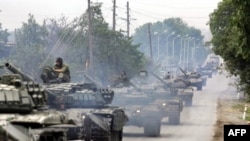
Recent media reports in Georgia and the West have fueled speculation that a second round of military conflict between Moscow and Tbilisi could resume as early as the spring.
But Georgian Interior Minister Vano Merabishvili recently sought to dismiss such rumors as a Russian spin campaign meant to scare off Georgia's potential investors. In a rare interview on Georgia's Rustavi-2 television, Merabishvili ticked off a laundry list of reasons why a renewal of Russia's "large-scale military aggression" is unlikely "in the immediate future." First among his arguments -- the U.S.-Georgia Charter on Strategic Partnership, which Merabishvili said gave Georgia "a serious security guarantee."
The charter, signed in Washington on January 9 between the United States and Georgia, has been widely touted in Tbilisi as a unique and "historic" document that underscores Washington's unequivocal support for the Georgian government, and even as a surrogate guarantee of fast-track NATO membership after neither the NATO summit in Bucharest in April 2008 nor the NATO foreign ministers meeting in Brussels in December yielded the ardently hoped-for NATO Membership Action Plan (MAP).
(NATO's decision on March 5 to restore full working ties with Russia after a six-month suspension following the Russia-Georgia war was also interpreted, in some corners, as a sign that Tbilisi's wait for a MAP will be a long one.)
In his televised New Year's address to the Georgian people, President Mikheil Saakashvili described the charter as the start of a "new phase" in Georgia's international relations and the end of over two centuries of Russian domination that began with the signing in 1783 between Tsarist Russia and the kingdom of Kartli and Kakheti of the Treaty of Georgievsk, under which Georgia voluntarily became a Russian protectorate, civil.ge reported. Parliament speaker Davit Bakradze and Foreign Minister Grigol Vashadze have both stressed that the charter is the first formal bilateral agreement to describe Georgia as a "strategic partner" of the United States. For that reason, Vashadze has argued, its importance "cannot be overestimated."
No Guarantees
But a close reading of the text suggests that to interpret the charter as an expression of unqualified support for the Tbilisi leadership is misleading.
First, the signing of the charter does not of itself imply that Georgia occupies a unique place in U.S. foreign policy, for the simple reason that the text very largely duplicates the wording of an analogous charter signed between Ukraine and the United States just three weeks earlier, on December 19, 2008.
However, as Western experts have pointed out, the charter does reaffirm both the fundamental tenets of U.S. policy toward Georgia, including support for Georgia's sovereignty and territorial integrity, and Washington's continued interest in the South Caucasus as a whole, not least as a conduit for the export of Caspian hydrocarbons.
 Merabishvili said the charter gives Georgia "a serious security guarantee."Second, the charter is nonbinding (in contrast to a treaty). And third, most of the provisions that are unique to the U.S.-Georgia charter and do not figure in the U.S.-Ukraine charter focus on explicit areas -- such as media freedom and rule of law -- in which Georgia is clearly perceived as not living up to its commitments.
The first three points of the preamble to the respective charters are almost identical. The first affirms "the importance of our relationship as friends and strategic partners" and the shared intention to deepen partnership and cooperation. The second stresses that cooperation is based on shared values and common interests, including expanding democracy and economic freedom, protecting security and territorial integrity, and strengthening the rule of law.
The Georgian, but not the Ukrainian charter, additionally notes in this context the need to respect human rights. It also affirms the right of displaced persons (meaning those who fled Abkhazia and South Ossetia during the August war) to return to their homes, and the need to "bolster Eurasian energy security." The third point stresses the shared desire to strengthen cooperation "across the economic, energy, diplomatic, scientific, cultural, and security fields." The preamble to the Ukrainian charter contains two further points reaffirming commitment to earlier agreements, including Ukraine's accession in 1994 to the Nuclear Nonproliferation Treaty, and the Priorities for U.S.-Ukraine Cooperation of March 31, 2008.
Stressing Cooperation
The first section of both charters focuses on "principles of partnership." These too are largely identical, affirming mutual support for territorial integrity and sovereignty; a shared belief that "democracy is the chief basis" for, in the Georgian case, "political legitimacy and therefore stability," and in the case of Ukraine, for "security, prosperity, and freedom."
Both charters also underscore the need for cooperation on defense and security in order to "respond effectively to threats to peace and stability," and note that "a strong, independent and democratic Georgia/Ukraine, capable of responsible self-defense, contributes to the security and prosperity" not only of the population of those two countries, but "of a Europe whole, free, and at peace."
The Georgian charter contains three additional paragraphs in this section stressing that "an increasingly democratic Georgia can unleash the full creative potential of its industrious citizens, and thereby catalyze prosperity throughout the region and beyond"; and encouraging Georgia's efforts to deepen political, economic, security, and social ties with the Euro-Atlantic community. At the same time, the third paragraph contains the clear proviso that Georgia must "meet the necessary standards" for full integration into "European and trans-Atlantic political, economic, security, and defense institutions," meaning the EU and NATO.
The second main section of the charter, on defense and security cooperation, is likewise very similar. In both cases, the signatories term integration into Euro-Atlantic structures "a priority," and "plan to undertake a program of enhanced security cooperation intended to increase Georgian/Ukrainian capabilities and to strengthen Georgia's/Ukraine's candidacy for NATO membership," referring in that context to the final document adopted at the Bucharest NATO summit that affirmed that both countries "will become NATO members," without specifying any time frame.
Both charters include a paragraph on working to increase "the interoperability and coordination of capabilities between NATO and Georgia/Ukraine," including through enhanced training and equipment for Georgian/Ukrainian forces. But the Georgian charter stresses that the United States supports Georgia's efforts "to provide for its legitimate security and defense needs," implying that Washington would not condone a new, disproportionate buildup of the Georgian armed forces, such as President Saakashvili has hinted at, and that could be used in an offensive capacity, to launch a new war with the aim of restoring by force Georgia's hegemony over Abkhazia and South Ossetia.
Diverging Priorities
The third section of the respective charters, on trade and energy cooperation, is more country-specific. In Ukraine's case, it refers to Ukraine's accession in May 2008 to the World Trade Organization and to the need "to work closely together on rehabilitating and modernizing the capacity of Ukraine's gas transit infrastructure." With regard to Georgia, it refers to measures for trade liberalization and "explor[ing] the possibility of a Free Trade Agreement." It contains a commitment by the United States to assist in postwar reconstruction in Georgia, and affirms Washington's determination to build on a decade of cooperation on the export of Azerbaijan's oil and gas by developing "a new Southern Corridor to help Georgia and the rest of Europe diversify their supplies of natural gas."
The fourth section of the charter, on "strengthening democracy," similarly reflects diverging priorities. In both cases, the need is stressed to strengthen the independence of the judiciary and the professionalism of the police. The Ukrainian charter notes the need for greater public monitoring of anticorruption efforts and to enforce ethical standards by establishing internal investigation units. By contrast, the Georgian charter underscored the need to bolster independent media, freedom of expression and access to objective information (not mentioned in the case of Ukraine); to promote political pluralism; and to "strengthen the capacity of Georgian civil society to develop and analyze public policy,[...] participate in the legislative process, and provide oversight of public officials."
The final section, on "increasing people to people and cultural exchanges" contained, in the Ukrainian case, mention of Washington's intention to open a U.S. diplomatic presence in Simferopol, and in the Georgian case, affirmation of the shared intent to "foster continued contacts between the residents of Abkhazia and Tskhinvali Raion/South Ossetia and the rest of Georgia."
Most independent commentators in Tbilisi pointed to the limitations of the charter, noting that it does not oblige the United States to defend Georgia in the event of attack. Eurasianet.org on January 9 quoted professor Tornike Sharashenidze as suggesting that the document was intended primarily as a psychological boost for the Georgian leadership in the wake of the August war, the loss of Abkhazia and South Ossetia, and the failure to secure an MAP at the NATO foreign ministers meeting in early December.
Some opposition politicians were more scathing. Eka Beselia, general secretary of the Movement for a United Georgia established in the fall of 2007 by former Defense Minister Irakli Okruashvili, pointed out to journalists on January 14 that on the very day that Vashadze signed the charter pledging Georgia's commitment to further democratization, her party was evicted from the office premises it owned in Tbilisi, which were forcibly nationalized.
The United States has not signed a comparable charter with any other CIS state, nor is any known to be under discussion. Although nonbinding, the twin Ukraine-Georgia charters can nonetheless be presumed to reflect a desire on the part of the United States to induce Kyiv and Tbilisi to address those systemic weaknesses on which some European NATO members based their arguments against offering either country a MAP. Yet at the same time, precisely because they are nonbinding, the charters offer little protection to either country against continued Russian bullying and blackmail.
Liz Fuller is commentary and analysis co-editor at RFE/RL. The views expressed in this commentary are the author's own and do not necessarily reflect those of RFE/RL
But Georgian Interior Minister Vano Merabishvili recently sought to dismiss such rumors as a Russian spin campaign meant to scare off Georgia's potential investors. In a rare interview on Georgia's Rustavi-2 television, Merabishvili ticked off a laundry list of reasons why a renewal of Russia's "large-scale military aggression" is unlikely "in the immediate future." First among his arguments -- the U.S.-Georgia Charter on Strategic Partnership, which Merabishvili said gave Georgia "a serious security guarantee."
The charter, signed in Washington on January 9 between the United States and Georgia, has been widely touted in Tbilisi as a unique and "historic" document that underscores Washington's unequivocal support for the Georgian government, and even as a surrogate guarantee of fast-track NATO membership after neither the NATO summit in Bucharest in April 2008 nor the NATO foreign ministers meeting in Brussels in December yielded the ardently hoped-for NATO Membership Action Plan (MAP).
(NATO's decision on March 5 to restore full working ties with Russia after a six-month suspension following the Russia-Georgia war was also interpreted, in some corners, as a sign that Tbilisi's wait for a MAP will be a long one.)
In his televised New Year's address to the Georgian people, President Mikheil Saakashvili described the charter as the start of a "new phase" in Georgia's international relations and the end of over two centuries of Russian domination that began with the signing in 1783 between Tsarist Russia and the kingdom of Kartli and Kakheti of the Treaty of Georgievsk, under which Georgia voluntarily became a Russian protectorate, civil.ge reported. Parliament speaker Davit Bakradze and Foreign Minister Grigol Vashadze have both stressed that the charter is the first formal bilateral agreement to describe Georgia as a "strategic partner" of the United States. For that reason, Vashadze has argued, its importance "cannot be overestimated."
No Guarantees
But a close reading of the text suggests that to interpret the charter as an expression of unqualified support for the Tbilisi leadership is misleading.
First, the signing of the charter does not of itself imply that Georgia occupies a unique place in U.S. foreign policy, for the simple reason that the text very largely duplicates the wording of an analogous charter signed between Ukraine and the United States just three weeks earlier, on December 19, 2008.
However, as Western experts have pointed out, the charter does reaffirm both the fundamental tenets of U.S. policy toward Georgia, including support for Georgia's sovereignty and territorial integrity, and Washington's continued interest in the South Caucasus as a whole, not least as a conduit for the export of Caspian hydrocarbons.

The first three points of the preamble to the respective charters are almost identical. The first affirms "the importance of our relationship as friends and strategic partners" and the shared intention to deepen partnership and cooperation. The second stresses that cooperation is based on shared values and common interests, including expanding democracy and economic freedom, protecting security and territorial integrity, and strengthening the rule of law.
The Georgian, but not the Ukrainian charter, additionally notes in this context the need to respect human rights. It also affirms the right of displaced persons (meaning those who fled Abkhazia and South Ossetia during the August war) to return to their homes, and the need to "bolster Eurasian energy security." The third point stresses the shared desire to strengthen cooperation "across the economic, energy, diplomatic, scientific, cultural, and security fields." The preamble to the Ukrainian charter contains two further points reaffirming commitment to earlier agreements, including Ukraine's accession in 1994 to the Nuclear Nonproliferation Treaty, and the Priorities for U.S.-Ukraine Cooperation of March 31, 2008.
Stressing Cooperation
The first section of both charters focuses on "principles of partnership." These too are largely identical, affirming mutual support for territorial integrity and sovereignty; a shared belief that "democracy is the chief basis" for, in the Georgian case, "political legitimacy and therefore stability," and in the case of Ukraine, for "security, prosperity, and freedom."
Both charters also underscore the need for cooperation on defense and security in order to "respond effectively to threats to peace and stability," and note that "a strong, independent and democratic Georgia/Ukraine, capable of responsible self-defense, contributes to the security and prosperity" not only of the population of those two countries, but "of a Europe whole, free, and at peace."
The Georgian charter contains three additional paragraphs in this section stressing that "an increasingly democratic Georgia can unleash the full creative potential of its industrious citizens, and thereby catalyze prosperity throughout the region and beyond"; and encouraging Georgia's efforts to deepen political, economic, security, and social ties with the Euro-Atlantic community. At the same time, the third paragraph contains the clear proviso that Georgia must "meet the necessary standards" for full integration into "European and trans-Atlantic political, economic, security, and defense institutions," meaning the EU and NATO.
The second main section of the charter, on defense and security cooperation, is likewise very similar. In both cases, the signatories term integration into Euro-Atlantic structures "a priority," and "plan to undertake a program of enhanced security cooperation intended to increase Georgian/Ukrainian capabilities and to strengthen Georgia's/Ukraine's candidacy for NATO membership," referring in that context to the final document adopted at the Bucharest NATO summit that affirmed that both countries "will become NATO members," without specifying any time frame.
Both charters include a paragraph on working to increase "the interoperability and coordination of capabilities between NATO and Georgia/Ukraine," including through enhanced training and equipment for Georgian/Ukrainian forces. But the Georgian charter stresses that the United States supports Georgia's efforts "to provide for its legitimate security and defense needs," implying that Washington would not condone a new, disproportionate buildup of the Georgian armed forces, such as President Saakashvili has hinted at, and that could be used in an offensive capacity, to launch a new war with the aim of restoring by force Georgia's hegemony over Abkhazia and South Ossetia.
Diverging Priorities
The third section of the respective charters, on trade and energy cooperation, is more country-specific. In Ukraine's case, it refers to Ukraine's accession in May 2008 to the World Trade Organization and to the need "to work closely together on rehabilitating and modernizing the capacity of Ukraine's gas transit infrastructure." With regard to Georgia, it refers to measures for trade liberalization and "explor[ing] the possibility of a Free Trade Agreement." It contains a commitment by the United States to assist in postwar reconstruction in Georgia, and affirms Washington's determination to build on a decade of cooperation on the export of Azerbaijan's oil and gas by developing "a new Southern Corridor to help Georgia and the rest of Europe diversify their supplies of natural gas."
The fourth section of the charter, on "strengthening democracy," similarly reflects diverging priorities. In both cases, the need is stressed to strengthen the independence of the judiciary and the professionalism of the police. The Ukrainian charter notes the need for greater public monitoring of anticorruption efforts and to enforce ethical standards by establishing internal investigation units. By contrast, the Georgian charter underscored the need to bolster independent media, freedom of expression and access to objective information (not mentioned in the case of Ukraine); to promote political pluralism; and to "strengthen the capacity of Georgian civil society to develop and analyze public policy,[...] participate in the legislative process, and provide oversight of public officials."
The final section, on "increasing people to people and cultural exchanges" contained, in the Ukrainian case, mention of Washington's intention to open a U.S. diplomatic presence in Simferopol, and in the Georgian case, affirmation of the shared intent to "foster continued contacts between the residents of Abkhazia and Tskhinvali Raion/South Ossetia and the rest of Georgia."
Most independent commentators in Tbilisi pointed to the limitations of the charter, noting that it does not oblige the United States to defend Georgia in the event of attack. Eurasianet.org on January 9 quoted professor Tornike Sharashenidze as suggesting that the document was intended primarily as a psychological boost for the Georgian leadership in the wake of the August war, the loss of Abkhazia and South Ossetia, and the failure to secure an MAP at the NATO foreign ministers meeting in early December.
Some opposition politicians were more scathing. Eka Beselia, general secretary of the Movement for a United Georgia established in the fall of 2007 by former Defense Minister Irakli Okruashvili, pointed out to journalists on January 14 that on the very day that Vashadze signed the charter pledging Georgia's commitment to further democratization, her party was evicted from the office premises it owned in Tbilisi, which were forcibly nationalized.
The United States has not signed a comparable charter with any other CIS state, nor is any known to be under discussion. Although nonbinding, the twin Ukraine-Georgia charters can nonetheless be presumed to reflect a desire on the part of the United States to induce Kyiv and Tbilisi to address those systemic weaknesses on which some European NATO members based their arguments against offering either country a MAP. Yet at the same time, precisely because they are nonbinding, the charters offer little protection to either country against continued Russian bullying and blackmail.
Liz Fuller is commentary and analysis co-editor at RFE/RL. The views expressed in this commentary are the author's own and do not necessarily reflect those of RFE/RL