



BRUSSELS -- When it comes to Russia, the mood in Brussels is one of disillusionment and resignation.
The upcoming EU-Russia summit in Khabarovsk on May 21-22 will be a far cry from the heady days of 2005, when the two sides solemnly pledged to pursue all-encompassing cooperation in four "common spaces" -- external security, internal security, the economy; and science, culture, and education.
Since then, the EU's hopes of setting up a well-ordered relationship have had a hard landing. Russia's alienation from the West, accentuated since the coming to power of President Dmitry Medvedev, saw Moscow invade Georgia last August, cut Ukrainian and European gas deliveries this January, and continue to harry the bloc with a myriad of lesser irritants.
 Diplomats in Brussels say there is an increasing realization within the EU that any rhetoric of partnership that has been offered by Russia does not match the reality of its aspirations or actions. Similarly, the EU itself must now decide whether its own rhetoric of seeking a "strategic partnership" with Russia corresponds any longer with the reality on the ground.
Apart from the Russian pressure on Georgia and Ukraine, the deterioration of links is best exemplified by the growing dysfunctionality of the commercial heart of the EU-Russia partnership. This, in turn, is nowhere more evident than the state of energy trade, which has been phenomenally profitable for both sides since the days of the Soviet Union.
The EU has spent years trying to get Russia to abide by the provisions of the Energy Charter, which aspires to provide transparent and market-based rules for international energy cooperation. As such, it would oblige Russia to open up the development of its hydrocarbon reserves and the running of its pipelines to foreign commercial involvement. Having signed -- but never ratified -- the Energy Charter, Russia now wants to scrap it and replace it with a new accord strengthening its own hand as the EU's main external energy supplier.
The European Commission, the EU's executive, has said it will not abandon the Energy Charter. But on May 19, EU officials held out an olive branch to Russia, saying an ongoing review of the charter could be an opportunity to address some of Russia's concerns. Officials indicated they expect no concrete decisions from the summit on energy cooperation beyond an upgrade to an embryonic "early-warning" system set up last year to preempt delivery disruptions.
Disunity, Disappointment
Russian officials have said Moscow will be seeking EU support for a proposed new European security treaty repeatedly trotted out by Medvedev since June 2008. Moscow knows, of course, that an EU delegation made up of Czech President Vaclav Klaus, European Commission President Jose Manuel Barroso, and EU foreign-policy chief Javier Solana has no powers to negotiate on hard security issues. They can only voice whatever consensus the EU's 27 member states can agree to.
At a meeting with EU foreign ministers on April 28, Russian Foreign Minister Sergei Lavrov said Moscow wants a new binding treaty on security. He dismissed the Organization for Security and Cooperation in Europe (OSCE), which nominally remains the top pan-European security body, by saying it has failed because it has no powers to make international law.
But the OSCE will be the forum where Russia, the EU, and the United States will first officially lock horns on the issue, at a special foreign ministers' meeting on the Greek island of Corfu on June 27-28.
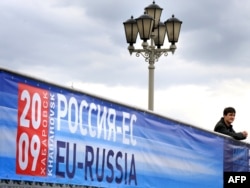 Can the EU overcome its many minor trade disputes with Moscow?Officials in Brussels fear Russia will try its best to ridicule the EU at the Khabarovsk summit by exploiting the fact the bloc's delegation will be headed by Klaus, the notoriously euroskeptical and Russia-friendly Czech president. The Czech Republic, now with a caretaker government, is running a lame-duck EU presidency, to be relieved on July 1 by Sweden.
The disappointment felt by the European Commission at the state of EU-Russia relations is perhaps the best measure of how far ties have sunk. Traditionally the technocratic voice of moderation within the EU, the commission at recent EU meetings has argued that Russia's recent record is not befitting of a "strategic partner." Apart from Georgia and Ukraine, the commission is palpably frustrated by what it views as Russian obstructionism on often minor trade issues, thus undermining the entire pragmatic rationale for cooperation.
Trade Disputes
Commission officials, in an off-the-record briefing on May 19, produced a long list of grievances. Exorbitant Russian levies remain in place on EU aircraft crossing Siberia, despite ostensibly being dropped after an agreement was signed with the EU in 2007. "Khabarovsk will provide a good setting to address the matter," one official quipped ruefully, in reference to the city's eastern location.
Then there is the tariff "barrier" officials say Russia has erected in the early months of this year, affecting a vast array of EU goods from cars and agricultural machinery to steel products, TV screens, and radio cables.
Russia argues the mostly 5-20 percent increases in tariffs follow World Trade Organization (WTO) rules. EU officials counter that as a country negotiating to join the WTO, Russia must keep its tariffs steady to provide a stable basis for talks. But it is clear that the tariffs, together with the ruble's depreciation, are hurting EU businesses.
Russia has also banned all imports of EU pork, citing concerns over the spread of Mexican swine flu. The EU contends the measure is an overreaction, particularly as no proven link exists between consuming pork and contracting the disease.
The EU's disillusionment with Russia is also evident in the lack of zest with which officials tackle issues such as human rights, media freedom, and standards of democracy. Traditionally a mainstay of the EU agenda at any summit with Russia, these topics are now relegated to obscurity, with tight-lipped commission officials limiting themselves to the affirmation that "rule of law" issues will be raised at the Khabarovsk summit.
Eventually, it is the member states, however, not the European Commission, that will have to decide on the way forward. EU member states, wielding final authority on all foreign-policy issues, are currently split into three broad camps.
First, there is the "Friends of Russia" club -- with France, Germany, and Italy at its helm, and including also Greece, Cyprus, and a few others -- which sees Russia as a strategic partner for the EU, no matter what.
Then there are the skeptics -- led by Poland, Lithuania, Sweden, and, now less prominently, Britain. These countries increasingly have the support of the commission.
There is now emerging a third, loose grouping, featuring Russian neighbors Finland, Latvia, Estonia, and some countries in Southeastern Europe, which argue pragmatic cooperation with Russia remains an essential EU interest at all costs.
The upcoming EU-Russia summit in Khabarovsk on May 21-22 will be a far cry from the heady days of 2005, when the two sides solemnly pledged to pursue all-encompassing cooperation in four "common spaces" -- external security, internal security, the economy; and science, culture, and education.
Since then, the EU's hopes of setting up a well-ordered relationship have had a hard landing. Russia's alienation from the West, accentuated since the coming to power of President Dmitry Medvedev, saw Moscow invade Georgia last August, cut Ukrainian and European gas deliveries this January, and continue to harry the bloc with a myriad of lesser irritants.
Apart from the Russian pressure on Georgia and Ukraine, the deterioration of links is best exemplified by the growing dysfunctionality of the commercial heart of the EU-Russia partnership. This, in turn, is nowhere more evident than the state of energy trade, which has been phenomenally profitable for both sides since the days of the Soviet Union.
The EU has spent years trying to get Russia to abide by the provisions of the Energy Charter, which aspires to provide transparent and market-based rules for international energy cooperation. As such, it would oblige Russia to open up the development of its hydrocarbon reserves and the running of its pipelines to foreign commercial involvement. Having signed -- but never ratified -- the Energy Charter, Russia now wants to scrap it and replace it with a new accord strengthening its own hand as the EU's main external energy supplier.
The European Commission, the EU's executive, has said it will not abandon the Energy Charter. But on May 19, EU officials held out an olive branch to Russia, saying an ongoing review of the charter could be an opportunity to address some of Russia's concerns. Officials indicated they expect no concrete decisions from the summit on energy cooperation beyond an upgrade to an embryonic "early-warning" system set up last year to preempt delivery disruptions.
Disunity, Disappointment
Russian officials have said Moscow will be seeking EU support for a proposed new European security treaty repeatedly trotted out by Medvedev since June 2008. Moscow knows, of course, that an EU delegation made up of Czech President Vaclav Klaus, European Commission President Jose Manuel Barroso, and EU foreign-policy chief Javier Solana has no powers to negotiate on hard security issues. They can only voice whatever consensus the EU's 27 member states can agree to.
At a meeting with EU foreign ministers on April 28, Russian Foreign Minister Sergei Lavrov said Moscow wants a new binding treaty on security. He dismissed the Organization for Security and Cooperation in Europe (OSCE), which nominally remains the top pan-European security body, by saying it has failed because it has no powers to make international law.
But the OSCE will be the forum where Russia, the EU, and the United States will first officially lock horns on the issue, at a special foreign ministers' meeting on the Greek island of Corfu on June 27-28.

The disappointment felt by the European Commission at the state of EU-Russia relations is perhaps the best measure of how far ties have sunk. Traditionally the technocratic voice of moderation within the EU, the commission at recent EU meetings has argued that Russia's recent record is not befitting of a "strategic partner." Apart from Georgia and Ukraine, the commission is palpably frustrated by what it views as Russian obstructionism on often minor trade issues, thus undermining the entire pragmatic rationale for cooperation.
Trade Disputes
Commission officials, in an off-the-record briefing on May 19, produced a long list of grievances. Exorbitant Russian levies remain in place on EU aircraft crossing Siberia, despite ostensibly being dropped after an agreement was signed with the EU in 2007. "Khabarovsk will provide a good setting to address the matter," one official quipped ruefully, in reference to the city's eastern location.
Then there is the tariff "barrier" officials say Russia has erected in the early months of this year, affecting a vast array of EU goods from cars and agricultural machinery to steel products, TV screens, and radio cables.
Russia argues the mostly 5-20 percent increases in tariffs follow World Trade Organization (WTO) rules. EU officials counter that as a country negotiating to join the WTO, Russia must keep its tariffs steady to provide a stable basis for talks. But it is clear that the tariffs, together with the ruble's depreciation, are hurting EU businesses.
Russia has also banned all imports of EU pork, citing concerns over the spread of Mexican swine flu. The EU contends the measure is an overreaction, particularly as no proven link exists between consuming pork and contracting the disease.
The EU's disillusionment with Russia is also evident in the lack of zest with which officials tackle issues such as human rights, media freedom, and standards of democracy. Traditionally a mainstay of the EU agenda at any summit with Russia, these topics are now relegated to obscurity, with tight-lipped commission officials limiting themselves to the affirmation that "rule of law" issues will be raised at the Khabarovsk summit.
Eventually, it is the member states, however, not the European Commission, that will have to decide on the way forward. EU member states, wielding final authority on all foreign-policy issues, are currently split into three broad camps.
First, there is the "Friends of Russia" club -- with France, Germany, and Italy at its helm, and including also Greece, Cyprus, and a few others -- which sees Russia as a strategic partner for the EU, no matter what.
Then there are the skeptics -- led by Poland, Lithuania, Sweden, and, now less prominently, Britain. These countries increasingly have the support of the commission.
There is now emerging a third, loose grouping, featuring Russian neighbors Finland, Latvia, Estonia, and some countries in Southeastern Europe, which argue pragmatic cooperation with Russia remains an essential EU interest at all costs.