



Keeping its eastern neighbors on the path to stability and prosperity has become a formidable test for EU foreign policy in recent months.
As she unveiled an annual review of the bloc's European Neighborhood Policy, EU External Relations Commissioner Benita Ferrero Waldner told the 27 EU foreign ministers it has been a "difficult year" -- particularly in the east.
But Czech Foreign Minister Karel Schwarzenberg, who chaired the meeting, said the EU is resolved to push on with its Eastern Partnership initiative, which is designed to forge closer ties between the bloc and six eastern neighbors.
"We believe that sending a strong message to the six partnership countries -- Ukraine, Belarus, Moldova, Georgia, Armenia, and Azerbaijan -- is very important in the light of the recent developments in the region, and that we need to engage with our neighbors more closely in order to promote good governance, the rule of law, and transparency," he said.
Brutal Crackdown
One need look no further than this month's unrest in Moldova to know that this will not be easy.
That country is still recovering from a brutal crackdown on mass public protests in the capital, Chisinau, following a landslide win for the ruling Communists in parliamentary elections. In the wake of the violence, the country's increasingly Russian-leaning president, Vladimir Voronin, pointedly accused neighboring Romania -- an EU member -- of fomenting the unrest.
Moldova then expelled the ambassador to Romania and imposed a summary visa regime on Romanian visitors. And sources in Brussels say Voronin told Kalman Miszei, the EU special envoy, that Moldova has "friends elsewhere."
Now, at Romania's request, EU foreign ministers meeting in Luxembourg discussed Moldova during talks over lunch -- a setting usually reserved for issues of particular concern.
The EU adopted a declaration saying it has "serious concerns" about developments in the country, and Czech Foreign Minister Schwarzenberg said Moldova "poses a challenge" for the EU.
"The current tensions in the country pose a challenge for the European Union. Our task is now to find a proper way to strengthen our policy of bringing Moldova closer to our standard," he said. "We expect Moldova to behave in a European way, not only vis-a-vis the European Union and its members, but first of all, of course, internally."
But, Schwarzenberg stressed, the Eastern Partnership initiative remains "no doubt the right tool" to bolster reforms in Moldova.
Cutting Some Slack
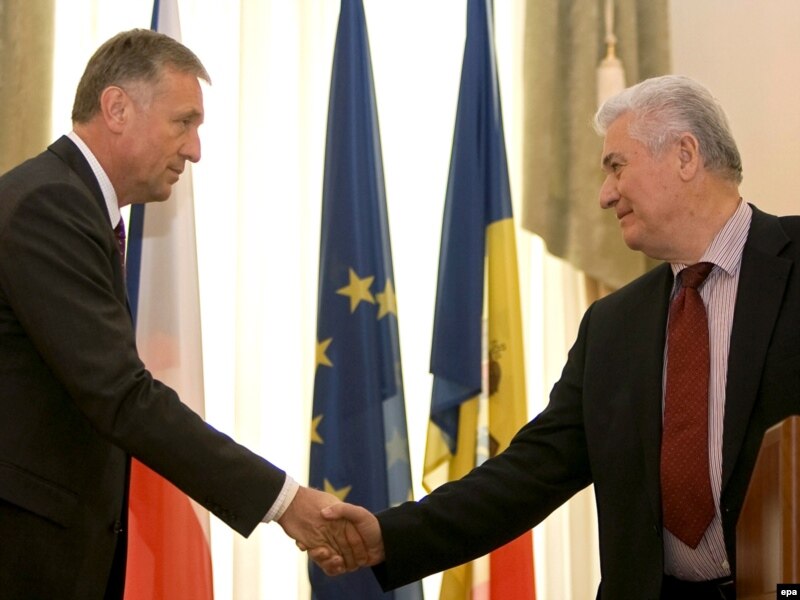
Czech Prime Minister Miroslav Topolanek, who was in Chisinau last week representing the EU Presidency, reported that neither the government nor the opposition appears to have the political will to meet the other side for talks -- a key EU wish.
 Moldovan President Vladimir Voronin (right) meets with Czech Prime Minister Mirek Topolanek in Chisinau on April 22.The Netherlands is the lone advocate of a tougher EU stance on Moldova (and another problematic partnership member, Belarus). But Germany and Poland head the EU's mainstream in arguing that Moldova must not be isolated and needs greater EU support.
The country's economy is seen by many in the EU to be on the brink of collapse.
Moldova's decision to slap visas on Romanians is, however, likely to have repercussions. The European Commission has called the measure unacceptable in light of EU-Moldova visa facilitation talks and is likely to raise it at an EU-Moldova meeting in a few days.
Moldova's partner on the EU lunch agenda was neighboring Ukraine, where there has been no public unrest but where mounting political and economic paralysis increasingly threatens the country's viability.
Again, Germany and Poland appear to be closely coordinating policy, with the two countries' foreign ministers reported to have addressed a joint letter to the EU's Czech presidency last week expressing concern at the economic and political situation in Ukraine.
The two ministers are said to have floated the idea of an EU assistance mission to Ukraine to facilitate dialogue among all political leaders. However, it is generally feared that a resolution to the political crisis in Ukraine is improbable before the 2010 presidential elections.
The EU's foreign-policy chief, Javier Solana, said after the meeting that the EU would now study ways of stabilizing the country. "After the discussion today we will see how we can help prior to the elections and after the elections, the presidential elections, to see how we can arrange the economic situation and the political situation," he said.
Is Lukashenka Coming?
The EU foreign ministers on April 27 will also discuss the agendas and guest lists of two important upcoming summits.
On May 7, representatives of Belarus, Ukraine, Moldova, Georgia, Armenia, and Azerbaijan have been invited to attend a summit in Prague on its Eastern Partnership, which is meant to extend special benefits to the EU's eastern neighbors.
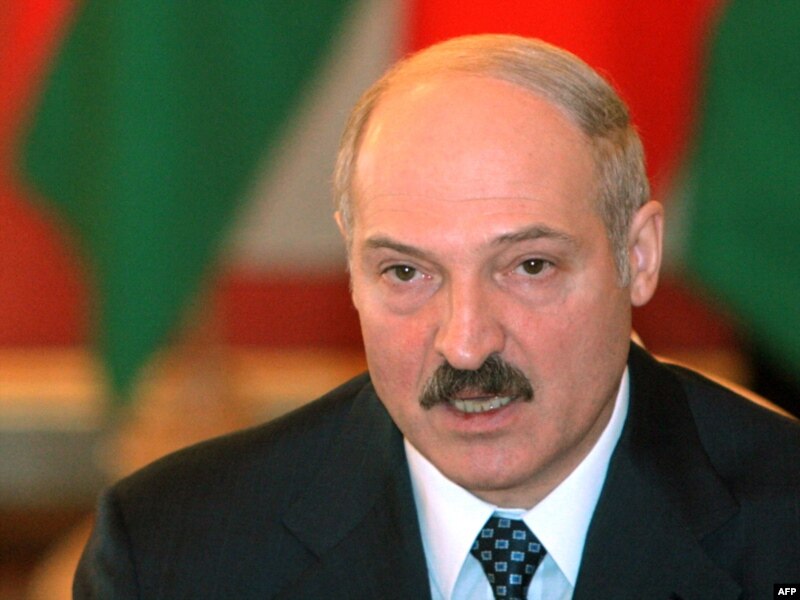
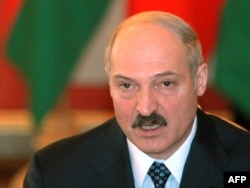 Belarusian President Alyaksandr LukashenkaMuch speculation is circulating over whether Belarus's authoritarian president, Alyaksandr Lukashenka, will attend. The invitations to the summit are not personal, giving every country's leader the choice of whether to turn up in Prague in person. Many EU nations expect Lukashenka to send a stand-in.
A joint declaration signed by the 27 EU member states and the six partner countries is planned for the summit. The text of the document is still being discussed with the partners and is expected to be finalized a week in advance of the summit.
On May 8, the EU will hold another summit in Prague, dedicated to what has become known as the Southern Corridor of energy provision.
This meeting will be conducted under the auspices of the EU "troika" of Topolanek, Solana, and European Commission President Jose Manuel Barroso. The three will face officials representing Azerbaijan, Georgia, Turkey, Kazakhstan, and Turkmenistan.
Six 'Observers'
Together, the five countries represent the EU's main hope of securing significant amounts of natural gas deliveries without resorting to Russian supplies or mediation.
Six "observers" have also been invited -- Iraq, Egypt, and Uzbekistan as potential supplier countries; and Russia, Ukraine, and the United States as other major interested parties.
The presence of the last three has been the subject of some controversy within the EU. Germany led a long-established group of countries -- including France, Italy, and Spain, among others -- which overcame resistance from others and secured an invitation for Russia.
The Southern Corridor is explicitly defined by the EU as a direct link to energy resources in the Caspian Sea region bypassing Russia.
A draft summit declaration, seen by RFE/RL, breaks new ground for the EU by saying the bloc intends to "give strong political support" to the construction of the Southern Corridor -- including the "trans-Caspian link."
This is a planned gas pipeline running from Turkmenistan to Azerbaijan which would link Central Asia directly with the Nabucco pipeline projected to run from Baku to Europe, circumventing Russia.
As she unveiled an annual review of the bloc's European Neighborhood Policy, EU External Relations Commissioner Benita Ferrero Waldner told the 27 EU foreign ministers it has been a "difficult year" -- particularly in the east.
But Czech Foreign Minister Karel Schwarzenberg, who chaired the meeting, said the EU is resolved to push on with its Eastern Partnership initiative, which is designed to forge closer ties between the bloc and six eastern neighbors.
"We believe that sending a strong message to the six partnership countries -- Ukraine, Belarus, Moldova, Georgia, Armenia, and Azerbaijan -- is very important in the light of the recent developments in the region, and that we need to engage with our neighbors more closely in order to promote good governance, the rule of law, and transparency," he said.
Brutal Crackdown
One need look no further than this month's unrest in Moldova to know that this will not be easy.
That country is still recovering from a brutal crackdown on mass public protests in the capital, Chisinau, following a landslide win for the ruling Communists in parliamentary elections. In the wake of the violence, the country's increasingly Russian-leaning president, Vladimir Voronin, pointedly accused neighboring Romania -- an EU member -- of fomenting the unrest.
Moldova then expelled the ambassador to Romania and imposed a summary visa regime on Romanian visitors. And sources in Brussels say Voronin told Kalman Miszei, the EU special envoy, that Moldova has "friends elsewhere."
Now, at Romania's request, EU foreign ministers meeting in Luxembourg discussed Moldova during talks over lunch -- a setting usually reserved for issues of particular concern.
The EU adopted a declaration saying it has "serious concerns" about developments in the country, and Czech Foreign Minister Schwarzenberg said Moldova "poses a challenge" for the EU.
"The current tensions in the country pose a challenge for the European Union. Our task is now to find a proper way to strengthen our policy of bringing Moldova closer to our standard," he said. "We expect Moldova to behave in a European way, not only vis-a-vis the European Union and its members, but first of all, of course, internally."
But, Schwarzenberg stressed, the Eastern Partnership initiative remains "no doubt the right tool" to bolster reforms in Moldova.
Cutting Some Slack
Czech Prime Minister Miroslav Topolanek, who was in Chisinau last week representing the EU Presidency, reported that neither the government nor the opposition appears to have the political will to meet the other side for talks -- a key EU wish.
The country's economy is seen by many in the EU to be on the brink of collapse.
Moldova's decision to slap visas on Romanians is, however, likely to have repercussions. The European Commission has called the measure unacceptable in light of EU-Moldova visa facilitation talks and is likely to raise it at an EU-Moldova meeting in a few days.
Moldova's partner on the EU lunch agenda was neighboring Ukraine, where there has been no public unrest but where mounting political and economic paralysis increasingly threatens the country's viability.
Again, Germany and Poland appear to be closely coordinating policy, with the two countries' foreign ministers reported to have addressed a joint letter to the EU's Czech presidency last week expressing concern at the economic and political situation in Ukraine.
The two ministers are said to have floated the idea of an EU assistance mission to Ukraine to facilitate dialogue among all political leaders. However, it is generally feared that a resolution to the political crisis in Ukraine is improbable before the 2010 presidential elections.
The EU's foreign-policy chief, Javier Solana, said after the meeting that the EU would now study ways of stabilizing the country. "After the discussion today we will see how we can help prior to the elections and after the elections, the presidential elections, to see how we can arrange the economic situation and the political situation," he said.
Is Lukashenka Coming?
The EU foreign ministers on April 27 will also discuss the agendas and guest lists of two important upcoming summits.
On May 7, representatives of Belarus, Ukraine, Moldova, Georgia, Armenia, and Azerbaijan have been invited to attend a summit in Prague on its Eastern Partnership, which is meant to extend special benefits to the EU's eastern neighbors.
A joint declaration signed by the 27 EU member states and the six partner countries is planned for the summit. The text of the document is still being discussed with the partners and is expected to be finalized a week in advance of the summit.
On May 8, the EU will hold another summit in Prague, dedicated to what has become known as the Southern Corridor of energy provision.
This meeting will be conducted under the auspices of the EU "troika" of Topolanek, Solana, and European Commission President Jose Manuel Barroso. The three will face officials representing Azerbaijan, Georgia, Turkey, Kazakhstan, and Turkmenistan.
Six 'Observers'
Together, the five countries represent the EU's main hope of securing significant amounts of natural gas deliveries without resorting to Russian supplies or mediation.
Six "observers" have also been invited -- Iraq, Egypt, and Uzbekistan as potential supplier countries; and Russia, Ukraine, and the United States as other major interested parties.
The presence of the last three has been the subject of some controversy within the EU. Germany led a long-established group of countries -- including France, Italy, and Spain, among others -- which overcame resistance from others and secured an invitation for Russia.
The Southern Corridor is explicitly defined by the EU as a direct link to energy resources in the Caspian Sea region bypassing Russia.
A draft summit declaration, seen by RFE/RL, breaks new ground for the EU by saying the bloc intends to "give strong political support" to the construction of the Southern Corridor -- including the "trans-Caspian link."
This is a planned gas pipeline running from Turkmenistan to Azerbaijan which would link Central Asia directly with the Nabucco pipeline projected to run from Baku to Europe, circumventing Russia.