

Norboy Holjigitov, a former oppositionist and human rights activist serving a long sentence in Uzbekistan, has reportedly fallen seriously ill in recent weeks.
Abdurahmon Tashanov, a Tashkent-based civil rights activist, tells RFE/RL's Uzbek Service that Holjigitov "is in a serious, life-threatening condition. His blood pressure is high, his arms and legs are almost paralyzed. According to our reports, his fellow inmates have to carry him when he needs to go in or out."
Uzbek prisons are notorious for the mistreatment and torture of prisoners, and rights groups suspect that Holjigitov has also been subject to severe beatings and other forms of ill-treatment.
The 60-year-old Holjigitov was arrested in June 2005 and sentenced to 10 years in jail on what one rights group calls "baseless and fabricated charges."
Holjigitov was on an EU list of imprisoned activists that Brussels, Human Rights Watch (HRW), and other international institutions have demanded Tashkent should set free.
According to HRW, at least 11 rights activists remain in Uzbek prisons, while at least one other is being held in a psychiatric hospital, "simply because of their peaceful human rights work and criticism of the government."
Yet the EU has praised Uzbekistan for its alleged progress on human rights and, in March, Brussels decided to continue a suspension of the EU visa ban for Uzbek government officials for another six months.
The visa ban was imposed after Uzbekistan refused an international probe into the uprising in the eastern city of Andijon in May 2005, which was violently suppressed by government forces and resulted in the deaths of hundreds of people.
Failure Of EU 'Engagement'?
Since March, many independent journalists and rights defenders have accused the EU of forgetting about the Andijon bloodshed and ignoring human rights violations in Uzbekistan for the sake of geopolitical gains and energy supplies.
Those critics say Uzbek authorities have freed just a handful of activists while many others remain in prison. Many more have been labeled as "terrorists" or "religious extremists" and sent to jail for peacefully practicing their religion.
There is no active political opposition or truly independent media in Uzbekistan, as all media operate under the tight control of the government.
The government has apparently tried to silence Uzbek journalists even beyond the country's borders. Earlier this month, Uzbek state television aired a special program about RFE/RL's Uzbek Service journalists, accusing them of carrying out antistate activities and giving personal details about the journalists and their family members.
In another attack on the independent media, former RFE/RL correspondent Solijon Adburahmonov was arrested in the western Uzbek city of Nukus, where he was accused of being a drug addict.
Pierre Morel, the EU's special representative for Central Asia, tells RFE/RL's Uzbek Service that the EU has been closely monitoring the political and human rights situation in Uzbekistan -- and he rejects accusations that the EU has turned a blind eye to the harassment of rights activists and other attacks on the media in Uzbekistan.
Morel says that "the EU is not naive" and does not believe that the situation in Uzbekistan has dramatically improved. But he says that considering Uzbekistan's difficult circumstances, even small progress in human rights is important.
"The [easiest option] is to shout [about abuses] and stop doing anything," Morel says. "So fine, OK, it is an option -- take it if you want. This is not the path we have taken. We have taken a demanding path, which is difficult, which is frustrating, and which is getting some results."
And the human rights groups apparently concur with that strategy as well. They have repeatedly called on the EU to continue its pressure on Uzbekistan, saying the recent release of several imprisoned rights defenders "shows that sustained international pressure on Tashkent is effective."
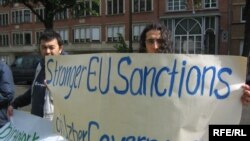
The activists say that even if the EU sanctions are symbolic and have no obvious impact on the country's economy, they are effective in terms of damaging the regime's image and keeping the rights issue on the international agenda.
The EU, too, has stressed that its sanctions on Tashkent will be reinstated if Uzbekistan does not fulfill the EU's conditions, which include releasing all imprisoned rights activists and ceasing official harassment of them.
RFE/RL's Uzbek Service correspondent Alisher Siddikov contributed to this report
Abdurahmon Tashanov, a Tashkent-based civil rights activist, tells RFE/RL's Uzbek Service that Holjigitov "is in a serious, life-threatening condition. His blood pressure is high, his arms and legs are almost paralyzed. According to our reports, his fellow inmates have to carry him when he needs to go in or out."
Uzbek prisons are notorious for the mistreatment and torture of prisoners, and rights groups suspect that Holjigitov has also been subject to severe beatings and other forms of ill-treatment.
The 60-year-old Holjigitov was arrested in June 2005 and sentenced to 10 years in jail on what one rights group calls "baseless and fabricated charges."
Holjigitov was on an EU list of imprisoned activists that Brussels, Human Rights Watch (HRW), and other international institutions have demanded Tashkent should set free.
According to HRW, at least 11 rights activists remain in Uzbek prisons, while at least one other is being held in a psychiatric hospital, "simply because of their peaceful human rights work and criticism of the government."
Yet the EU has praised Uzbekistan for its alleged progress on human rights and, in March, Brussels decided to continue a suspension of the EU visa ban for Uzbek government officials for another six months.
The visa ban was imposed after Uzbekistan refused an international probe into the uprising in the eastern city of Andijon in May 2005, which was violently suppressed by government forces and resulted in the deaths of hundreds of people.
Failure Of EU 'Engagement'?
Since March, many independent journalists and rights defenders have accused the EU of forgetting about the Andijon bloodshed and ignoring human rights violations in Uzbekistan for the sake of geopolitical gains and energy supplies.
Those critics say Uzbek authorities have freed just a handful of activists while many others remain in prison. Many more have been labeled as "terrorists" or "religious extremists" and sent to jail for peacefully practicing their religion.
There is no active political opposition or truly independent media in Uzbekistan, as all media operate under the tight control of the government.
The government has apparently tried to silence Uzbek journalists even beyond the country's borders. Earlier this month, Uzbek state television aired a special program about RFE/RL's Uzbek Service journalists, accusing them of carrying out antistate activities and giving personal details about the journalists and their family members.
In another attack on the independent media, former RFE/RL correspondent Solijon Adburahmonov was arrested in the western Uzbek city of Nukus, where he was accused of being a drug addict.
Pierre Morel, the EU's special representative for Central Asia, tells RFE/RL's Uzbek Service that the EU has been closely monitoring the political and human rights situation in Uzbekistan -- and he rejects accusations that the EU has turned a blind eye to the harassment of rights activists and other attacks on the media in Uzbekistan.
Morel says that "the EU is not naive" and does not believe that the situation in Uzbekistan has dramatically improved. But he says that considering Uzbekistan's difficult circumstances, even small progress in human rights is important.
"The [easiest option] is to shout [about abuses] and stop doing anything," Morel says. "So fine, OK, it is an option -- take it if you want. This is not the path we have taken. We have taken a demanding path, which is difficult, which is frustrating, and which is getting some results."
And the human rights groups apparently concur with that strategy as well. They have repeatedly called on the EU to continue its pressure on Uzbekistan, saying the recent release of several imprisoned rights defenders "shows that sustained international pressure on Tashkent is effective."
The activists say that even if the EU sanctions are symbolic and have no obvious impact on the country's economy, they are effective in terms of damaging the regime's image and keeping the rights issue on the international agenda.
The EU, too, has stressed that its sanctions on Tashkent will be reinstated if Uzbekistan does not fulfill the EU's conditions, which include releasing all imprisoned rights activists and ceasing official harassment of them.
RFE/RL's Uzbek Service correspondent Alisher Siddikov contributed to this report