


BRUSSELS -- After years of cultivating bilateral ties with the three South Caucasus countries, the European Union is now looking to inject a new, regional dynamic into the relationship.
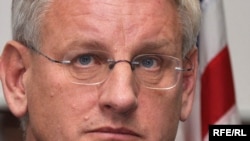
Swedish Foreign Minister Carl Bildt, speaking for the current EU Presidency, said the bloc has a "common approach" for the region that takes account of the "individual preparedness" of the different countries.
 The emphasis in Bildt's remarks after today's series of meetings between the EU and the three foreign ministers -- which culminated in a joint press conference -- was distinctly on the region, rather than on individual countries.
"I think we have overall a very good atmosphere between the European Union and the region," Bildt said.
In practice, this means the three countries find themselves in relatively similar starting positions as the EU prepares to launch talks with them in November on new association agreements. None can realistically hope for EU membership in the foreseeable future, but all three can qualify for free trade and visa-free travel arrangements with the EU in the long term.
All are members of the EU's Neighborhood Policy and its Eastern Partnership scheme, which seek to promote technical cooperation and political contacts.
No Longer Front-Runner
Behind the scenes, EU officials make it clear that Georgia no longer enjoys front-runner status in the region. All three governments have serious problems with democratic standards, harbor prisoners of conscience, and harass free media in their countries.
Nevertheless, all three countries have very different political agendas, something which they sought to impress on the EU throughout the meetings today.
Armenia, which was the first to sit down this morning with Bildt and the EU's external relations commissioner, Benita Ferrero-Waldner, has limited aims when it comes to political cooperation. The country is Russia's closest ally in the region, and it is looking to the EU for mostly technical assistance and financial aid.
Eduard Nalbandian, Armenia's foreign minister, stressed the particular attraction of visa-free travel arrangements with the EU for Yerevan.
"In the course of our discussions, I also highlighted the importance that we attach to the facilitation of people-to-people contacts and visa arrangements for our citizens," he said.
 Although all three South Caucasus countries are keen to escape the EU visa requirement, a number of powerful member states, led currently by Spain, resist the idea.
The EU today welcomed the recent agreement between Armenia and Turkey to normalize relations. But the EU played no direct role in the rapprochement, which was chaperoned by the United States and Russia.
There is a small "advisory group" of EU experts working with a number of Armenian ministries, but the impact of their presence is expected to be negligible. After an high-level EU judicial assistance mission achieved very little in Georgia in 2004, the bloc has grown increasingly pessimistic about its ability to transform the three governments.
'Core Of The Issue'
Azerbaijan remains most concerned about the presence of Armenian troops in the disputed territory of Nagorno-Karabakh and a number of adjoining Azeri districts. Elmar Mammadyarov, the country's foreign minister, raised the issue today at the press conference.
"We believe strongly that the core of the issue, if we want to achieve peace and stability in the region, is the withdrawal of Armenian forces from the occupied territories, which is definitely the core if we want to bring sustainable and durable peace and development to the region," he said.
Azerbaijan has had relatively good relations with the EU. Brussels regards Baku as a crucial link in its energy diversification plans, which rest on the hope of reaching out to the Central Asian countries.
But Baku has been rattled by the Armenian-Turkish rapprochement, and today Mammadyarov spoke at some length about the "different options" of supplying gas to EU markets without once mentioning the EU's Nabucco pipeline expected to link Azerbaijan via Turkey to an pipeline hub in Austria by 2015.
The EU is keen to speed up Azerbaijan's accession to the World Trade Organization, something it sees as important in developing energy cooperation with the country.
Georgia, meanwhile, remains preoccupied by Russia's virtual annexation of Abkhazia and South Ossetia in the wake of the war between the two countries in August 2008.
Foreign Minister Grigol Vashadze stressed the importance his government attaches to continued EU support on this issue.
"We are thankful to the European Union for its unwavering support for our territorial integrity, independence and sovereignty," Vashadze said. "We drew the attention of our colleagues to the fact that Russia is fulfilling none of the obligations it voluntarily has undertaken under the August 12, 2008 agreement [the so-called Sarkozy-Medvedev accord]."
The EU is a key mediator at the Geneva talks between Tbilisi, Moscow, and the two de facto separatist governments.
Like Armenia, Georgia has put visa-free travel and free trade at the top of its EU wish list. Political reforms have been moved to the back burner, as the country's increasingly restrictive president, Mikheil Saakashvili, has accumulated an estimated 200 political prisoners and taken over the country's most influential media outlets.
Today, Vashadze thanked the EU for its "ideas and suggestions" aimed at "increasing the quality of Georgia's democracy," and promised that Tbilisi will make "extensive" use of the bloc's expertise in the field.
Swedish Foreign Minister Carl Bildt, speaking for the current EU Presidency, said the bloc has a "common approach" for the region that takes account of the "individual preparedness" of the different countries.

"I think we have overall a very good atmosphere between the European Union and the region," Bildt said.
In practice, this means the three countries find themselves in relatively similar starting positions as the EU prepares to launch talks with them in November on new association agreements. None can realistically hope for EU membership in the foreseeable future, but all three can qualify for free trade and visa-free travel arrangements with the EU in the long term.
All are members of the EU's Neighborhood Policy and its Eastern Partnership scheme, which seek to promote technical cooperation and political contacts.
No Longer Front-Runner
Behind the scenes, EU officials make it clear that Georgia no longer enjoys front-runner status in the region. All three governments have serious problems with democratic standards, harbor prisoners of conscience, and harass free media in their countries.
Nevertheless, all three countries have very different political agendas, something which they sought to impress on the EU throughout the meetings today.
Armenia, which was the first to sit down this morning with Bildt and the EU's external relations commissioner, Benita Ferrero-Waldner, has limited aims when it comes to political cooperation. The country is Russia's closest ally in the region, and it is looking to the EU for mostly technical assistance and financial aid.
Eduard Nalbandian, Armenia's foreign minister, stressed the particular attraction of visa-free travel arrangements with the EU for Yerevan.
"In the course of our discussions, I also highlighted the importance that we attach to the facilitation of people-to-people contacts and visa arrangements for our citizens," he said.

The EU today welcomed the recent agreement between Armenia and Turkey to normalize relations. But the EU played no direct role in the rapprochement, which was chaperoned by the United States and Russia.
There is a small "advisory group" of EU experts working with a number of Armenian ministries, but the impact of their presence is expected to be negligible. After an high-level EU judicial assistance mission achieved very little in Georgia in 2004, the bloc has grown increasingly pessimistic about its ability to transform the three governments.
'Core Of The Issue'
Azerbaijan remains most concerned about the presence of Armenian troops in the disputed territory of Nagorno-Karabakh and a number of adjoining Azeri districts. Elmar Mammadyarov, the country's foreign minister, raised the issue today at the press conference.
"We believe strongly that the core of the issue, if we want to achieve peace and stability in the region, is the withdrawal of Armenian forces from the occupied territories, which is definitely the core if we want to bring sustainable and durable peace and development to the region," he said.
Azerbaijan has had relatively good relations with the EU. Brussels regards Baku as a crucial link in its energy diversification plans, which rest on the hope of reaching out to the Central Asian countries.
But Baku has been rattled by the Armenian-Turkish rapprochement, and today Mammadyarov spoke at some length about the "different options" of supplying gas to EU markets without once mentioning the EU's Nabucco pipeline expected to link Azerbaijan via Turkey to an pipeline hub in Austria by 2015.
The EU is keen to speed up Azerbaijan's accession to the World Trade Organization, something it sees as important in developing energy cooperation with the country.
Georgia, meanwhile, remains preoccupied by Russia's virtual annexation of Abkhazia and South Ossetia in the wake of the war between the two countries in August 2008.
Foreign Minister Grigol Vashadze stressed the importance his government attaches to continued EU support on this issue.
"We are thankful to the European Union for its unwavering support for our territorial integrity, independence and sovereignty," Vashadze said. "We drew the attention of our colleagues to the fact that Russia is fulfilling none of the obligations it voluntarily has undertaken under the August 12, 2008 agreement [the so-called Sarkozy-Medvedev accord]."
The EU is a key mediator at the Geneva talks between Tbilisi, Moscow, and the two de facto separatist governments.
Like Armenia, Georgia has put visa-free travel and free trade at the top of its EU wish list. Political reforms have been moved to the back burner, as the country's increasingly restrictive president, Mikheil Saakashvili, has accumulated an estimated 200 political prisoners and taken over the country's most influential media outlets.
Today, Vashadze thanked the EU for its "ideas and suggestions" aimed at "increasing the quality of Georgia's democracy," and promised that Tbilisi will make "extensive" use of the bloc's expertise in the field.